
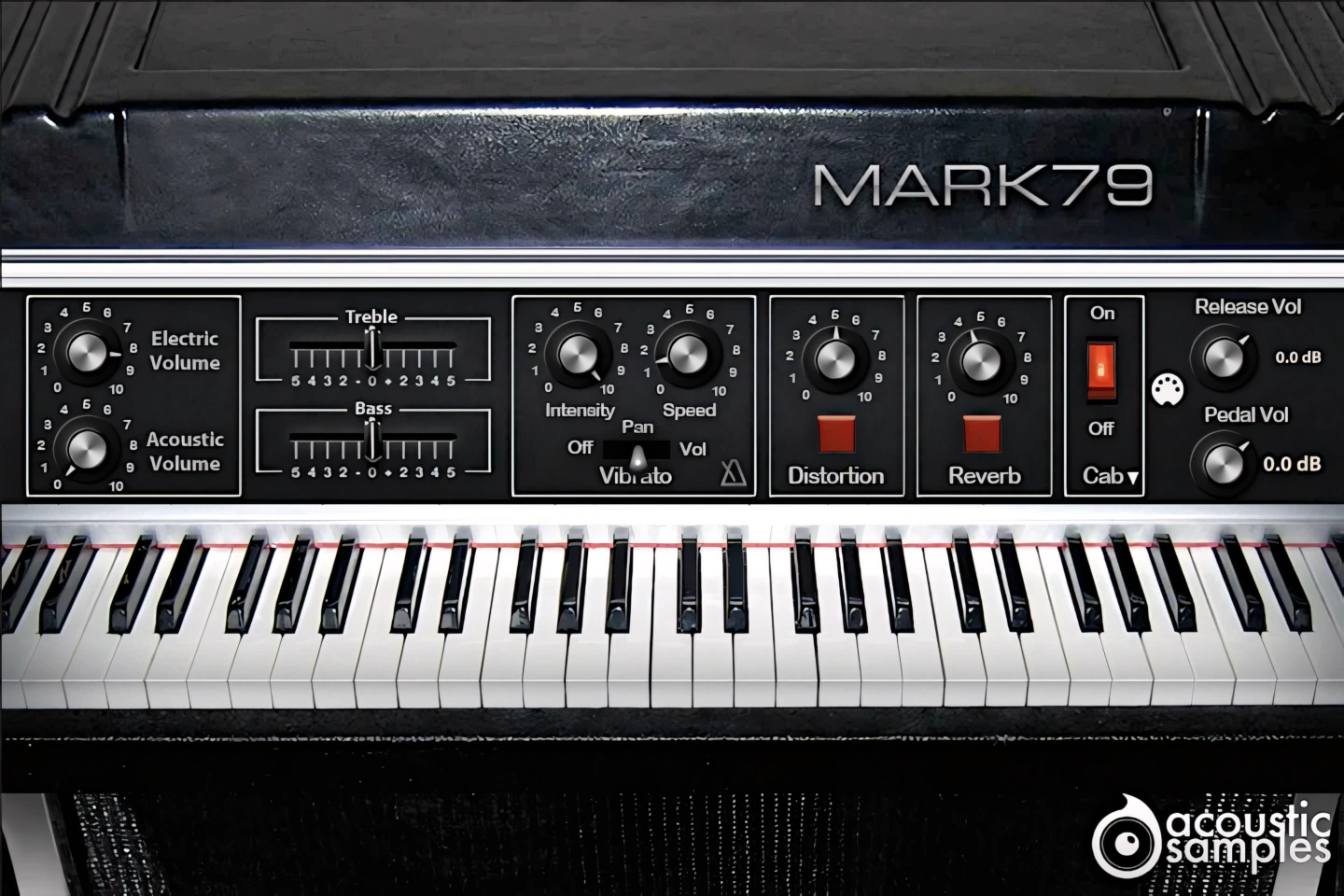
What is Mark79?
Mark79 is an impressively detailed sample library that recreates the classic 1979 Fender Rhodes Mark II 73-key electric piano. It’s available exclusively in .ufs format for UVI’s Workstation and Falcon sample players. Throughout this in-depth AcousticSamples Mark79 review, we’ll take a look at its notable attributes such as:
- Source Instrument: Based on a classic 1979 Rhodes Mark II with 73 keys
- Recording Method: The original piano’s direct output was captured through a tube pre-amplifier, preserving its warm, bell-like vintage tone
- Musical Styles: Popular for soul, jazz, pop, and any production seeking authentic 1970s electric piano sounds
- 10 velocity layers for sustain samples
- 10 velocity layers for release samples
- Resonance modeling
- Staccato adjustments
- Release fine-tuning
- Vibrato controls (stereo pan depth and rate)
- Option to change vibrato to volume tremolo
Introduction:
Over the better part of a decade, AcousticSampleS has consistently proven themselves as master purveyors of fine, high-quality sampled instruments. You can see this dedication in every single product they release. They strike a perfect balance between massive library sizes and genuine sonic realism. It’s a delicate dance, but they execute it flawlessly!
Still, one question begs to be asked: “What good is ‘realism’ if the original instrument wasn’t pristine to begin with?” After all, sampling a broken piano is like trying to photograph a masterpiece through a dirty window—you might get the image, but you won’t get the soul!
Fortunately, company founder Arnaud Sicard and his AcousticSampleS team sonically capture some of the world’s best-sounding instruments. The Mark79 perfectly showcases this Parisian craftsmanship, par excellence.
Made for UVI Workstation:
You can experience this engaging instrument directly inside the proprietary “UVI Workstation” sample player, which you can download for free from UVI.net. The ufs format definitely competes for audio quality supremacy. It also delivers clear convenience, easy operation, and excellent built‑in effects. These even include a streamlined version of UVI’s fantastic algorithmic reverb, Sparkverb. Yes, it sounds as good as its name.
Just like with other sample players, such as Kontakt, you can configure disk streaming and RAM consumption. You can also adjust ADSR and virtually any other relevant option you can think of. In practice, you stay in control rather than digging through menus.
Personally, I really like the UVI platform. I find it very comfortable and intuitive to use. Honestly, it feels more like playing than tweaking.
Mark79 is undoubtedly a classic, vintage instrument. Imagine a superb sample library of a 73-key ‘suitcase’ Fender Rhodes Mark II, circa 1979 – that’s what you’re getting here!
The creators recorded the samples dry using a studio-grade DI into a high-end, tube-powered preamp. As soon as you play that first chord or riff, your ears are treated to an authentic Rhodes experience. The tone is rich, full, and beautifully balanced.
And the best part? You can get all this sumptuous tone for a reasonable €79 / $87 (USD). It’s not a bad deal!
Different Flavours of Rhodes-o-liciousness
If you’ve read my earlier review of SonicCouture’s remarkable “EP73 Deconstructed,” you know I hold it in the highest regard. That said, standing proudly beside it is this equally impressive rendering of Rhodes sound. They are like two champions sharing a podium—both exceptional, just in their own ways!
Hi, you! If you like these kinds of reviews,
be sure to subscribe.
To be fair, these two sample libraries aren’t meant for direct comparison; they demonstrate distinctly different keyboard models. However, the sound quality of each is undeniably superb.
While “EP73” offers a unique library capable of divergent creative exploration, AcousticSampleS’ “Mark79” takes a more straightforward path. This release is dedicated solely to representing a Mark II Fender Rhodes® electric piano with as much purity as possible. It doesn’t try to reinvent the wheel; it simply polishes the existing one until it shines!
Size Matters . .
The library includes nearly 3.5 GB of uncompressed samples. To put that into perspective, it delivers an impressive ten layers of sustained-note samples and ten layers of release samples.
Fortunately, the developers compressed the samples using lossless FLAC encoding. As a result, the library requires just 1.46 GB of storage space. By today’s standards, where many sample libraries easily stretch into the tens or even hundreds of gigabytes, this footprint feels refreshingly modest.
Better still, the samples load remarkably quickly. Even from a cold start, the library is ready to play within seconds—leaving you more time to make music and less time to watch progress bars crawl across the screen.
Installation and Authorization:
Once you complete your purchase, you immediately receive an emailed invoice with your personalized serial number. Before that, you simply create a User Account at acousticsamples.net so you can register and authorize your serial number. It’s quick, and it doesn’t require any arcane rituals or secret handshakes.
After you finish the registration, your account instantly displays the download links in the “Downloads/Serials” section. The whole process stays simple and efficient from start to finish. Even better, the system does not restrict how often you download your purchases or when you access them. You stay in control, not the calendar.
The not-so-glamorous world of copy protection!
For most UVI-powered products, including this one, the iLok system handles copy protection. Let’s face it, dongles can be a hassle, especially for laptop users like many of us.
However, iLok protection generally works smoothly and runs in the background, so you can focus on the fun stuff – creating amazing music!
Personally, I prefer personalized serial numbers or digital watermarks. These methods feel far less intrusive than the clunky “Challenge/Response” activations or the physical hassle of dongle protection. After all, who really wants a USB key collecting dust in their pocket just to play some music?
That said, I completely understand why developers must protect their businesses. Software piracy is a real threat, and without safeguards, creators simply can’t survive. It’s a necessary evil, much like putting a lock on your front door; you don’t enjoy locking it, but you definitely don’t want your house wide open to strangers!
** The latest AcousticSampleS iLok licenses can also be machine activated/authorized up to a maximum of 3 devices.
Visuals:
Mark79 makes an excellent first impression. The GUI fits comfortably within UVI Workstation’s standard 720 x 716-pixel interface, and showcases attractive, photo-realistic graphics throughout.
More importantly, the design strikes the right balance between form and function. Every element feels purposeful, yet the interface remains visually engaging. As a result, navigating the library feels intuitive and enjoyable—a combination that is not always guaranteed in the world of software instruments.
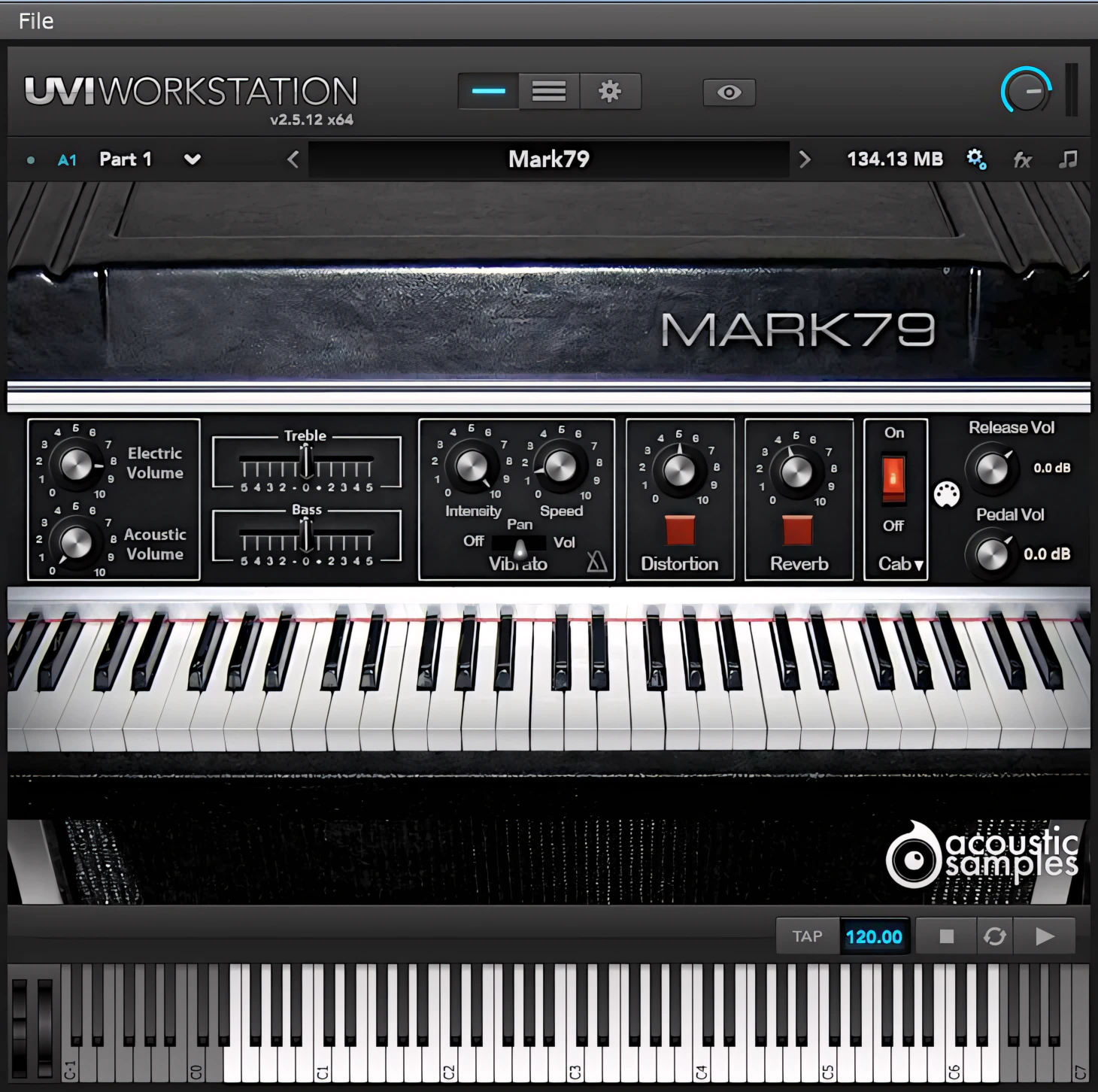
The instrument immediately strikes you as a beautifully maintained, vintage Rhodes e-piano. Delicate graphics use light, shadow, and reflections to serve up a tasty visual dish.
The keys visually reflect off the metal panel behind them and practically beckon you to sit down and play. They do not whisper “come hither,” but it feels close.
The interface lays out all user-adjustable controls exactly where you expect them. It respectfully mirrors the original instrument’s front panel, so you feel at home right away. Overall, the GUI looks charming, works smoothly, and strongly suggests an authentic Rhodes experience. J’aime Ça!
Operations and Control:
You get a conventional yet thoroughly satisfying array of controls to manipulate Electric and Acoustic levels. You also have bass, treble EQ, Vibrato speed and intensity, Distortion (or more accurately, overdrive), Reverb, Cabinet modeling, and Release & Pedal volumes.
Each control responds smoothly to your mouse movements, feeling as fluid as butter on hot toast. The labels remain legible and clearly visible at all times, so you won’t need a magnifying glass to find the knobs.
Three amply-sized push buttons handle Distortion, Reverb, and Cabinet emulation. They brightly indicate their “on/off” status, glowing like friendly little traffic lights in the dark.
For added versatility, a small dip switch lets you toggle the vibrato between off, pan, or traditional volume oscillation. It’s a thoughtful touch that proves great design doesn’t always need to be complicated; sometimes, it just needs to work exactly how you expect it to!
Smooth, Consistent Controls:
Adjusting the knobs or EQ sliders produces smooth, gradual changes to the instrument’s tone. As a result, shaping sounds feels precise and intuitive rather than abrupt or unpredictable.
The stereo-capable vibrato and panning section stands out in particular. It adds movement and width in a highly musical way, making it easy to bring patches to life.
Another welcome touch is the ability to double-click any user-adjustable control and enter values directly from the keyboard. This small feature streamlines workflow and makes fine-tuning settings remarkably convenient.
Despite how easy it is to craft an excellent sound in Mark79, I was surprised by the absence of presets. Even a modest collection would have provided useful starting points and showcased the library’s versatility. That said, I’m admittedly searching hard for a criticism here—review balance is important, after all.
Q: How many velocity layers are available?
A: This library packs ten true velocity layers for natural, sustained notes. It also provides another ten layers just for release noises. Under the hood, the UVI scripting performs admirably. It seamlessly glues the various sampled elements together.
Of course, you can mix in the raw, unamplified acoustic samples to taste. Flawlessly integrated pedal and release samples dive into a lush pool, massively boosting realism. You can easily blend these with normal sustained notes. Even better, you can tweak each level from -20dB up to +8dB.
Separate the Sounds:
As mentioned earlier, you get an independent “Acoustic” volume knob. AcousticSampleS does not push this feature as far as SonicCouture do with their “EP73 Deconstructed” Kontakt library. However, you still enjoy plenty of mechanical-noise realism here.
In most professional recordings, engineers do not include a Rhodes’ acoustic mechanical noise. That means you rarely hear this side of the instrument. For you as the player, this becomes a delightful authenticity bonus, like a behind-the-scenes pass to the real Rhodes.
Q: Can I customize the instrument’s dynamics to match my MIDI keyboard?
A: Yes, you sure can!
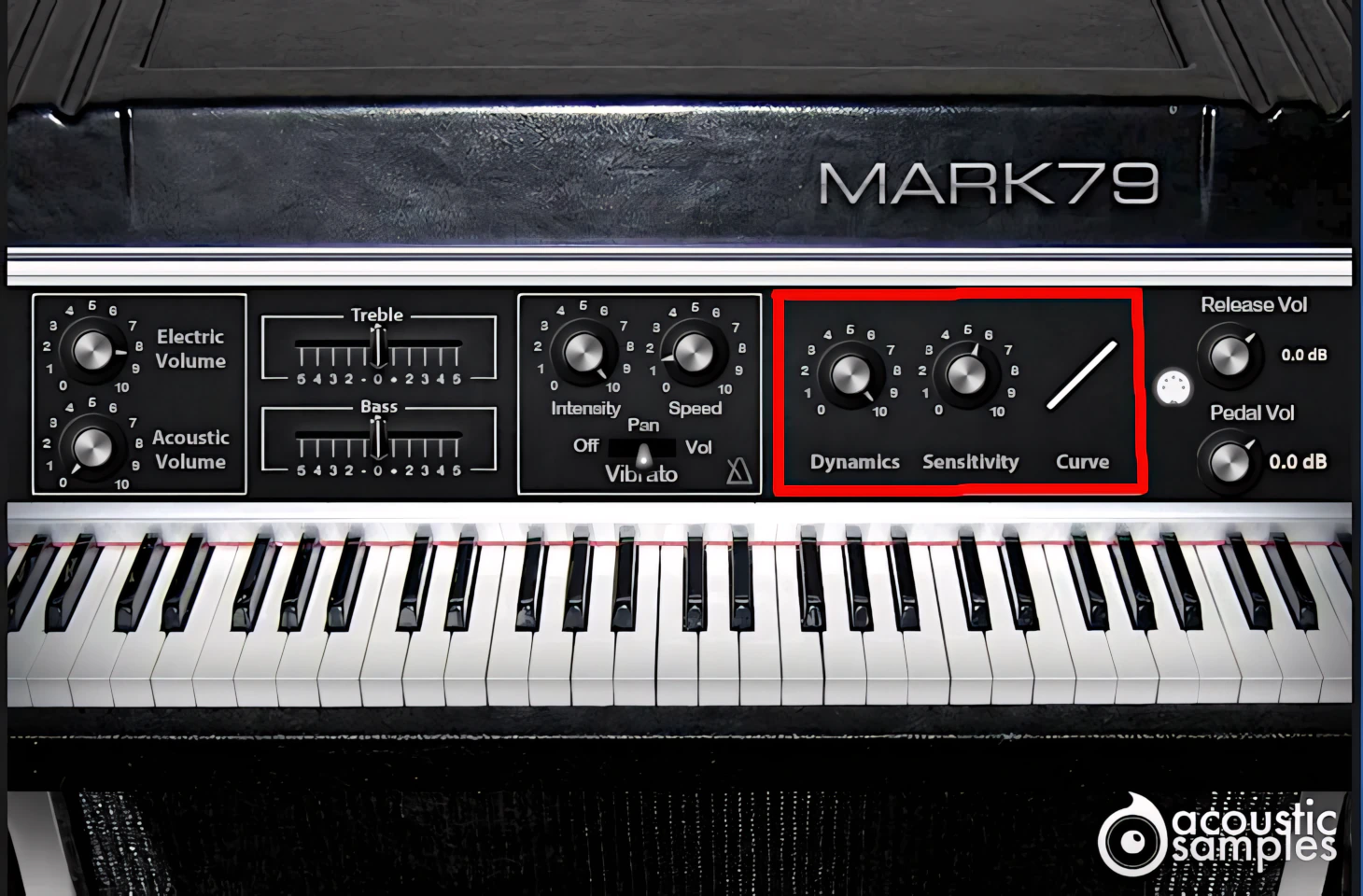
To the immediate left of the pedal and release knobs, you see a small white icon shaped like a MIDI DIN port. When you click this icon, it opens a handy keyboard dynamics panel with two knobs for fine-tuning Dynamics and Sensitivity.
Together with the velocity curve parameter, these controls let you tailor the instrument’s MIDI and velocity response precisely to your own keyboard. In other words, you make the piano adapt to you—not the other way around.
A shed full of virtual speaker cabinets
The original “Mark79” release was a great start, but AcousticSampleS has taken it to the next level.
Initially, the release included just one 2×12 speaker cabinet IR. Now, they’ve supercharged it with a whopping 25 high-quality IRs. You’ll get a treasure trove of tones, including the Rhodes amp, Twin, Bassman, Silverface, Mesa, Markbass, and many more.
These IRs are actually a collection of the best ones from other AcousticSampleS libraries. It’s like getting a bonus round of awesome tones – a nice little cherry on top!
This sample library certainly produces faithful and believable sounds, but it does so with scrupulously credible responsiveness. More so than many similar products, Mark79 ‘feels’ legit.
Sound Quality:
You receive genuine bark, tine tinkle, and gorgeous, rich tone in spades. Let’s be crystal clear here. If budget or hard drive space limits you to one library, choose Mark79. It earns that spot decisively.
This package oozes vintage Rhodes tone. It drips with even-tempered character too. That specific “Rhodesy” vibe saturates every single note. Honestly, I simply cannot make it sound bad. Try forcing a fail. It won’t happen. That takes effort!
Did the developers hide sample loops inside? I detect zero traces whatsoever. Notes decay smoothly and then fade away evenly. Yet, sufficient variance persists within the samples. This variety imparts convincing savoir-faire to your performance. It sounds undeniably organic. It genuinely feels alive. Your fingers will likely thank you for the realism!
Convincing classic spring reverb on tap
Engage the reverb, and the instrument rewards you with remarkably realistic convolution processing. The included spring reverb impulse response delivers plenty of character, adding a delightfully “sproingy” quality that feels authentic and musically satisfying.
For even more vintage flavor, switch on the Cab feature. Combined with the right impulse response, it produces the kind of classic amplified tones that keyboard players have loved for decades.
In particular, some settings evoke the rich, spacious character of a 2×12 Fender Twin™ guitar amplifier.
Together, these effects elevate the instrument well beyond a straightforward sample library. They transform it into an expressive performance tool that begs to be played—and occasionally makes it difficult to stop.
True stereo panning and deluxe tremolo
Creating wide, pulsating stereo movement takes little more than a quick flick of the mouse. Alternatively, you can choose a traditional volume-based vibrato for a more classic modulation effect.
Whichever option you select, the implementation feels polished and musical. The effects enhance the sound without drawing unnecessary attention to themselves, striking an ideal balance between character and control.
Lovely tone and EQ balance
Across the full 73-key spectrum, the authentic tone completely captivates you. Honestly, sitting in front of a good pair of monitors and just playing brings absolute joy.
At default EQ settings, the instrument delivers a full, even tonal quality. When you tweak the EQ, the lows thunder and the upper range sparkles brilliantly. (Just be careful with that low end, unless you want to test your studio monitors’ warranty.)
The real deal “feel”
For any real Rhodes player, the immediacy and authenticity of the note attack and tactile response matter deeply. You do not just want to hear the Rhodes—you want to feel it fight back a little under your fingers.
Today’s digital world offers more virtual Rhodes choices than anyone truly needs. Where things get interesting is not only in how authentic they sound, but also in how they feel and play. That is where your decision really takes shape.
In this area, Mark79 truly excels and often outperforms many of its competitors. This library delivers faithful, believable Rhodes tones, but it goes further by responding to your touch with impressive nuance and credibility.
Compared to many similar products, Mark79 genuinely feels legit—less like software, more like an instrument with a personality.
CPU Consumption:
The moment of truth – putting “Mark79” through its paces!
I’ve been putting “Mark79” to the test on a trusty Intel i5 2650 laptop, paired with a 7200 RPM HDD. And I’m happy to report that performance has been superb. No drop-outs, no glitches – just smooth sailing.
I kept a close eye on the CPU usage using the Windows 7 (64-bit) Task Manager. Even with the sustain pedal depressed and a flurry of random notes, the CPU spikes stayed below 10%. And during actual play, the CPU demand was a mere 3-7%. That’s incredibly efficient!
AcousticSamples Mark79 Review – Concluding Remarks:
AcousticSampleS has hit a home run with this release. “Mark79” looks sharp, feels intuitive, and sounds absolutely marvellous. In my opinion, it delivers a highly usable and enjoyable vintage electric piano experience that you can trust immediately.
Now, let’s address the iLok dongle. . .
Yes, carrying a USB stick on a laptop tour can feel like lugging around a tiny brick of security. However, there is a silver lining here! Once your software is on that dongle, you never need to log into a “Service Center” or wrestle with an “Authorization Manager” when swapping computers. Just plug the iLok in, and you’re ready to rock. It might be a small device, but it saves you from massive headaches later. Just remember: keep your dongle safe, or you’ll be singing the blues!
It certainly has been a pleasure for me to finally experience this exemplary sample library. I’m an e-Piano fanatic and I promise you, dear reader, that this one does not disappoint.
5 out of 5 Stars


:: Pros
- Winning interface design.
- Even-tempered, realistic-sounding Rhodes library oozing with character.
- Affable value vs. Cost ratio .
- Simple to configure & Easy to dial up great Rhodes sounds.
- Although basic, the effects are high quality and sound wonderful.
- Modest system requirements.
- Plenty of control over midi dynamics and sensitivity.
- Large collection of convincing cabinet impulse responses.
- Honourable, customer-oriented company.
- Available for both MAC & PC (32 & 64 bit, including AAX)
::Cons
- It would be nice to have a few presets. Since this is a UVI-powered sample library, some useful presets including phase, chorus, delay, and etcetera would add an additional degree of “out-of-the-box” convenience.
- I’m not particularly struck on iLok protection for laptop use, but generally, it is a reliable and trouble-free copy protection system.
Visit the AcousticSampleS website. www.AcousticSampleS.net
Intellectual Copyright – 2015 – All rights Reserved. This review may not be copied or reproduced in whole, nor in part, without express written permission from the author.

Leave a Reply