
What is EP73 Deconstructed?
EP73 Deconstructed is a high-detail virtual instrument that recreates the classic Fender Rhodes Stage 73 electric piano. It’s available exclusively as a Kontakt sample library, and is absolutely drenched in tonal character. It stands apart for its unnerving ability to emulate the authentic behavior of a real vintage Rhodes. Ultimately, how it responds to aggressive playing (distortion, “snarling”) versus gentle playing. Stick n’ stay! In this exhaustive SonicCouture EP73 Deconstructed review we’ll investigate nifty features such as:
- Uses round-robin multi-sampling to prevent repetitive sounds and improve realism
- Velocity-dependent timbres that respond naturally to playing dynamics
- Detailed control over parameters to emulate the nuanced character of a real Rhodes
- 5 unique instrument layers created using both traditional and “extended techniques”
- Extended techniques capture unconventional playing styles like muted, slap, and percussive articulations
- Approximately 15 GB of audio (around 8 GB download size)
- 120 factory presets
- It’s a full-fledged Kontakt Player compatible sample library
Introduction:
“Uncontested” is a strong word, isn’t it?
To use it, you must substantiate your claim. Otherwise, the world will see you as brazen, ill-informed, rash, gullible, or just plain stupid. You surely don’t place dear old Brother Charles into any of those categories. (Unless, of course, you’re looking for a family feud at the next dinner table.)
SonicCouture has set a new standard for Rhodes MKI sample libraries – in fact, they’ve become the gold standard. This library is a game-changer. I mean it, it’s absolutely phenomenal!
Let’s break it down: SonicCouture has clearly gone above and beyond with their sampling process. The depth and detail are truly impressive.
SonicCouture’s EP73 Deconstructed library has achieved a tremendous level of realism, and it’s easy to see why. The release noises, pedal noises, and triple-layered Round Robin sampling all come together to create an incredibly authentic sound.
But what really sets it apart is the attention to sonic detail. By including direct line out and close (and contact) mic’d acoustic and mechanical sounds, SonicCouture has essentially captured the instrument’s DNA.
The result? A virtual Rhodes that’s uniquely realistic and authentic – perhaps the most convincing one out there.
Sounds impressive so far, but what’s the price?
SonicCouture occasionally offers sales, yet the listed retail price of $129 USD remains remarkably fair given the exceptional sound quality. I must tread carefully here; if I brag too much about this sample library, they might raise the price! After all, we wouldn’t want to accidentally trigger a price hike just by praising their work too enthusiastically. 😉
Native Instruments Kontakt – another Gold Standard
Native Instruments’ “Kontakt” has undeniably become the industry-standard sample engine, and few would argue otherwise. Whilst other samplers exist, Kontakt reigns supreme when you compare features head-to-head.
Developers have produced countless vintage keyboard libraries specifically for this robust platform. Take the “Scarbee Vintage Keys Collection,” for instance; it delivers powerful, authentic sounds that truly impress. Even the classic keyboards bundled within Native Instruments’ massive 27GB “Factory Library” perform brilliantly.
Hi, you! If you like these kinds of reviews,
be sure to subscribe.
On a personal note, I absolutely love PrecisionSound’s “Dusty Electric MKII,” a fantastic Rhodes Mark II sample set that never fails to inspire. Honestly, if these libraries were people, they’d be the ones winning every talent show in town!
Which leads us into SonicCouture EP73 Deconstructed . .
We are currently exploring one Kontakt-powered sample library with sound quality that can genuinely make a player’s jaw drop: SonicCouture’s EP73 Deconstructed.
This deeply sampled, 24-bit library consists of 15 GB of exceptionally well-recorded content. Fortunately, NCW compression reduces the footprint to just under 8 GB, sparing your storage drive from a minor panic attack.
The library’s size comes as no surprise. After all, it includes an impressive 14 velocity layers of 24-bit samples, delivering remarkable depth and responsiveness.
Interestingly, most professional pianists need only eight or nine velocity layers to achieve realistic and expressive performances. As a result, the extra layers provide an additional level of nuance that discerning players will certainly appreciate.
There are Lots of Round Robins too!
SonicCouture takes realism to the next level with not one, not two, but three layers of Round Robin sampling for each sound part. And what sound parts they are!
You’ve got three distinct layers to work with:
- The primary “Line Out” sound, which captures the instrument’s rich tone
- The “Close Mic” acoustic sounds, which add an intimate, up-close feel
- The mechanical sounds, cleverly recorded via a ‘contact’ microphone to bring out the instrument’s inner workings
It’s a Big’un though – got lots of storage?
In a previous review, I gushed about ToonTrack’s “EZkeys Essential Pianos Collection” – and for good reason. Their suite features one of the best-sounding, fastest-loading MKI sample libraries on the market. The Rhodes sound is really good, especially considering it weighs in at a mere 500 MB.
But, as amazing as ToonTrack’s library is, it’s a different story altogether with SonicCouture’s offering.
This behemoth of a sample library is not for the faint of heart or those with limited system capacity. Nope, this is a high-end instrument for those who demand absolute perfection and have the computer muscles to handle it.
If you’re looking to load up a netbook with a gazillion instruments, this isn’t the library for you. But if you’re willing to splurge on a top-notch system and crave unparalleled sound quality, then SonicCouture’s EP73 is the ultimate indulgence.
Rhodes sounds plus kool kookiness
Intriguingly, “EP73 Deconstructed” easily ranks among the absolute best Rhodes Mark I sample libraries available. But SonicCouture didn’t stop there. They dove straight down the rabbit hole to engineer sublime creative effects and some beautifully crazy weirdness.
coaptation:
\koh-ap-TEY-shuhn\, noun: a joining or adjustment of parts to one another.
The library features five distinct variations, or “instruments” as SonicCouture calls them. You get the EP73 Keyboard, Bowed, Mallets, Plucked, and SFX. Ultimately, this collection serves as a prime example of coaptation—taking a classic tool and adapting it for brilliant new mutations.
SonicCouture has cleverly deconstructed the Rhodes electric piano’s sonic elements, breaking them down into separate components. Then, they’ve reassembled them into a cohesive sound-creation package – a process that’s essentially coaptation in action.
At the heart of the collection is the EP73 itself, which is undoubtedly the crown jewel. But here’s the exciting part: the remaining four instruments offer a range of unique, creative options that are sure to delight the more musically adventurous among us. Think of them as the secret ingredients that can add a dash of magic to your music.
Installation and Authorization:
Don’t own the full $399 Kontakt software? No worries. You can quickly activate this library via Native Instruments’ Service Center to run it inside the FREE Kontakt Player. Either way, you get the exact same feature-rich experience. Your wallet can breathe a sigh of relief.
** NOTE: This library requires Kontakt 5.01 or newer.
** As of 2017, Service Center is no longer a thing – you now activate Kontakt libraries through Native Instruments’ “Native Access” software.
Visuals:
I’m obsessed with this Kontakt-powered GUI – it’s a total blast from the past! The vintage vibe is so strong, I half expect to see a nostalgic photo of a 1970s recording studio on the back of the box. While there are other excellent Rhodes sample libraries out there, this interface has a certain je ne sais quoi that sets it apart. The attention to detail is impressive, and the subtle design elements are a testament to the creators’ love for the era.
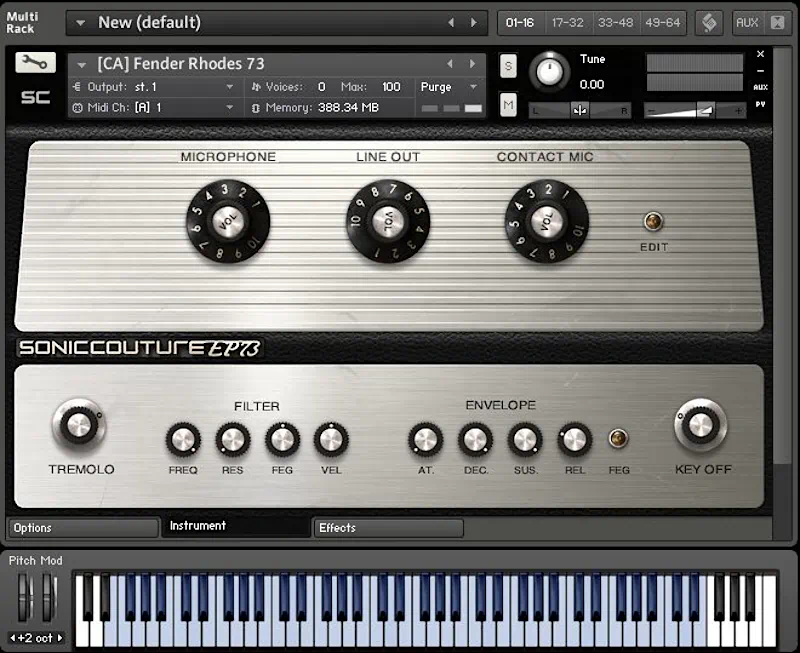
Now, let’s talk about the layout. The interface is cleverly organized, with three configuration tabs at the bottom that make it easy to navigate: Options, Instrument, and Effects.
These tabs give you a range of customization options, from tweaking the instrument to adding effects that’ll make your tracks sound like they were recorded in a legendary studio.
Instrument Tab:
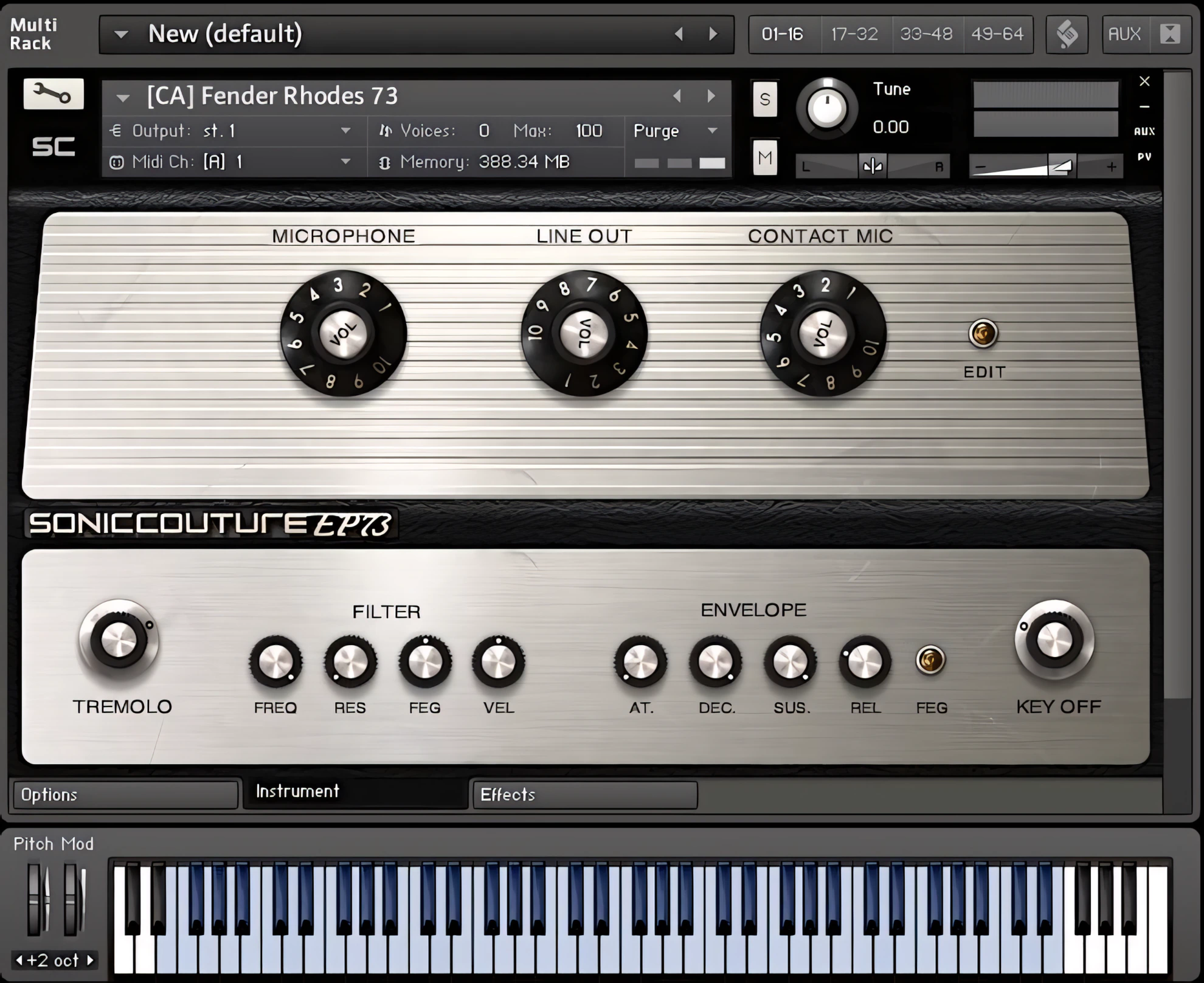
The retro, Fender-style knobs grab your attention first. They sit sexily atop the silver, anodized, ridged grill. They mimic exactly what you see when you face the original instrument.
Just below, the lower panel looks like smooth, anodized metal plating. It holds ribbed, smaller buttons that control the filter and envelope parameters.
As you keep looking, you notice that the advanced instrument features hide in plain sight as vintage, true-to-form amber indicator lights. When you click them, they light up brightly and reveal knobs for tremolo speed, saturation, low-pass filtering, and more. It feels a bit like discovering a secret control room in a classic amp.
All of this comes wrapped up tightly in too-kewl-looking faux tolex. It looks so good, you might find yourself admiring the casing before you even play a note.
Options Tab:
The Options Tab puts you in the driver’s seat with a dedicated velocity control area. Here, you can fine-tune minimum and maximum velocity values, adjust sensitivity, and shape the velocity curve to your exact liking.
Meanwhile, the lower section of the tab offers precise controls for noise sample levels, pedal noise, resonance, and Round Robin features. If you need to conserve your system’s precious RAM, simply disable the three extra Round Robin layers.
Don’t worry, though; this isn’t a compromise at all, especially since you still have a robust 14 velocity layers to keep your playing dynamic and realistic. Think of it as decluttering your workspace without losing any of your favorite tools!
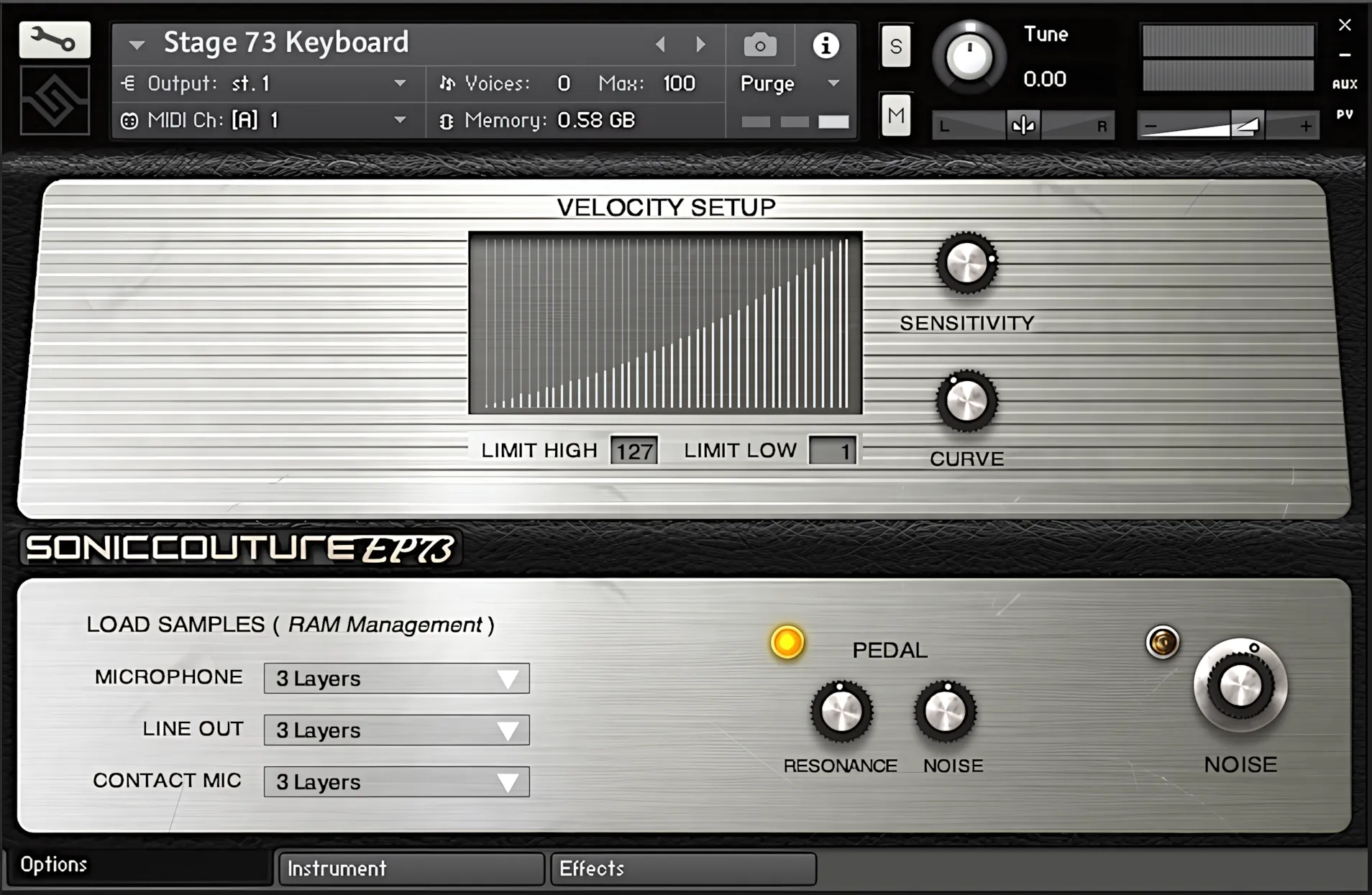
If you treat the EP73 as your primary instrument, then yes, the triple-layered Round Robin feature delivers tremendous realism. However, keeping all those layers engaged demands significant memory and extra CPU cycles.
Therefore, you should strongly consider disabling the Round Robin samples for the “Microphone” and “Contact Mic” tracks. This simple move frees up a generous amount of memory while remaining completely undetectable in a typical mix. It’s like removing a heavy coat when you step indoors; you won’t miss the warmth, but you’ll certainly appreciate the freedom of movement!
Effects Tab:
The Effects Tab is a treat for the eyes and ears. This intuitive control center is where you’ll find a range of tasty effects to enhance your sound. You get access to Auto Wah, Auto Pan, Chorus, Phaser, Delay, and Reverb – all of which are Kontakt’s top-notch built-in DSP effects. And, kudos to SonicCouture, they’ve wrapped these effects in a beautifully designed interface that’s a joy to use.
One of the things that caught my attention is the color palette – soft, pastel shades that are a welcome change from the usual GUI fare. It’s like a breath of fresh air, making the whole experience feel more relaxed and creative.
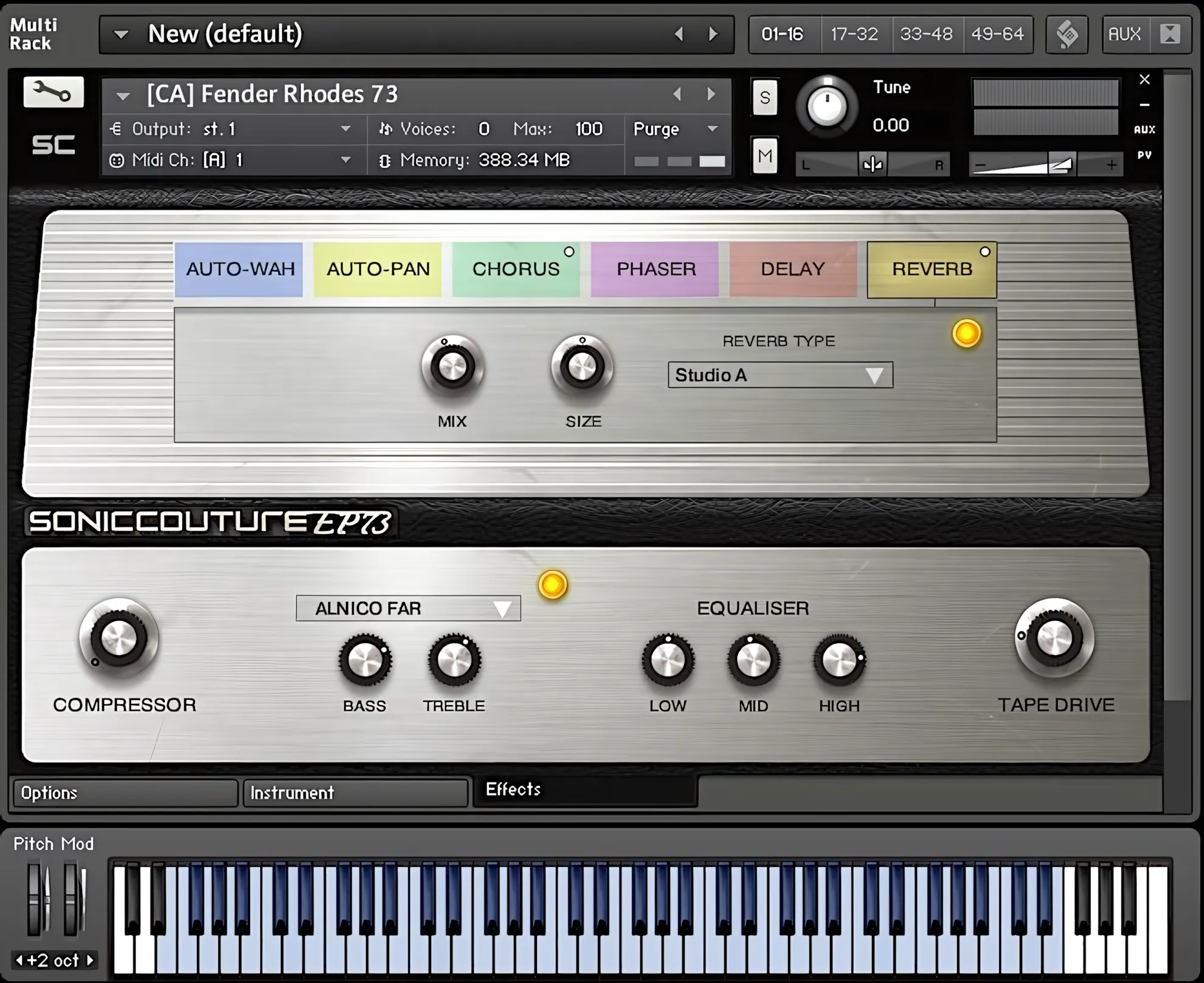
The lower panel gives you direct control over a simple, one-knob compressor, a speaker cabinet selection menu, and a fully functional three-band EQ. The EQ section actually serves as a front panel for Native Instruments’ “Solid Mix Gold EQ,” so you get serious tone shaping without any fuss.
To neatly round off this processing group, you get a “Tape Drive” emulation. This feature now comes standard in Kontakt 5.x. It delivers a solid, quick-and-dirty tape emulation that lets you dial in everything from subtle soft saturation to obvious, gritty grunge.
Consequently, it does slightly round off the high frequencies, so your sound takes on that familiar, gently worn tape character, however.
SonicCouture EP73 Deconstructed Review | Operations and Control:
[ Presets and Patches ]
SonicCouture neatly shrink-wrapped a massive bundle of Kontakt patches for this sample library. Honestly, they nailed the factory presets. They deliver fantastic, highly usable sounds right out of the box—no assembly required.
The collection packs a serious punch. You get “suitcase-style” patches, classic phase variations, and funky “lid-less” sounds. If you want to get gritty, they also threw in crunchy tones and rich, ambient stage textures.
They even included a unique “No amp” patch. This brilliant little feature bypasses the Line Out mix entirely. Instead, it captures only the acoustic, mechanical clacks of the Rhodes, perfect for when you want your keyboard to sound like a beautiful, musical typewriter.
The EP73 library includes five individual instruments, and you can access each one by loading the corresponding base patch.
From there, you’ll find dozens of neatly organized presets across two nested folders. One folder focuses on special effects and creative sounds. Meanwhile, the other delivers more traditional Rhodes settings—or at least traditional by SonicCouture’s standards. 😄
Are there Sound Creation patches included?
Yes! Quite a few of them, actually.
The sound-design patches offer a particularly compelling collection. They provide an abundance of harp-like tones, unusual effects, bowed tines, and rich mallet plucks and strikes.
You can even repurpose the latter as convincing alternatives to steel drums, marimbas, or xylophones. As a result, this distinctive collection of Rhodes-inspired sounds arrives generously draped in cinematic sonic texture.
Moreover, the cinematic patches rank among the most unique and evocative sounds you’ll likely encounter in any classic electric piano library. They consistently inspire exploration and reward experimentation.
Perhaps the most impressive achievement, however, is how these unconventional patches never lose sight of their roots. No matter how far the sound design ventures, the unmistakable elegance and vintage charm of a classic Rhodes remain firmly intact. It’s as if the instrument refuses to stop being itself—and that’s very much a compliment.
Keep an eye out for BIG RAM demands
Some instrument patches load without activating the overhead or contact mic samples, yet the software still hoards these unused files in your memory. This behavior creates a genuine headache for anyone operating in a 32-bit environment. It can also be an issue for computers with fewer than 16 gigabytes of installed RAM.
Although it might prove slightly annoying, I strongly recommend inspecting the factory presets to see if they actually utilize these extra samples. If the mic or contact mic samples remain idle, simply unload them and save the configuration under a fresh name. You could slash your memory consumption by nearly half in certain scenarios, which is a victory worth celebrating for your computer’s sanity!
Sound Quality:
In a word, this library is stunning. I must reiterate my initial findings despite the risk of sounding repetitive, because the bombastic level of authenticity is simply overwhelming.
I have read a few less favorable comments about this sample library, so I say this with a wink: go listen again, naysayers! This delicious heap of “Kontakt-ed-ness” is totally the bomb; know what I’m saying? It delivers such a powerful performance that even the skeptics might find themselves humming the tune before they know it!
The complete span of classic Rhodes tones is here, and then some. This EP can sound as silky smooth as Mae West’s stockings. Or it can flip in an instant into a dynamic, gritty rocker with sassy, saturated attitude.

In my sincere opinion, EP73 Deconstructed reaches right under the tines and pulls out “the real deal” a little better than most. And no, it’s not just showing off—it really delivers.
Aren’t there other really good Rhodes libraries out there too?
Sure there are! Many competing Mark 1 sample libraries are also worth consideration.
For example, I hold Scarbee’s “Mark I” (Vintage Keys Collection) in very high regard. I’m also completely sold on ToonTrack’s “Classic Electrics – Electric MK I.” Meanwhile, PrecisionSound’s “Dusty Electrik Mark II” punches way above its weight class, taking home a fair share of trophies despite its smaller size.
Even so, SonicCouture operates in a different league. They spent months deep-sampling a superbly reconditioned Rhodes 73. Then, they wrapped it in a handsome interface and mixed in the choicest FX. Next, they polished the sound with hand-crafted Round Robin layers. Finally, they topped everything off with elaborate Kontakt scripting.
When a company pours that much obsessive love into a virtual instrument, the result is pure platinum. It’s so good it might actually make your real piano jealous.
Keepin’ it real, yo!
I appreciate that SonicCouture resisted the temptation to polish away the original instrument’s character and imperfections. Instead, they embraced those quirks and brought them to the forefront. As a result, the library delivers a level of realism that is remarkably authentic and difficult to match.
That exceptional attention to detail does come at a cost, however. The installation footprint is substantial, ultimately occupying just under eight gigabytes of storage. Then again, realism of this caliber rarely travels light.
So you ask, “How well does it sit in a mix?”
I’m glad you asked. EP73 not only commands attention as a stand-alone instrument, but it also sits remarkably well in a mix.
Better yet, you won’t need to reach for third-party plug-ins to make it work. The onboard EQ handles tone shaping with ease and delivers polished, mix-ready results. Much of that flexibility comes from Native Instruments’ Solid Mix Gold EQ, which is built directly into Kontakt 5.x.
As a result, dialing in the right sound feels quick and intuitive. The instrument can confidently take center stage when needed, then just as gracefully settle into the ensemble when the arrangement calls for a little more diplomacy.
Onboard Reverb IRs and Old Skool Tremolo – Noiice!
The included convolution IRs (Impulse Responses) deliver realistic, natural-sounding ambience. Moreover, they come with a tidy collection of very cool plate and spring reverbs. It’s a small bonus, but a very welcome one.
SonicCouture has also implemented a refined set of controls that fully unlock Kontakt’s built-in tremolo capabilities. As a result, shaping the effect feels intuitive and musical.
I particularly enjoy playing big, full chords and letting the instrument do the rest. The pure Rhodes tone shines through effortlessly, while the lush, realistic tremolo pulse carries the sound forward with remarkable depth and character.
Well Balanced and Toneful
The deep sampling of the original instrument is immediately apparent throughout the library. More importantly, every octave feels rewarding to both play and hear.
As a whole, this EP delivers a remarkably balanced tone across its entire range. The low end sounds warm, rich, and full without becoming muddy. Meanwhile, the midrange remains clear and expressive.
In the upper register, the mallets and tines exhibit a smooth, satin-like sheen that draws you in. At the same time, you can easily add more bite and sparkle when needed, allowing notes to pop with impressive clarity. The result is an instrument that remains refined when played gently yet has no trouble stepping into the spotlight when the music calls for it.
Q: What are “Round Robins”?
A: You may already know what “Round Robin” means. Still, in case it’s not completely clear, let me quickly explain it.
Round Robin sampling uses multiple versions of the same note and rotates them as you play. This method boosts realism and keeps the sound from becoming predictable.
As a result, you avoid that dreaded “machine gun” effect that makes even great performances sound like a stuck arcade game.
Let’s be honest: the average recording project won’t need this level of staggering realism. Unless you feature the Rhodes prominently in your mix, you can safely disable those extra Round Robin layers. Your computer’s CPU and RAM will thank you.
But make no mistake. The raw sound quality of these 14 velocity layers easily crushes almost any competing Rhodes library. It stands head and shoulders above the rest, delivering an authentic vibe right out of the box.
Beyond the Archetypal Rhodes | Sound Designing
The plucks, harp-like samples, sound-creation possibilities, bowed tines, and cinematic sounds on offer here are truly one-of-a-kind. To be honest, I’m not even sure how to begin comparing them – they’re just that unique! But if I had to draw a parallel, I’d say they hold their own against the high-quality sounds found in libraries like Native Instruments’ “The Giant”.
Let’s just say that SonicCouture has outdone themselves in crafting an array of unusual, yet captivating sounds that will add a touch of magic to your music. Whether you’re looking to create something experimental or just want to add some texture to your tracks, these sounds are sure to inspire.
Let’s begin with some presets . .
The “Sound Design” folder holds a heaping platter of unusual and engaging cinematic instrument patches. A dizzying array of “bowed tines” presets leads this impressive collection.
Many of these sounds are spectacular, effortlessly fitting into Sci-fi, Mystery, or Fantasy soundtracks. Immersive ambience effects and pre-configured filter assignments captivate your ears immediately. Furthermore, the “Options” panel grants you complete Glissando control.
I believe this specific subset of the EP73 offers the most unique and uncommon sounds you will ever hear from a classic electric piano! Frankly, these patches are so strange and wonderful that they might make your old synth feel like it’s speaking a dead language.
Nova Chord:
The library also introduces you to Nova Chord and other synth-like sounds. To pull this off, the developers applied creative ADSR filtering to the standard keyboard samples.
Metal and Mallets:
Meanwhile, the metal-struck mallet sounds offer a fascinating twist. This specific bundle generates compelling percussive tones that instantly recall steel drums or a xylophone. Think of it as a Rhodes that spent its summer vacation in the Caribbean.
Plucks n’ Harps:
The “Plucked” samples deliver a strikingly harp-like quality. Think of them as rock n’ roll harps. You still hear plenty of Rhodes tone underneath. Yet, “plucking” the EP’s strings with a guitar pick creates distinct harp-like sounds.
The “Plucked” category also features a fascinating preset called “Twisted Glass.” This patch radiates a large, dense, glass-like vibe. Honestly, it sounds like you’re smashing a piano with a cello bow.
Cool Weirdness – the EFX Patches:
Whoa, what’s going on here? Many of the EFX patches are delightfully unconventional. Better yet, they embrace that eccentricity in the best possible way.
Through creative filtering and expertly crafted envelopes, SonicCouture transforms these sounds into a collection of imaginative and highly effective effects patches. Consequently, they excel at creating everything from subtle sonic textures to wildly inventive soundscapes.
Be sure to check out the video links at the bottom of this article. They showcase these patches far better than words alone ever could. Once you hear them in action, you’ll quickly understand what all the excitement is about.
CPU Consumption:
This high-quality, modern Kontakt library can feel moderately imposing at first glance. However, a relatively up-to-date 64-bit dual or quad-core system handles it with very few hiccups. You can make this fine library much friendlier to resource-limited systems by limiting Round Robin layers or unloading unnecessary samples. Think of it as packing lighter for a hike; you still reach the summit, but your backpack weighs a lot less!
This library performs “ok” on my six year old, dual core, AMD test system. It operates very well on my newer INTEL i3 system.
Concluding Remarks:
Kudos to SonicCouture for their unwavering dedication, meticulous efforts, and uncompromising attention to detail. Every SonicCouture sample library I’ve had the pleasure of exploring has left me in awe. I’m consistently impressed by their commitment to excellence.
If your system has enough hard drive space, and you want one of the most realistic, deeply sampled Rhodes libraries ever created, you owe it to yourself to add this one to your arsenal. Load it up, play a few notes, and you will not be disappointed. In fact, you may wonder how you ever settled for anything less.
The cinematic and sound-creation instrument patches in this library are no exception. This eclectic collection is packed with presets that will leave your listeners speechless, delivering that special brand of “cinema magic” that elevates your music to new heights. With these unique, offbeat sounds, you’ll be able to craft sonic landscapes that are both captivating and unforgettable.
5 out of 5 Stars


:: Pros
- BEST-in-CLASS Fender Rhodes sample-library.
- Well designed interface and super-easy to use.
- Wide range of sample/memory management features.
- Exceptionally high degree of realism and playability.
- Honourable, proactive customer support.
- Available and fully functional for FREE Kontakt Player.
- Very concise, well-prepared documentation in PDF.
- Wonderfully eclectic and unusual sound-creation patches.
::Cons
- None that I can think of.
- Well, it is a pretty large sample library (not really a con, just a warning).
Visit the SonicCouture website. www.SonicCouture.com
Intellectual Copyright – 2014 – All rights Reserved. This review may not be copied or reproduced in whole, nor in part, without express written permission from the author.

Leave a Reply