
What is U-NO-LX v2?
U-NO-LX is an amazing virtual analog synthesizer plugin developed by Togu Audio Line (TAL). It faithfully recreates the iconic sound of the famous Roland Juno-60 analog synthesizer. This brilliant VA synth accurately captures that characteristic “thick vintage sound” that the original hardware was known and loved for, while offering modern workflow conveniences. In this detailed TAL U-NO-LX review, let’s scope out its generous features — such as:
- Three DCOs (Digitally Controlled Oscators) modeling the original Juno-60’s oscillator design
- 24-dB low-pass filter with resonance
- Built-in high-quality chorus effect (a signature Juno feature)
- Portamento/glide functionality
- Selectable filter-LFO waveforms
- Integrated arpeggiator with multiple sync modes
Introduction:
We love and appreciate you, Patrick Kunz!
Many of us feel incredibly grateful for Switzerland’s Patrick Kunz and his full line of TAL (Togu Audio Line) virtual synths and plug-ins. Seriously, we are very thankful.
Over the past six years, TAL audio products have blessed countless DAWs. The lineup includes the illustrious TAL-Chorus and the reliable, ear-pleasing TAL-Reverb (II and III). Producers also love the fluid, silky TAL DUB-Delays and the incredibly easy-to-dial-in TAL Effects. Essentially, Patrick has been single-handedly rescuing our mixes one free plugin at a time—talk about a studio savior!
As we celebrate the wealth of products TAL has given us, we should definitely include their standout VA synths: TAL-Elec7ro, TAL-NoiseMaker, and the ever-popular U-NO-60. Leaving them out would be like talking about coffee and forgetting caffeine.
Let’s show our appreciation with our wallets
After years of generously sharing his hard work and exemplary programming for free, Mr. Kunz has now released the finest “Roland Juno 60” emulation ever heard ‘In The Box’—available for both MAC and PC. Talk about a plot twist.
Originally, TAL priced the U-NO-LX at $70. However, the company made it available during pre-release for a remarkably generous $17. That’s the kind of pricing that makes you double-check your credit card statement.
Today, the recommended retail price sits at just $60 (USD). For a recreation of this caliber, that price point represents genuinely exceptional value. You’re getting professional-grade Juno 60 character without the five-figure vintage price tag or the maintenance headaches that come with original hardware.
As soon as the news spreads about just how “good” this true-modelled VA synth truly is, I suspect a whole new generation of synth players will emerge. These future stars will likely view that $60 price tag not as a cost, but as an absolute steal. After all, it’s cheaper than a few sets of decent guitar strings, yet it gives you access to legendary sounds for decades!
Preamble:
Q: So what’s the big deal? There are many so-called vintage synths on the market, what makes this one special? The previous version was free; it was pretty good. Why should I pay for it now?
A: I’m glad you asked, but before I directly answer, let me draw a backdrop.
I grew up grooving to FM radio during an era that gave us memorable hits such as A Flock of Seagulls’ I Ran (So Far Away) and Eurythmics’ Sweet Dreams (Are Made of This). I suspect many others share those fond memories and still find those classic synth sounds as inspiring as ever.
Hi, you! If you like these kinds of reviews,
be sure to subscribe.
Why should anyone regard classic synth sounds as more outdated than other vintage instruments? After all, countless guitarists chase the elusive “pure” tone and covet tube amplifiers from the 1960s and 1970s. Likewise, many old-school keyboard players hunt for pristine Mark I Rhodes pianos and A200 Wurlitzers.
So, is it really unreasonable to think that synth enthusiasts feel the same affection for time-honoured synthesizers? I would argue that it isn’t. Some sounds simply age gracefully—and a great synth patch can wrinkle less than the rest of us.
The Ultimate Juno Emulation
As this TAL U-NO-LX review discloses, this glorious VA softsynth stands as the world’s most authentic-sounding virtual Juno synth. I’ve heard plenty of Juno sample libraries that certainly sound realistic. However, they simply lack the breathing, organic quality that this incredibly well-programmed VSTi oozes.
The developer’s intricate attention to detail clearly shines through in U-NO-LX. He carefully considered every single sonic subtlety of the original hardware. In fact, Patrick even painstakingly recreated the original factory presets. This delivers an unprecedented level of authenticity.
Furthermore, the new, larger GUI pays a beautiful homage to a mint-condition, 1982 Roland Juno 60. It looks fantastic—and bonus points to the developer for finally giving our eyesight a well-deserved break!
U-NO-LX stays true to the original hardware and also gives you several welcome advantages of modern technology. For example, TAL doubles the original six‑voice polyphony and gives you 12 voices instead.
The original hardware did not support MIDI at all. Thankfully, U-NO-LX is fully MIDI controllable and even includes effortless MIDI‑learn functionality. You still get the luscious pads, breathy chorused strings, and punchy, stabbing basses that made the original famous. And U-NO-LX delivers them with impressively accurate character — like the original, just without the maintenance bills.
Continuing commitment to excellence
One particularly admirable quality in Patrick Kunz is his ongoing commitment to improving and refining U-NO-LX. Since its first release in August 2012, TAL has consistently updated and enhanced this outstanding instrument.
The team quickly eliminates every reported or potential bug as soon as they detect it. Patrick Kunz also keeps communication with TAL users open and transparent, and he delivers customer support that sets a standard many developers only dream about.
In my view, both Patrick Kunz and Variety of Sound’s legendary “Bootsy” have truly earned the title of “philanthropist” in the audio world. They just happen to give their gifts in the form of code instead of cookies and candy.
TAL U-NO-LX’s Significance:
The market already offers a wide, diverse range of high‑quality virtual synthesizers. This fact will not shock anyone. If you have an internet connection and even a passing interest in synths, you already know the landscape is crowded.
Here, we focus on something more specific. We want to pinpoint the defining qualities and unique characteristics that make the TAL U-NO-LX v2 stand out. In other words, we are not asking, “Are there great synths out there?” We are asking, “Why should U-NO-LX earn a place in your setup?”
The JUNO 6 and JUNO 60’s Significance:
Here’s a couple of paragraphs that educate younger readers on the Juno 6 and 60’s historical significance:
The Roland Juno 6 and Juno 60 fundamentally shaped the sound of 1980s pop, new wave, and electronic music. These affordable polysynths democratized synthesis—suddenly, bedroom producers and touring musicians could access rich, lush pad sounds without mortgaging their futures.
The Juno’s signature warm, detuned chorus effect became instantly recognizable across countless hit records. Furthermore, these instruments proved that you didn’t need a Moog or ARP to create sonically sophisticated music. Consequently, they remain beloved by producers today.
Vintage units command steep prices on the secondhand market, which speaks volumes about their enduring sonic character and cultural footprint. In short: the Juno 6 and 60 are the synthesizers that made synthesis finally accessible to the masses.
Installation and Authorization:
Hold on! “Easy, breezy, beautiful color girl…” Arghh! That silly cosmetics commercial from the eighties almost tricked me for a split second there! 😅
Whew, all this 80s chatter has even sparked some old TV jingles in my memory banks. But let’s get back to the real point: this spiffy little VSTi is genuinely an “easy, breezy” 2MB download. You won’t be waiting around forever! It installs in seconds using a standard Windows or Mac installer. It’s faster than recalling that annoying jingle you just tried to forget!
After purchasing the software, buyers receive a 64-character alphanumeric serial code by email. Until they authorize the plug-in, it operates without restrictions, except that users cannot save or edit presets, nor can they save its current state within a host or DAW.
To authorize the software, you simply click the preset name at the top centre of the GUI and select “Register Plugin.” That’s it. The registration takes effect immediately, so there is no need to relaunch the plug-in or reload the DAW. A rare moment in software licensing when everything just works.
Yay! No Dongles or C/R bother . .

Let’s be honest: piracy totally blows and software theft sucks. It is an absolute crime, and it is certainly not victimless. Independent developers like Patrick Kunz deserve immense respect and appreciation for their hard work.
Personally, I am incredibly grateful to TAL for choosing a simple serial code authorization. They make the installation process easy and convenient for honest users. Five stars! (And an extra gold star for keeping our USB ports free!)
** Editor’s UPDATE **
Uh Oh! TAL software is now aggressively protected by online Challenge-Response (C/R) protection (as of 2024). You now get only four activations per license – too many BAD GUYS made it difficult for TAL’s honest, loyal, genuine customers.
Visuals:
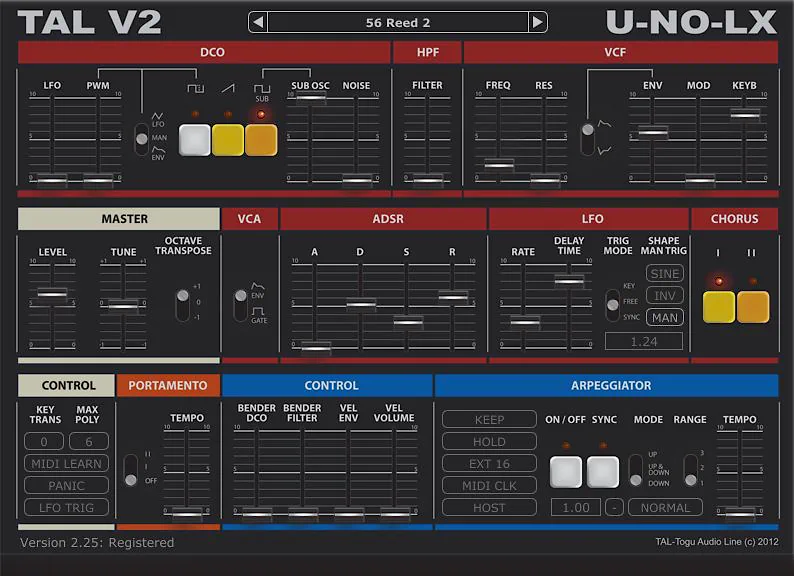
The U-NO-LX GUI looks expertly crafted and immediately feels right at home. The colors hit the mark and closely match the original hardware’s palette. TAL has also nailed the look and feel of the sliders, switches, and buttons, making them genuinely fun to tweak and “play,” not just click.
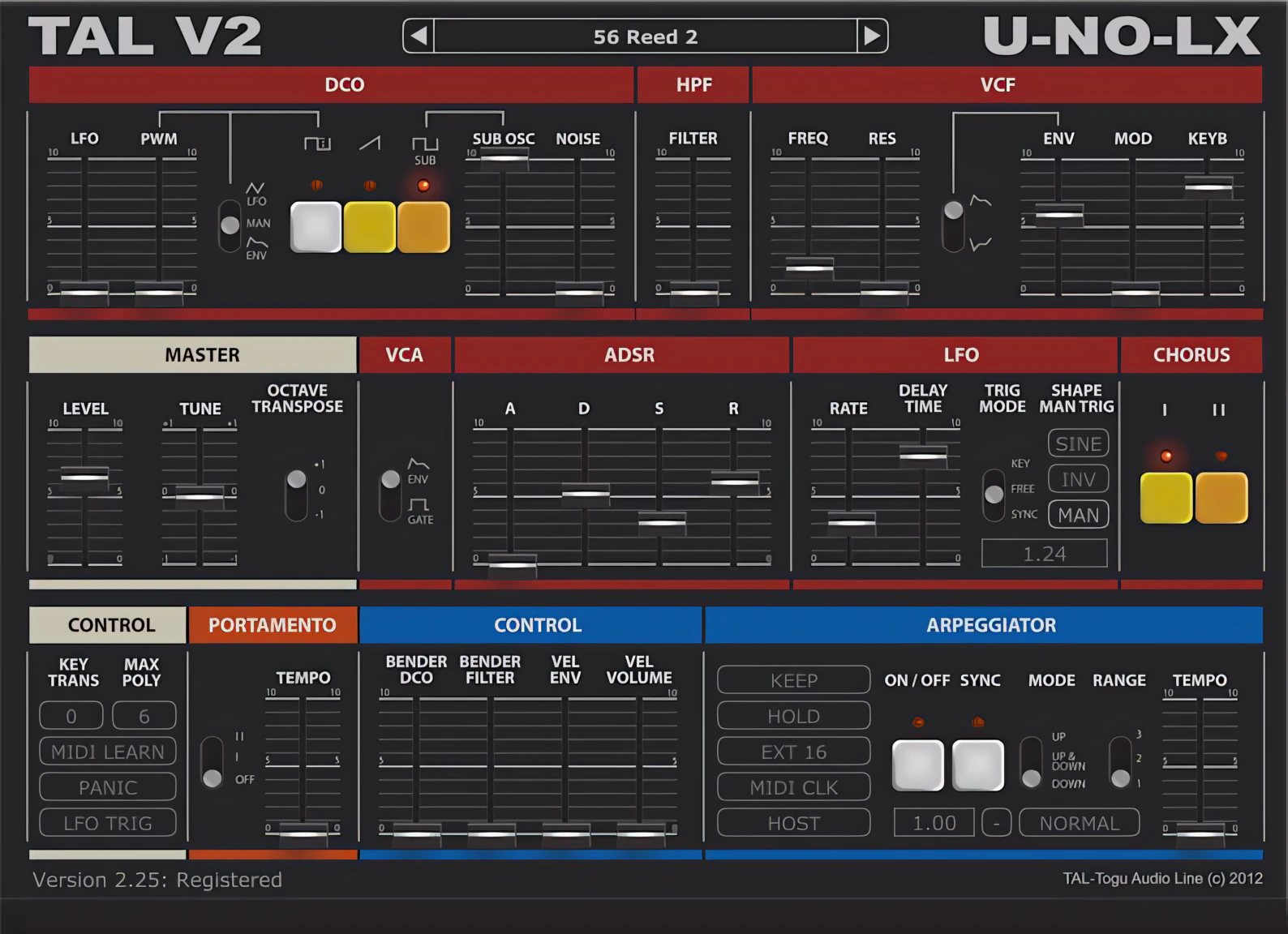
You will not find LED meters or digital readouts on this sonic workhorse. U-NO-LX stays fully committed to an unapologetically analog-style experience from top to bottom. Spend enough time with this gloriously retro instrument, and you might catch yourself growing a mullet and humming Duran Duran under your breath. And yes, you will absolutely know it.
A No-Nonsense Interface
The main background color—charcoal-grey—lets bold, white typeface jump right out at you. Thin, white lines carve out each control region, while large, easy-to-read labels guide your eye effortlessly.
Much like the original hardware, the interface prioritizes intuition and quick tweaking. Furthermore, the design embraces a rugged, old-skool aesthetic that rewards exploration. Even synth novices navigate this layout intuitively. Within minutes, you’ll feel genuinely comfortable diving into sound design.
Smooth Controls
The sliders on this soft-synth deliver the smoothest tweaking experience I’ve ever enjoyed with a computer mouse! You can even hold down the shift key to unlock granular, fine-tuned control that rivals physical hardware.
Unfortunately, the user’s manual doesn’t explain how to reset a slider to its default value, and I haven’t found a keyboard or mouse combo to do it yet. It’s a bit of a mystery, though perhaps the “undo” button is just waiting to be discovered!
On a brighter note, the interface nails the retro vibe. When you push a button, classic red LEDs light up with a decidedly 80s glow, instantly transporting you back to the era of neon and big hair.
There are three rows of synth controls; each being easy to navigate and manipulate.
Top Row:
At the top of the interface sit the DCO, HPF, and VCF sections. The DCO section features four sliders that control the LFO, PWM, Sub Oscillator, and Noise levels. It also includes a PWM modulation assignment switch and three push buttons.
These buttons enable or disable U-NO-LX’s three alias-free waveforms: pulse, sawtooth, and rectangle sub-oscillator. Users can activate any combination of these waveforms simultaneously, which provides plenty of scope for shaping rich and distinctive sounds. After all, synths rarely complain when you ask them to multitask.
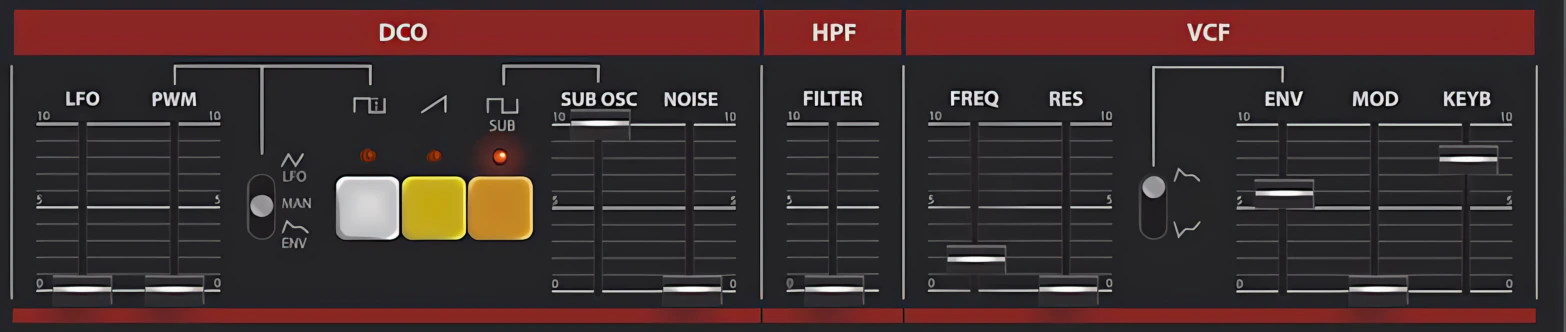
Next, a single slider controls the amount of High Pass Filtering. You won’t see a numeric readout for the frequency value here. Instead, this control forces some good old-fashioned “using your ears”—what a novel concept for a modern studio!
At the top right, you find the VCF (Voltage Controlled Filter) section. It gives you five sliders to control Frequency, Resonance, Envelope intensity, MOD (LFO intensity), and Keyboard control. The Keyboard control slider sets how strongly the filter tracks the key you play. You also get a switch that lets you choose either normal or inverted envelope mode. Think of it as “filter attitude adjustment” at the flick of a switch.
Middle Row:
Starting from the left, the “MASTER” section grants you volume, global tuning, and octave transposition (choose -1, 0, or +1). Next, the VCA/ADSR panel takes over the envelope game.
A single two-position switch lets you toggle between volume ENV and GATE mode. Here’s the key distinction: GATE mode bypasses volume shaping entirely. Conversely, when you switch ENV ON, the Attack, Decay, Sustain, and Release sliders directly sculpt the volume envelope. This dual-mode approach gives you flexibility. You can nail snappy, percussive hits with GATE, or craft lush, evolving textures with ENV.
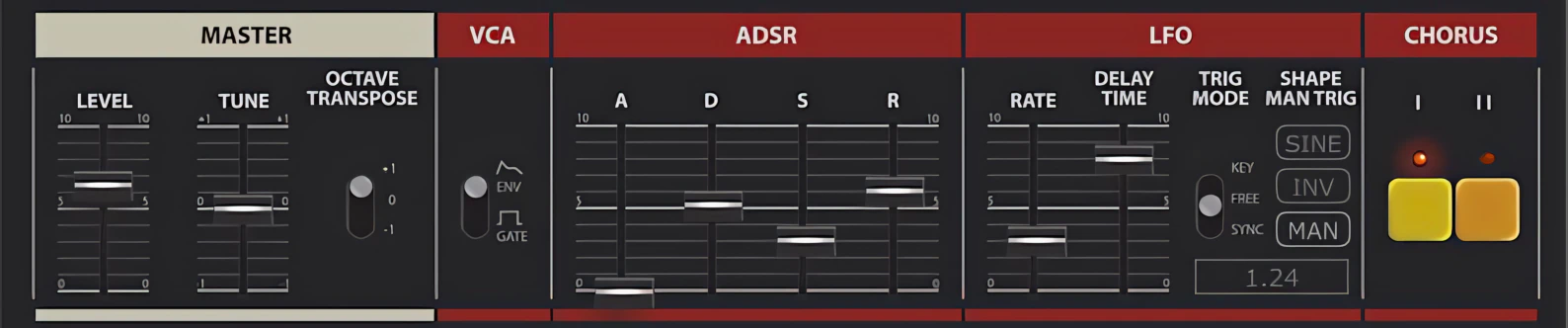
Right next to the ADSR section, you’ll discover the versatile LFO segment. This area provides two dedicated sliders to control rate and delay time with precision.
A handy switch lets you assign the trigger mode from three distinct options: Key, Free, or Sync. Selecting “Key” triggers the LFO on every note-on event, while “Sync” locks it perfectly to your host tempo, and “Free” offers total independence.
Next, a “Shape” menu allows you to select your preferred waveform: Triangle, Rectangle, Saw, or even Random for some chaotic fun! 🎲 Finally, enabling the “MAN” button tells the LFO to wait for manual activation via the LFO TRIG button, while the DELAY TIME control manages its smooth fade-in speed. It’s like having a traffic cop for your sound waves!
Featuring Roland’s signature chorus effect, U-NO-LX lets users select Chorus I, Chorus II, or both modes simultaneously. Using both together produces the lush, shimmering texture that helped make these instruments legendary. It’s the sort of sound that can make even a single note feel like it has a fan club.
Third Row:
The bottom row begins with the CONTROL panel. Here, users can transpose the keyboard up or down by as much as 24 semitones. They can also set the number of polyphonic voices from 1 to 12.
In addition, the MIDI Learn function allows users to assign a MIDI controller to virtually any adjustable parameter on the synth. This makes hands-on control easy, which is always more fun than chasing a mouse around the screen.
Adjacent to the initial Control panel sits the “PORTAMENTO” segment. Here, you can easily choose between three distinct settings. You can turn the effect completely off, select Mode 1 for standard legato gliding (which only affects overlapped notes), or engage Mode 2 to apply portamento to every single note you play.
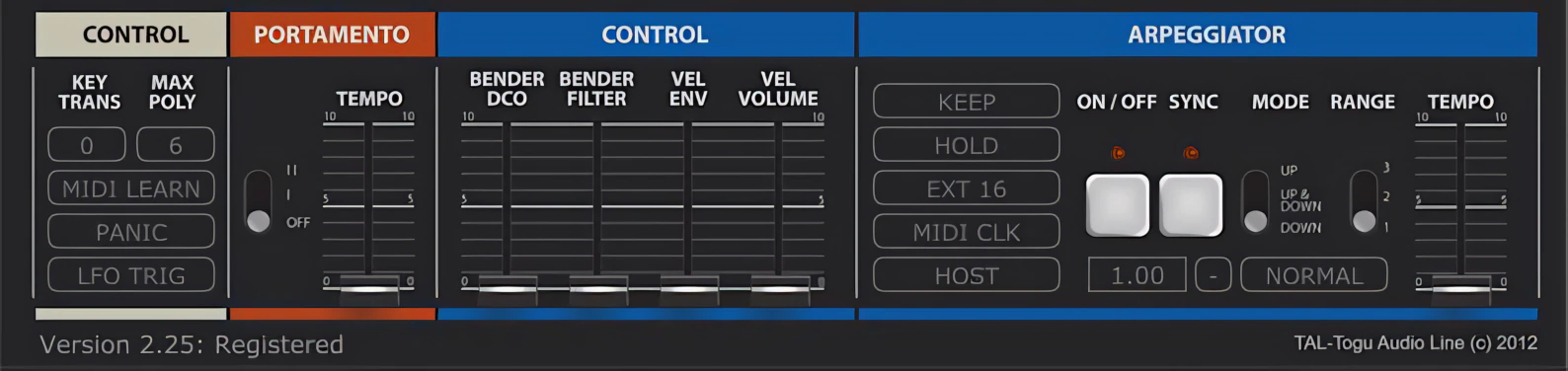
Want to lock your pitch glides to the track? You can also sync the effect directly to your tempo and dial it in perfectly with a slider. It’s an excellent way to keep your transitions smooth without throwing your timing entirely out the window!
Right next to the Portamento parameters sits the Pitch Wheel and Velocity CONTROL section. Here, four sliders let you fine‑tune how expressively U-NO-LX responds to your playing. You can set pitch‑wheel intensity, adjust how smoothly the pitch bend is filtered, shape the velocity envelope, and define how strongly keyboard velocity affects each note’s actual volume. In short, it is your personal “feel” and expression hub.
Classic, cool Arpeggiation that’s super simple to use:
Rounding out the interface is the wonderfully simple, classic ARPEGGIATOR section. It offers straightforward operation with powerful musical results. You can run it in standard up, down, or randomized up/down modes, and choose whether it sticks to the exact notes you play or sweeps across a range of up to three octaves.
The arpeggiator syncs tightly to your host or DAW and can be quantized to 1/8, 1/16, 1/32, or even hyperactive 1/64 notes per bar. It is instant inspiration on tap: dial in a rate, hold a chord, and U-NO-LX takes it from there.
Presets Aplenty:
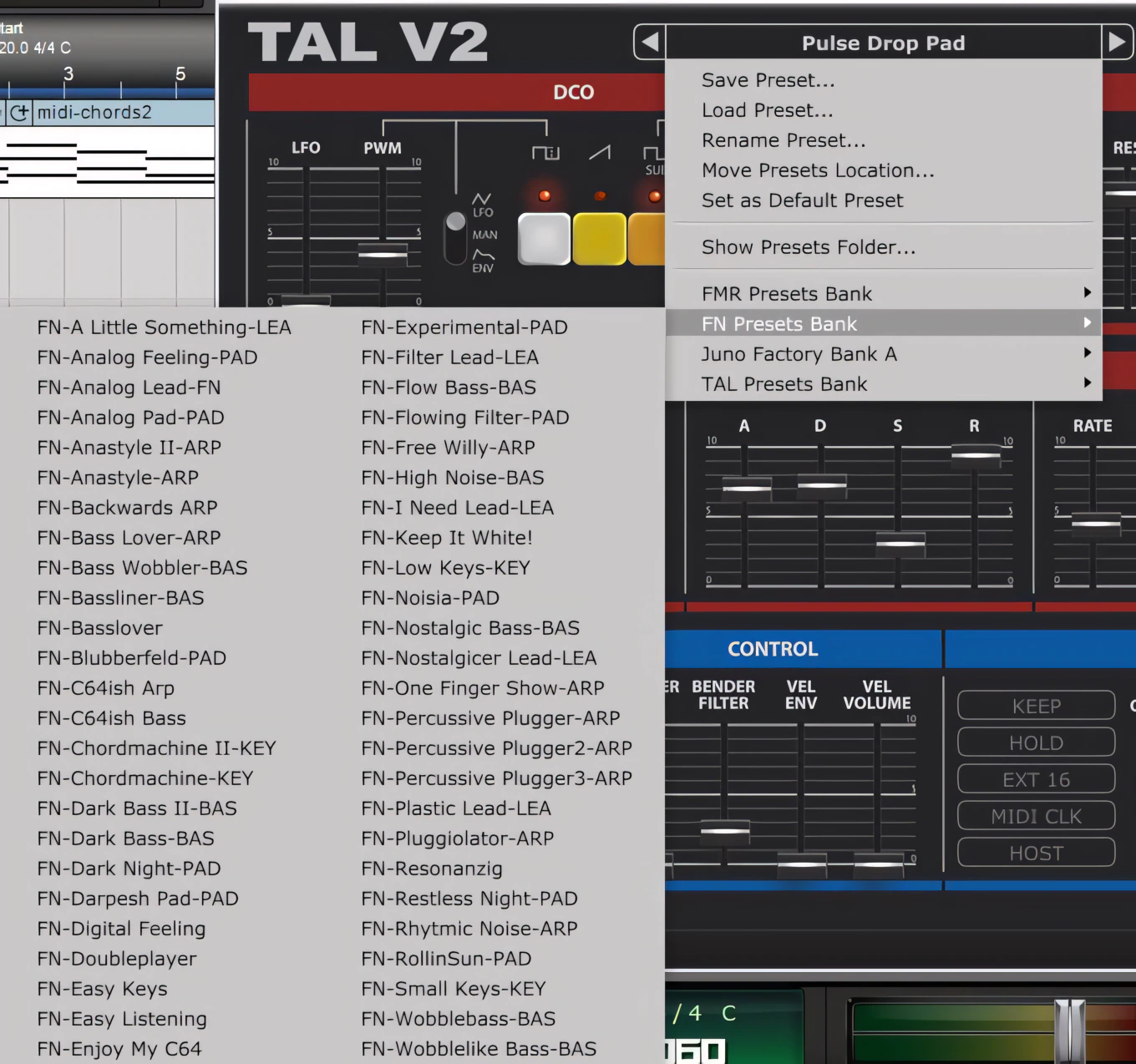
Furthermore, TAL carefully replicated the original Roland factory presets. To sweeten the deal, they also bundled three well-rounded additional banks: FMR, FN, and TAL.
Thankfully, you won’t need a magnifying glass to find them, as TAL neatly categorized each bank in alphabetical order. Best of all, the presets menu sits right at the top of the GUI—exactly where your impatient mouse cursor wants it to be.
Sound Quality:
This one is the real deal. Some synth historians call early DCO synths, like the Korg Polysix and Roland Junos, downright “cheesy.” They might be right. However, this isn’t cheap, rubbery, plastic-wrapped cheese. Instead, it delivers the character of a carefully cultured Brie or a smooth Havarti. In other words, it is still cheese. It just happens to be the fancy kind that makes you grin. 😉
The Portamento function lets your 80s “plastic” sounds stretch with delicious, bubblegum-like elasticity. It gives every note a smooth, sliding attitude that feels instantly nostalgic.
The single oscillator’s pulse and saw waves deliver rich, full-bodied tones. They easily recreate those big, bold sounds that dominated early eighties synth pop. A crisp rectangular sub-oscillator adds extra depth, while its variable noise range blends smoothly with the tasty warble of retro LFO modulation. Together, they create a sound that feels both classic and surprisingly fresh.
U-NO-LX doesn’t just emulate that era; it pulls it right into your studio. It is sure to bring out the “Berlin” in every one of us—leg warmers and leather jackets strictly optional.
Silky, wicked cool filters, Dude
The 24 dB low-pass resonance filter keeps your sound beautifully smooth and polished. To ensure crystal-clear audio quality, built-in 4x oversampling crushes sample aliasing before it even thinks about sneaking through. Meanwhile, accurate zero-feedback delay filtering works seamlessly with the oversampling to deliver something really special: you get to sweep your filter all the way up to 20 kHz without sacrificing that silky-smooth character.
TAL carefully modeled the filter cut-off to capture the charming inaccuracies of a real analogue synth. Think of this imperfection as digital cheese-whiz spreading around the main peak on 12-bit sample toast. It might sound a bit ridiculous, but hey, we are keeping the analogy cheesy to match the era. 🧀
The Juno-60 filter also produces two distinct harmonic distortion peaks. This remarkably accurate clone faithfully recreates them, preserving their subtle character. After all, even harmonics deserve a little attention.
What’s not to like?
I love this soft-synth. It chirps, sings, hums, stabs, drones, and pads its way across the early eighties digital horizon. Even better, it sounds, looks, and feels like the real deal. In fact, the price point offers a genuinely real deal too. Your wallet can finally stop sweating.
CPU Consumption:
The TAL U-NO-LX runs lightly on CPU—how refreshingly efficient! You get a genuine old-school synth that happily powers through even vintage machines without breaking a sweat. Just keep in mind that ambitious arpeggiation and chorusing will noticeably bump up your CPU load, so plan accordingly.
The developers hard-coded 4x anti-aliasing into the LFO functionality to maintain pristine audio quality. Of course, that choice does exact a small performance trade-off—but honestly, the sonic payoff is worth it. By today’s standards, you’ll find this soft-synth refreshingly light on CPU, making it a smart choice for producers who refuse to compromise on sound quality or system stability.
5 BIG, BRIGHT Stars!
TAL U-NO-LX Review -Concluding Comments:
You can expect great things from TAL in the not-so-distant future. U-NO-LX v2 stands tall on the horizon as a worthy peer to any offering, whether independent or commercial. I would be incredibly grateful if TAL releases other classic VA synths at this caliber. This reviewer finds that TAL U-NO-LX rules as the reigning prince of virtual Juno synths, beating both sample-based and VSTi rivals.
Many people have mistakenly dismissed this fantastic instrument as nothing more than a “freebie turned payware” product. However, I see it differently.
TAL’s generous spirit may have spoiled some of us over the years, but that hardly means this exceptional developer doesn’t deserve our support. On the contrary, purchasing their work is a fitting way to show appreciation for the quality they consistently deliver. After all, great developers run on more than goodwill alone.
The Reimagined Version
I recently reviewed Rob Papen’s Predator synth, which effortlessly recreates highly nostalgic tones and bleeps. Similarly, I greatly admire the magnificent, true-to-spec analog sounds of SonicProject’s OP-X Pro II Oberheim clone.
Arturia’s collection of Classic “Vs” also remains unquestionably desirable. I also recently reviewed the powerful, analog greatness of Xils-Lab’s PolyKB II.
In other words, the electronic music community devotedly embraces many feature-rich soft-synths. Nevertheless, not a single competitor accurately reproduces that famous self-oscillating resonance. That magical sound belongs exclusively to the Juno 60 by Roland—the undisputed prince of *DCO.
It is my honest findings that as of the time of this publication (May, 2016), no other JUNO 60 emulation comes close to reproducing the original synth’s greatness. TAL U-NO-LX v2 beats them all hands down.
*DCO (Digitally Controlled Oscillation)
5 out of 5 Stars


:: Pros
- Arguably THE BEST Juno clone available.
- Affordable.
- Very authentic sounding.
- Abundant, well-categorized presets management.
- Attractive user interface that closely resembles the original instrument.
- Smooth, high quality filtering.
- Easy-to-use & Easy-to-learn.
- Well-written user’s manual.
- Friendly, proactive product support.
- Regularly updated and maintained.
No dongles, call/response challenges, nor invasive piracy protection overhead.- 32 & 64 bit for both MAC & PC (AU or VST)
::Cons
- $60 is too small a price for such an accurate, well-modelled classic synth clone.
- Editor’s UPDATE – As of 2024, TAL now relies on aggressive C/R online copy protection.
Visit the TAL website. www.TAL-Software.com
Media Samples:
Just for grins and giggles, I put together this “cheesy” little 80s-style pop mish‑mash using only the factory bank presets. Nothing custom, nothing fancy—just pure preset fun.

This short clip highlights both classic arpeggiation and some delightfully unpredictable randomized patterns. First, the pads set the mood with a familiar retro warmth. Then, the arpeggios kick in and start dancing around them like they just discovered neon leg warmers.
The initial MIDI pad clip comes courtesy of Satya Choudhury. I handled the accompaniment ~ Bro. Charles.
Be sure to check out how awesomely U-NO-LX compares to the real thing in this impressive YouTube video!
Intellectual Copyright – 2017 – All rights Reserved. This review may not be copied or reproduced in whole, nor in part, without express written permission from the author.

Leave a Reply