
What is Wurlie?
Wurlie is a high-quality sample library designed to recreate the inimitable sound of the Wurlitzer 206A. This classic student-model electric piano is known for its distinct, warm, and slightly gritty tone. Unlike some other libraries that focus on the more common 200 or 200A models, Wurlie replicates the 206A. As a result, it offers a unique, special voice. In this comprehensive AcousticSamples Wurlie review, we’ll check out nifty details like:
- Deep Sampling: It captures the instrument with multiple velocity layers and round-robin articulations to ensure natural dynamics and playability.
- Tonal Character: The instrument is famous for its “reedy” sound. It ranges from mellow and warm to punchy and distorted, depending on how hard you play.
- Customization: Controls for adjusting reed resonance, mic positions, and other tonal nuances to shape the sound.
- Compatibility: It is available as a full sampler library, primarily working within UVI Workstation player.
Introduction:
The legendary Wurlitzer 206A doesn’t just play notes; it barks, purrs, and oozes soul. AcousticSampleS captured this exact magic with Wurlie, their meticulously sampled recreation of the iconic reed-based electric piano.
Hot on the heels of my deep-dive on the pristine Mark79, this library swaps out smooth bell tones for some serious vintage bite.
Not the same ole, same ole – this one is unique!
Unlike most Wurlitzer-based virtual instruments, this one does not rehash the same old “A200” model yet again. Not even close. Instead, it stands out as a meticulously crafted sample library of the 206A student Wurlitzer®.
Of course, because it is a Wurlie, it delivers that classic, definitive early 70s sound. However, it also adds just a little more attitude and vibe. Think of it as the cool cousin who actually practiced. 😉
For the discerning vintage-keyboard enthusiast, AcousticSampleS presents Wurlie, a virtual instrument that’s sure to strike a chord. This superb sample library, housed in the UVI Workstation format, showcases the sassy 64-key model 206A model.
AcousticSamples carefully recorded the Wurlitzer using studio-grade DI and a high-end tube-powered preamp. To capture the full range of its mechanical tone, they also added a pair of high-grade microphones positioned just above the keyboard.
With a sampling rate of 96 kilohertz and 24-bit depth, AS (AcousticSamples) spared no detail in crafting an authentic sound. The result is a virtual instrument (VI) that effortlessly recreates the feeling and sound you crave – think tube ampage with the charming mechanical sounds shining through as well.
Awesome Wurly Tone
You’ll fall in love with the rich, perfectly balanced tone. Each note responds with heartfelt warmth and crystal-clear resonance—think of your amp whispering compliments between songs.
Searching for that dream Wurlitzer vibe in digital form? This one nails the characterful, gritty charm without the vintage hassle. No bulky keys needed; just plug in and play.
Best of all, it’s wallet-friendly at €79 or $87 USD. Because great music shouldn’t come with a ransom note—or require a mortgage refinance.
Hi, you! If you like these kinds of reviews,
be sure to subscribe.
All the vibe, none of the hassle
Ahh, the warm, harmonically rich tones of a classic Wurly in top condition. Is there anything sweeter to a collector’s ears? Not really—unless, perhaps, a Rhodes from the same era happens to be nearby.
However, owning a Wurlitzer comes with its challenges. Maintaining one often demands the expertise of a seasoned technician. Even tuning a Wurly can turn into an adventure, as the job frequently requires a soldering iron. Eep!
We are incredibly spoiled, and let’s be honest, our lower backs are thanking us for it.
Decades ago, owning a vintage electric piano meant scouring classified ads, emptying your bank account, and risking a hernia every time you loaded into a gig.
Today, we avoid the collector’s premium and the back pain. Instead, we simply download a virtual instrument directly to our hard drives for a fraction of the cost.
This convenience changes the game for modern producers. We can instantly compare the meticulous work of different developers side-by-side in our DAWs. We test their sampling depth, scrutinize their dynamic response, and demand absolute realism.
Developers work tirelessly to capture every nuance of these heavy, temperamental instruments. Thanks to their efforts, we get to enjoy world-class vintage tones from the comfort of our studio chairs.
Q: Why would I want to cough up the better part of $hundred bucks for another Wurly VI? What makes this one so special?
A: I’m glad you asked; it’s a perfectly valid query.
I’ll start by telling you that the library keeps its footprint joyously sleek. Thanks to FLAC lossless compression, it shrinks 1.28 gigabytes of sample data down to a tidy 278 megabytes! Your hard drive will probably send you a thank-you note.
Next, AcousticSampleS makes it EZ-Breezy to dial up great sounds quickly, just like their other products. You spend less time tweaking and more time actually playing.
Third, the handsome, photo-realistic GUI not only looks great, it also stays functional and clearly laid out. You find what you need without going on a pixel scavenger hunt.
Most importantly, this nifty little UFS container delivers superb sound quality. It refuses to take a backseat to any similar competing product. For me, AcousticSampleS’ “Wurlie” emerges as the clear winner on all these fronts.
Installation and Authorization:
The moment you make a purchase, you’ll receive an emailed invoice with a personalized serial number. Easy peasy! To register and authorize your serial number, simply log in to your User Account at acousticsamples.net. They made it a breeze to get started.
Once you’ve completed the registration process, you’ll find download links waiting for you in the “Downloads/Serials” section of your online account. No fuss, no muss!
The best part? You can download your purchases as many times as you need, whenever you need them. There are zero restrictions on frequency or availability, so you can access your files with ease, anytime you need to.
iLok – like it or lump it
Most UVI-powered products rely on the iLok system for copy protection. While dongles can be a minor headache for laptop purists, the system generally works flawlessly.
You probably wouldn’t miss the blasted thing if it weren’t so reliable. In short, you get robust security without the constant hassle of online activation management.
Personally, I prefer personalized serial numbers or digital watermarking over challenge-response activation systems or dongle-based protection. Nevertheless, I fully understand why developers take steps to protect their businesses from blatant software piracy. After all, creating great software is challenging enough without it being stolen.
** The latest AcousticSampleS licenses can also be (iLok) machine activated/authorized.
Visuals:
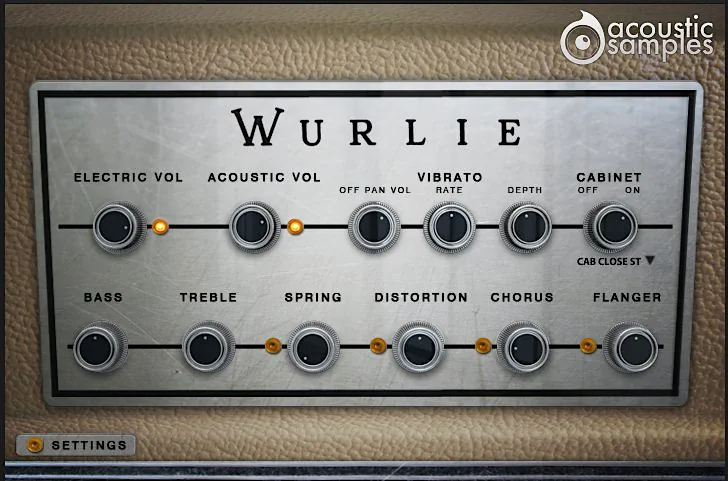
AcousticSampleS continues its tradition of visual excellence with the Wurlie interface. Just like the Mark79, this GUI fits comfortably within the standard UVI Workstation dimensions. The layout measures a compact 720px wide by 716px high and showcases eye-catching, photo-realistic graphics.
The presentation strikes a perfect balance between sleek functionality and retro charm. AcousticSampleS beautifully captures the original instrument’s vintage vibe. They even included cool chrome knobs, textured faux-tolex casing, and glowing amber indicators.
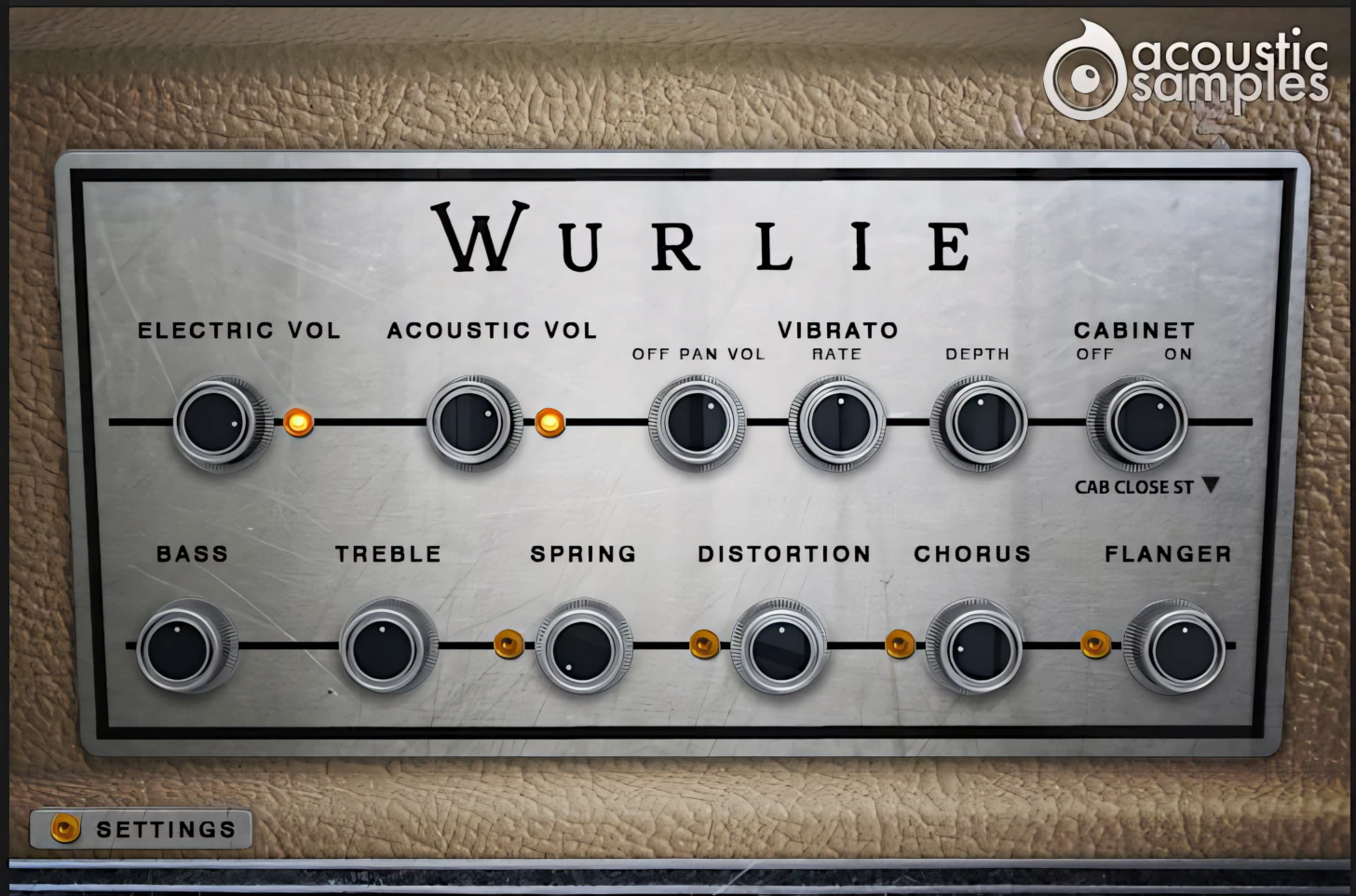
Beige is cool too, ya know!
Unlike many other Wurlitzer VIs, this one avoids the usual gray and black color tones. Instead, it showcases a 206A “student” model wrapped in tan/beige tolex, which instantly gives it a distinctive, vintage charm.
The main panel’s user-adjustable controls sit in two neatly arranged rows, and they make quick tweaks feel effortless. You do not waste time hunting for basic functions; you just grab, adjust, and play.
The instrument’s GUI looks charming and stays highly functional, while it clearly suggests an authentic e-piano experience from the classic rock era. In other words, it feels like the 70s called and actually sent you the good stuff. I still love it!
A Quick History Lesson:
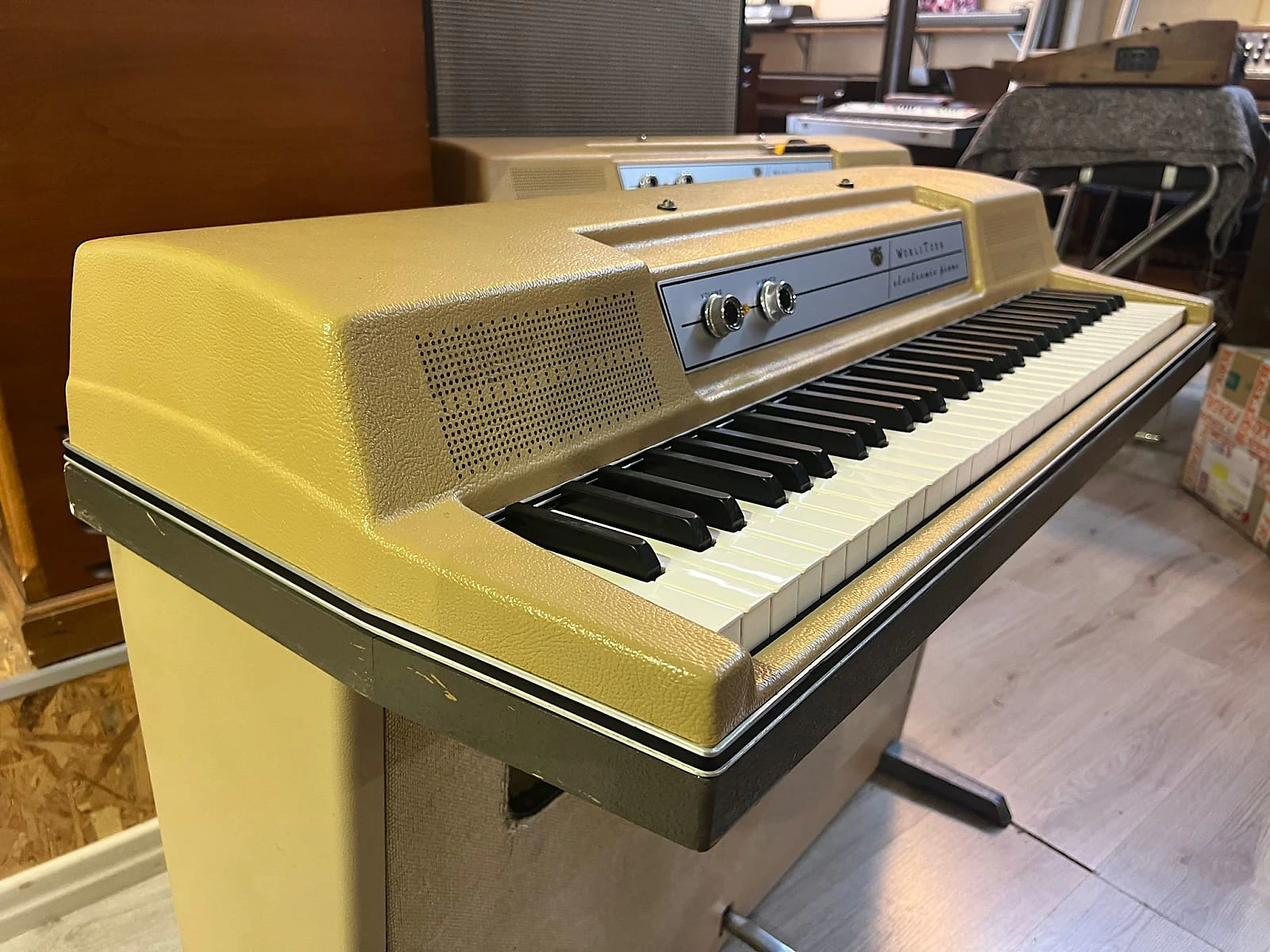
Manufactured from 1974 to 1983, the Wurlitzer 206A has earned its status as a highly sought-after vintage icon. Musicians and collectors hunt down this specific model for its unique, barky tone and robust build quality.
Originally built as a student console model for music classrooms, it ironically boasts an internal amplifier and speaker system that can really punch through a mix.
The 206A sets itself apart from its beloved 200A cousin by focusing purely on raw, unadulterated tone. It completely omits the vibrato circuitry to deliver a more straightforward, punchy sonic experience.
Without that modulation pulsing in the background, your ears get to focus entirely on the pure, direct bite of the vintage reeds. In sum, think of it as the no-nonsense rock-and-roll sibling of the family.
The Wurlitzer 206A packs 64 full-size keys into a compact design, delivering ample range for most musical pieces without sacrificing portability. This model was available in both Avocado and also Beige finishes, allowing musicians to choose a style that fits their personal aesthetic or studio decor.
Operations and Control:
On the main screen, the interface groups the controls into two rows, giving you a conventional yet very satisfying way to shape those classic Wurlitzer parameters.
Main Screen Controls: Top Row
The top row lets you adjust Electric and Acoustic levels, along with Vibrato type, rate, and depth. You can also switch the Cabinet on or off with a single click.
Additionally, a discrete drop-down menu sits neatly under the Cabinet knob and offers a selection of different cabinet types. To my delight, this tidy little set of impulse responses even includes Gibson and Fender cabinets.
Main Screen Controls: Bottom Row
Focus your attention on the bottom row of dials, where tonal shaping and effects magic happen. You’ll find Bass, Treble, Spring reverb, Distortion (or “overdrive” for those who prefer polite terms), Chorus, and Flanger waiting for you. Drag each knob with your mouse, and watch the sound respond as smoothly as a silk sheet on a hot summer day.
Reading the controls is a breeze too. Bold black text stands out clearly against the sleek silver background, so you never have to squint at cryptic symbols again.
More Settings:
Additional settings are available through the button of the same name in the lower-right corner of the main GUI screen. Once you click it, the interface switches to a detailed control panel.
There, you can adjust Release and Pedal noise levels, Resonances, Spring (reverb) length, and apparent cabinet distance. In addition, you can fine-tune Chorus and Flanging speeds. Everything you need is within easy reach—no treasure map required.
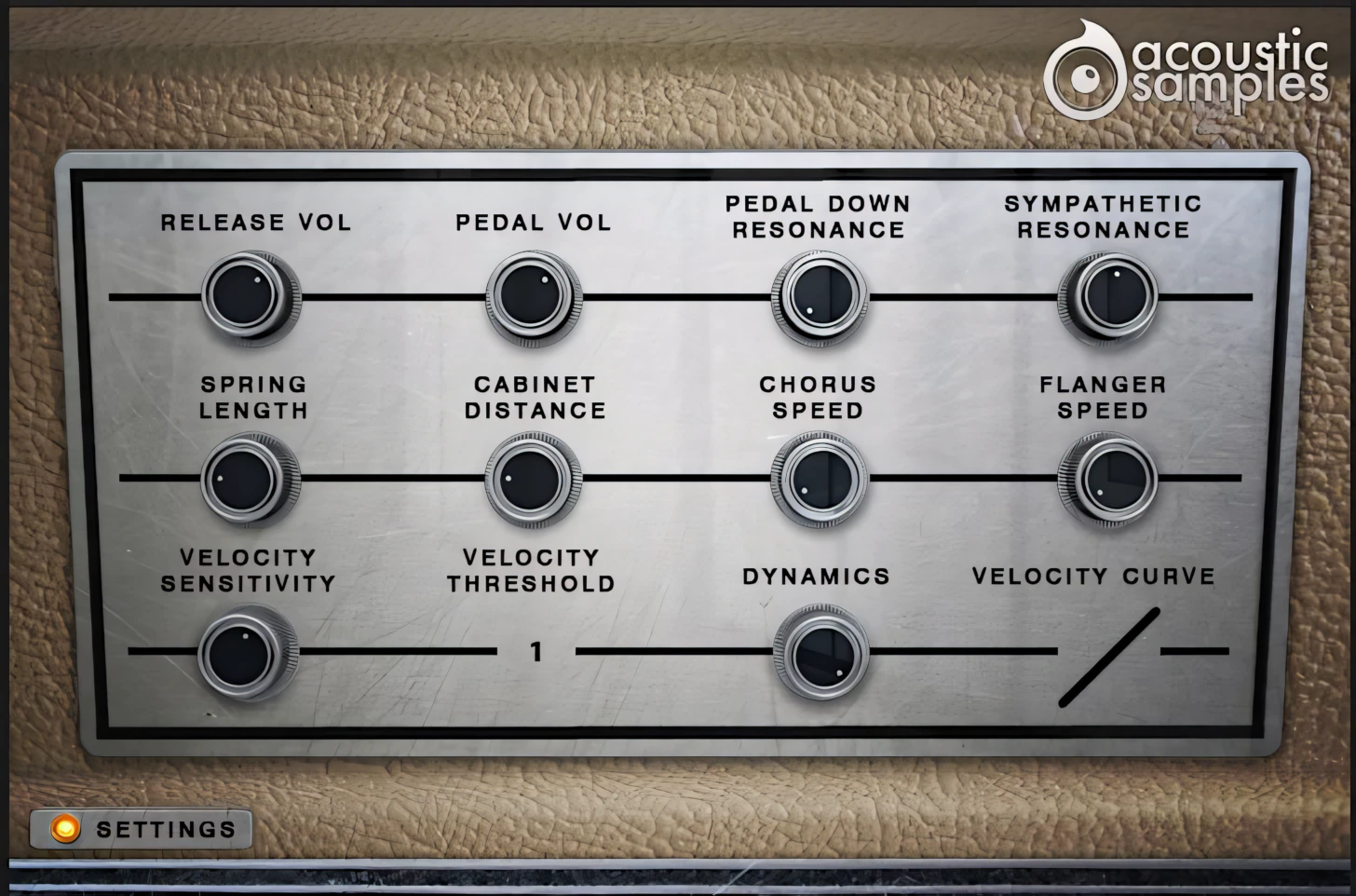
Take control of your instrument’s sound with the bottom row of knobs, which govern its dynamics. With these, you can set the velocity threshold, tweak the sensitivity, and customize the velocity curve. The result? A perfectly calibrated response to your MIDI keyboard’s every move.
Smooth Controls
Tweaking the dials produces smooth, gradual shifts in tone that feel incredibly natural. The stereo vibrato and panning nail that classic Wurlitzer “whirl” with convincing authenticity. Of course, this is a highly desirable extra that AcousticSamples put in for us, as the actual 206a doesn’t provide tremolo.
Double-click any control to type values directly from your keyboard—a handy shortcut that saves time. However, I hit a tiny snag: there doesn’t seem to be a way to reset a parameter to its default. You’ll have to twist knobs back manually, which is slightly annoying but not deal-breaking.

Dialing up a fantastic sound is effortless, yet I missed seeing a few famous Wurlitzer presets pre-loaded. (Admittedly, I’m fishing for minor flaws here to keep this review honest!) Still, the library could use a few iconic starting points to save you some creative hunting.
Excellent velocity range:
This library delivers ten true velocity layers for naturally sustained notes, along with a whopping 20 layers of release noises. As a result, performances feel expressive and remarkably lifelike. Meanwhile, UVI’s scripting works hard behind the scenes, ensuring seamless and intelligent integration between the various sampled elements. It keeps everything running smoothly, so you can focus on the music rather than the mechanics.
Realism expanded with Mechanical sounds
AcousticSampleS positioned a pair of close overhead mics directly above the original instrument. This setup perfectly captured the acoustic properties of the piano’s physical mechanics.
An independent Acoustic volume control lets you blend these mechanical elements entirely to your taste. Dialing in just the right amount of key-clack creates a wonderfully satisfying, tactile playing experience.
You can also adjust the release and pedal noise samples anywhere from -20dB to +10dB. This gives you massive control over the instrument’s realism, whether you want a squeaky-clean studio track or a clunky, lived-in vibe that sounds like it needs a tune-up.
Nice bevy of cabinet IRs
AcousticSampleS packs a generous collection of high‑quality cabinet IRs into this release. From the cabinet-type dropdown list, you can choose from 18 different variations, including the original Built-in Cabs, Fender 2×12, Mesa, Gibson, Markbass, and more. They provide these in both stereo and mono configurations, so you can match the vibe to your mix.
Interestingly, the built-in cabs come in three distance perspectives: Close, Player, and Far. Even better, you can further tweak the perceived cabinet distance on the Settings panel. In other words, you control whether the Wurlie whispers in your ear or shouts from the back of the stage.
Sound Quality:
Just like the McDonalds commercials diddy : I’m lovin’ it!
Imagine having vibe, growl, character, and mellow warmth all at your fingertips – it’s like having a sonic Swiss Army knife. “You know what I’m talkin’ bout, Willis?” It’s that special something that’s hard to put into words, but you know it when you hear it.
That “it” is the magic that happens when metal reeds resonate with a hint of “ping”, and mallets strike them with a satisfying “knock”. It’s a delicate balance of warmth and bite, a harmonious coexistence of gentle soul and sonorous punch.
AcousticSampleS’ Wurlie makes a bold statement, thanks to its impressive velocity layer range. Whether you’re crafting soft, emotive passages or unleashing raucous grunge, the Wurlie delivers a dose of electromechanical realism in spades. It’s like having the real deal, minus the maintenance headaches!
Not too sticky – it’s just right!
Right out of the box, the default settings hit the sweet spot with a perfect amount of note “stickiness.”
It captures that authentic, slightly heavy key-return physics that keyboardists crave.
If you want to tweak it, just head over to the “Settings” panel. The user-adjustable release noise knob lets you dial in the exact balance to suit your playing style. You can keep it subtle for fast, clean jazz lines, or crank it up to remind your listeners that this digital instrument mimics a living, breathing mechanical beast.
Get your Ray Charles on!
As soon as I opened the library, I was hooked – no tweaking required! It instantly transported me to a Ray Charles jam session, begging me to vamp all night long. The upper register sparkles with silky highs, while the lower range serves up big, warm vibes that’ll get you grooving in no time.
The tone stretches from here to next Tuesday, massaging your ears into eager, willing submission. “Wurlie” weaves its sonic web of allure with plenty of finesse and vibey attitude. From classic rock to soulful jazz, it easily satisfies even the most discriminating aficionado. And yes, it might also convince you that you need sunglasses indoors.
Dig the spring reverb!
Turn on the reverb, and your ears instantly receive a pampered treatment. Strikingly realistic convolution technology drives every note forward with authentic depth.
You’ll hear a delightfully “sproingy” spring reverb impulse response ready to rock.
It is so elastic, the sound might literally bounce right back at you
Returning to the Settings panel, you can easily adjust the spring reverb length to suit the mood of the moment. Meanwhile, the Cab feature helps shape those classic, time-honored amplified tones.
Cabs n’ Qs:
The included selection of cabinet IRs offers a wide range of appealing tonal flavors, giving you plenty of room to experiment. That said, the default Built-in Speakers setting has a charm all its own. In fact, its distinctive character and vintage cool factor make it difficult to resist.
The tone remains authentic and enthralling across the entire, compact 64-key spectrum. Put on a pair of high-quality studio headphones, dim the lights, flip on the lava lamp, and just lose yourself in the sound.
The instrument exhibits a beautifully full-bodied tonal palette at its default settings. If you want to reshape the sound, AcousticSampleS provides a pair of “tuned-by-ear” parametric EQ controls.
With just a couple of quick dial twists, you can easily dial in a massive, Beyoncé-league low end or add some serious, sparkling top-end clarity. It is basically plastic surgery for your frequency spectrum, minus the downtime.
Check out the vibey tremolo!
In general, we can safely say that every e-piano player listens for a certain special quality in an electromechanical piano’s vibrato or tremolo circuitry. After all, that shimmer can make or break the whole romance.
An original Wurly’s pulse and swell create a uniquely defined sound that digital gear does not easily mimic. There is much more happening than simple volume oscillation.
Owners of real Wurlies quickly hear the difference between the genuine article and a cold digital knockoff. This happens partly because the tone and intonation keep shifting subtly while the oscillation is, well… oscillating.
I am very pleased to report that AcousticSampleS does a really, really good job of recreating this particular magic. Even picky Wurly purists may find themselves nodding in approval instead of rolling their eyes.
Onboard Chorus and Flanging:
This virtual instrument puts Chorus and Flanger effects front and center – and they’re definitely attention-grabbers. At their default settings, I found them to be a bit overpowering. But, with some tweaking, they become much more usable.
During testing, I noticed that even at conservative settings, these effects still pack a punch. To tone them down, I adjusted the Chorus and Flanger times in the settings panel – and that did the trick.
On the other hand, if you’re after that classic, pulsating “Rotary” chorusing or CE-1-style vibrato, you’re in luck. These effects deliver. Want to add some subtle depth or go for a dramatic sweep? This instrument’s got you covered.
Sound Quality Summation:
You’ll find this sample library delivers consistent playability and smooth cadence across its five-plus octaves. My words struggle to capture the full magic my ears hear; I simply can’t do the instrument justice via text.
Visit the developer’s website (link at the bottom of this article) to experience the audio demos for yourself. Then, watch my brief video presentation listed here for a closer listen.
After all, you have to hear it to believe it!
CPU Consumption:
I tested “Wurlie” on an Intel i3 (2nd generation) laptop running a standard 5400 RPM HDD, and performance remained flawless throughout. I did not encounter any dropouts or glitches.
While monitoring system performance in the Windows 7 (64-bit) Task Manager, I observed CPU usage carefully. Even with the sustain pedal fully engaged and as many random notes as possible triggered, CPU spikes stayed below 10%.
During normal playing, CPU demand typically ranged between 3% and 7%. In short, the system barely broke a sweat. The laptop, apparently, was not auditioning for a stress test championship.
Concluding Remarks:
AcousticSampleS has truly outdone themselves with this release. Wurlie looks great, feels incredible, and sounds absolutely fantastic.
It accurately delivers a highly usable, deeply enjoyable vintage electric piano experience. Beyond its stellar tone, the instrument responds exceptionally well to your actual playing.
If you drop your buffer size for lower latency, the dynamics and responsiveness feel genuinely gratifying. It removes the digital wall between your fingers and the music, leaving you with pure, unfiltered vibe.
iLok dongle protection can annoy laptop users, especially when most portable machines skimp on USB ports. However, iLok protection does bring real convenience. You no longer worry about reactivating your software on a new computer through any “Service Center” or “Authorization Manager.”
As long as you keep your iLok dongle safe, you stay ready to go. In addition, you face no limit on the number or type of computers where you install your purchased software. You simply keep your iLok connected to whichever computer you use at the time. Think of it as your all‑access backstage pass—just don’t lose the lanyard.
Still my favourite, as of June 2026
I am a serious Wurly fan; I have been for more than 40 years now. I’ve got a few virtual favorites, both sampled and modeled, but this one deserves a top spot. It comes across with undeniable coolness and vibe like no other!
For Kontakt fans, you’re hard pressed to find better than e-Instruments’ Electric W, and SonicCouture’s Broken Wurli. However, those two present the decidedly more famous 200A model. In summary, if you’re in the market for a Wurly that truly delivers huge, characterful tone and vibe, this one’s a winner.
4.5 out of 5 Stars


:: Pros
- Cool, period-accurate interface design.
- Realistic-sounding Wurly library oozing with character.
- Excellent quality for a reasonable cost .
- Simple to configure & Easy to dial up great Wurly sounds.
- One of the BEST Wurly Vibrato emulations.
- Modest system requirements.
- Plenty of control over midi dynamics and sensitivity.
- Good selection of convincing cabinet impulse responses.
- Honourable, customer-oriented company.
- Available for both MAC & PC (32 & 64 bit, including AAX)
::Cons
- It would be nice to have a few presets. Since this is a UVI-powered sample library, some useful presets including phase, chorus, delay, and etcetera, would add an additional degree of “out-of-the-box” convenience.
- The built-in Chorus and Flanging effects tend to be strong and usually need to be used with their dials adjusted to minimal settings.
- I’m not particularly fond of iLok protection for laptop use, but generally, it is a reliable and trouble-free copy protection system.
Visit the AcousticSamples website. www.AcousticSamples.net
Intellectual Copyright – 2015 – All rights Reserved. This review may not be copied or reproduced in whole, nor in part, without express written permission from the author.

Leave a Reply