
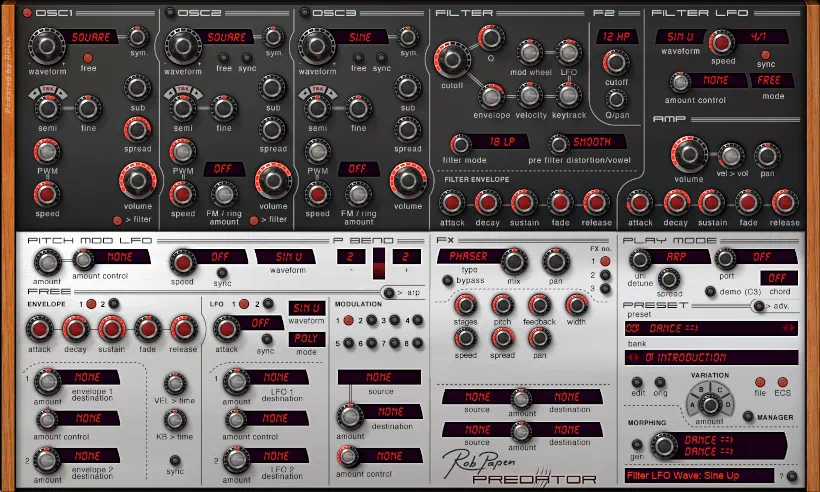
What is Rob Papen Predator?
Predator is Rob Papen’s flagship product, alongside other synths like Blue and Reveal. The plugin boasts a powerful sound engine and tremendous flexibility for creating both classic analog-style sounds AND modern digital textures. In this deep-dive Rob Papen Predator review, we’ll investigate exciting features such as:
- Multiple oscillators with various waveforms
- Comprehensive filter section
- Extensive modulation matrix for sound design
- Built-in high quality effects processors
- Arpeggiator and sequencer features
- Preset library with thousands of sounds
Introduction:
Rob Papen’s Predator has become one of the electronic genre’s perennial favorites because it delivers a wide breadth of sound types and synth flavors. This dynamic synth resists easy pigeonholing more than some of Mr. Papen’s other famous designs. Predator can pounce on its dance-floor prey with the agility of a hungry West African lion, or it can massage your cochlea with soothing, analog-like purrs.
Predator is the Alpha male leader of the pride in two bundles available from Rob Papen; EDM and Urban. Each Limited Edition bundle only costs €199 | $239 (USD).
Although some musicians may regard Predator as “bigger game” at €149/$179 USD, discerning electronic producers should still keep it firmly on their radar. This is an exceptionally capable cross-platform workhorse. Rather than confining itself to a single stylistic niche, this synth effortlessly moves between genres with remarkable versatility.
On one hand, Predator can unleash piercing, fat leads with real authority. On the other hand, it can just as convincingly lay down lush, comforting layers of warm pads. Better still, you are just as likely to encounter Predator prowling across a Mac desktop as you are on a Windows PC.
As always, dear reader, I’m genuinely grateful that you’re here. Without my fellow netizens stopping by and making themselves at home, Reviewer’s Revival would feel like nothing more than a collection of lonely, empty chambers. So, join me as we embark on a little internet safari together—without ever leaving the comfort and safety of our rooms—and track down the formidable Predator.
What type of animal is Predator?
As I have experimented with, bench-tested, and reviewed Predator, I have grown to admire its vast range of vibrant, clean sounds. Hold on—don’t hit that Back button just yet. Clean is not a bad thing. I am not suggesting this synth lacks tonal character or sounds sterile.
On the contrary, it can draw listeners in and gently lead its unsuspecting prey to a pleasant place of soliloquy and inner reflection. At the same time, Pred can turn playfully rambunctious and yank the digital leash right out of your hand if you are not careful!
Mr. Papen’s three-oscillator hybrid synth delivers exactly what he promises: true hybrid versatility. Consequently, Predator covers extensive synthesis territory with remarkable flexibility. The synthesizer channels its rich sonic palette through a feature-rich multimode modulation filter. Furthermore, an assortment of effects and a capable arpeggiator enhance these core functions.
Predator can be played in varied modes of Polyphony: Poly, Mono (1, 2 & 3), Legato (1 & 2), Arp, and Unison (2, 4 or 6).
As users bravely explore the array of available parameters, Predator’s powerful feature set reveals itself with increasing clarity. Fortunately, despite its immense power and functionality, the instrument remains intuitive and easy to master rather than becoming a confusing nightmare.
Hi, you! If you like these kinds of reviews,
be sure to subscribe.
While other soft synths painstakingly emulate VA hardware better than Predator can, none match Pred’s additive or subtractive digital prowess. Predator performs admirably as a ‘phat’, smooth VA synth. Although it lacks the intense, analog-like charm of instruments like Xils-Lab’s PolyKB II or SonicProject’s OP-X Pro II, it also avoids sounding like a robotic, sterile block of digital noise.
Predator is also part of two great bundles:
Rob Papen has released two bundled packages into the wild for we sonic adventurers, each featuring Predator as the leader of the pride. These are the EDM Synth Bundle and the Urban Synth Bundle. Together, these two bundles deliver a substantial savings of over 40 percent compared to purchasing each virtual instrument individually. Each Limited Edition bundle costs only €199 | $239 (USD).
The differences between them?
EDM ships with Predator, Blade, and Punch (RP’s speaker-busting and body-rattling drum machine). Urban bundle exchanges “Punch” for SubBoomBass (An ultra-deep groove bass synth with built-in step sequencer).
Licensing and Authorization:
The bundle installers weigh in at approximately 380 MB apiece. All three virtual instruments in each bundle are installed at once; they are not individually selectable. I suspect most owners will want all three components anyway, so this likely will not be an issue for anyone.
The single executable installer first requests your user name, company name (if applicable), and serial code. The very good news is that there is no nasty eLicensing, iLok, or challenge/response overhead —just straightforward serial-code protection.
That said, the serial code is called randomly while the plug-ins are in operation. I suspect there is some form of digital watermarking at work here to help authorities track down unscrupulous users and software pirates.
I greatly appreciate the fact that Rob Papen avoids burdening customers with frustrating, “pain-in-the-noodle” copy-protection schemes. In return, however, we owners should honour that trust by keeping these instruments for our own personal use.
Better still, registered users can obtain a free secondary license, allowing them to install the product legally on a second computer. Without question, Rob Papen earns a solid five stars for such an agreeable and musician-friendly authorization model.
Visuals:
Out of the den, Predator measures a healthy 1000 px wide by 600 px high. In my estimation, this makes for a comfortable instrument interface that is large enough to see clearly without sprawling all over your screen.
The duo-toned split screen is eye-catching and housed within an attractive virtual chassis. Even the warmth of the faux wooden side panels is convincingly rendered. The synth presents itself with a poise and polish sure to please even the most discriminating trophy hunters.
The upper half of the interface sports a rugged charcoal tone that contrasts nicely with the light silver-grey lower section.
As with any well-designed synthesizer, Predator’s GUI is neatly divided into logical sections. From left to right, the upper panel hosts Oscillators 1, 2, and 3. Next come the primary and secondary Filter sections, with the secondary filter proving especially useful for extra tone-shaping or dedicated high/low-pass duties.
Finally, at the far right, you will find the Filter LFO section, with the AMP subsection positioned directly beneath it.
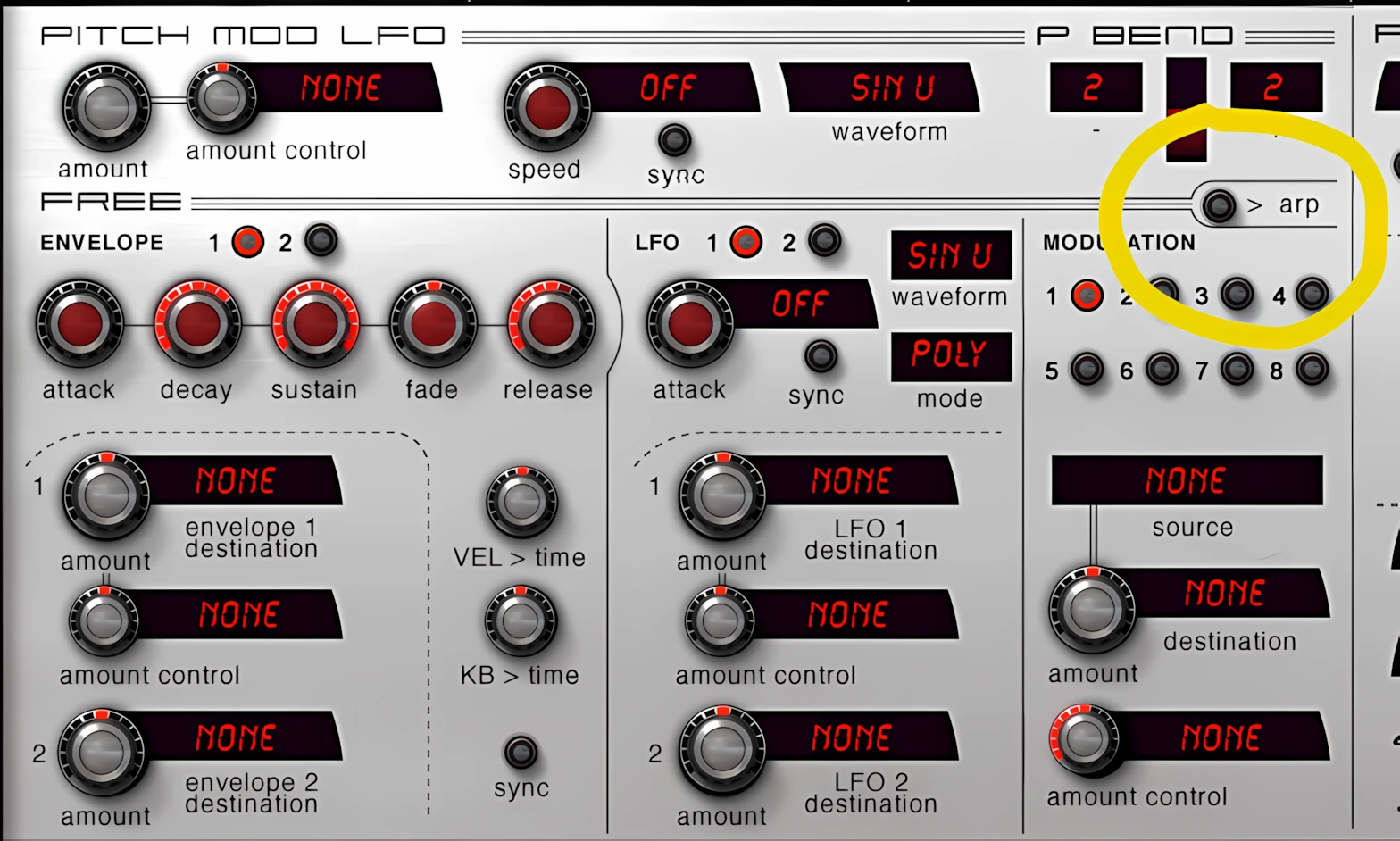
The lower panel houses the FREE MODULATION, ARPEGGIATOR, PITCH BEND, FX, and PLAY MODE sections. Although the MOD LFO and ARP sections share the same screen space, users access the latter simply by clicking the ARP button.
FX Section:
The FX section supports up to three simultaneous effects. Moreover, the range and selection of these effects is comprehensive. Specifically, the suite includes:
- Tape Delay
- Digital Delay
- Comb Filter
- Reverb
- Chorus
- EQ
- Compressor
- Phaser 1
- Phaser 2
- Flanger
- Wah
- Distortion
- Amp Sims
- Waveshapers
- Widener
- AutoPan
- Vocoder
Completing the robust suite of easily configured synth features are the PLAY MODE and ADVANCED sections. Here, users can select between monophonic or polyphonic modes, or activate the highly versatile Arpeggiator.
Within the ADVANCED subsection, users can leverage the onboard oversampling feature. Generally, oversampling enhances the sound quality of virtual instruments, particularly at lower sampling rates. This feature scales from 1x up to an impressive 32x.
However, my own testing revealed that 4x, and even 2x, provided more than enough fidelity. In fact, I found Predator’s sound quality remained excellent even when oversampling was disabled.
Layout and Navigation:
The array of knobs, sliders, buttons and switches are very well laid out and are each clearly seen; much like you would expect to see on a high quality hardware synthesizer. Clean, anti-aliased, sans serif typeface labels each control and makes for easy-to-read comprehension.
Overall, the photo-realistic design of Mr. Papen’s synth gives the user a solid impression of having access to a real hardware synthesizer.
Smooth, responsive mouse control is the norm here. Any GUI control can be instantly returned to its default value with a quick double-click or a “Ctrl + click” directly on the knob or slider. Finally, a red, LED-like halo encircles each knob, lending the instrument a polished, authentic hardware vibe that really enhances its visual appeal.
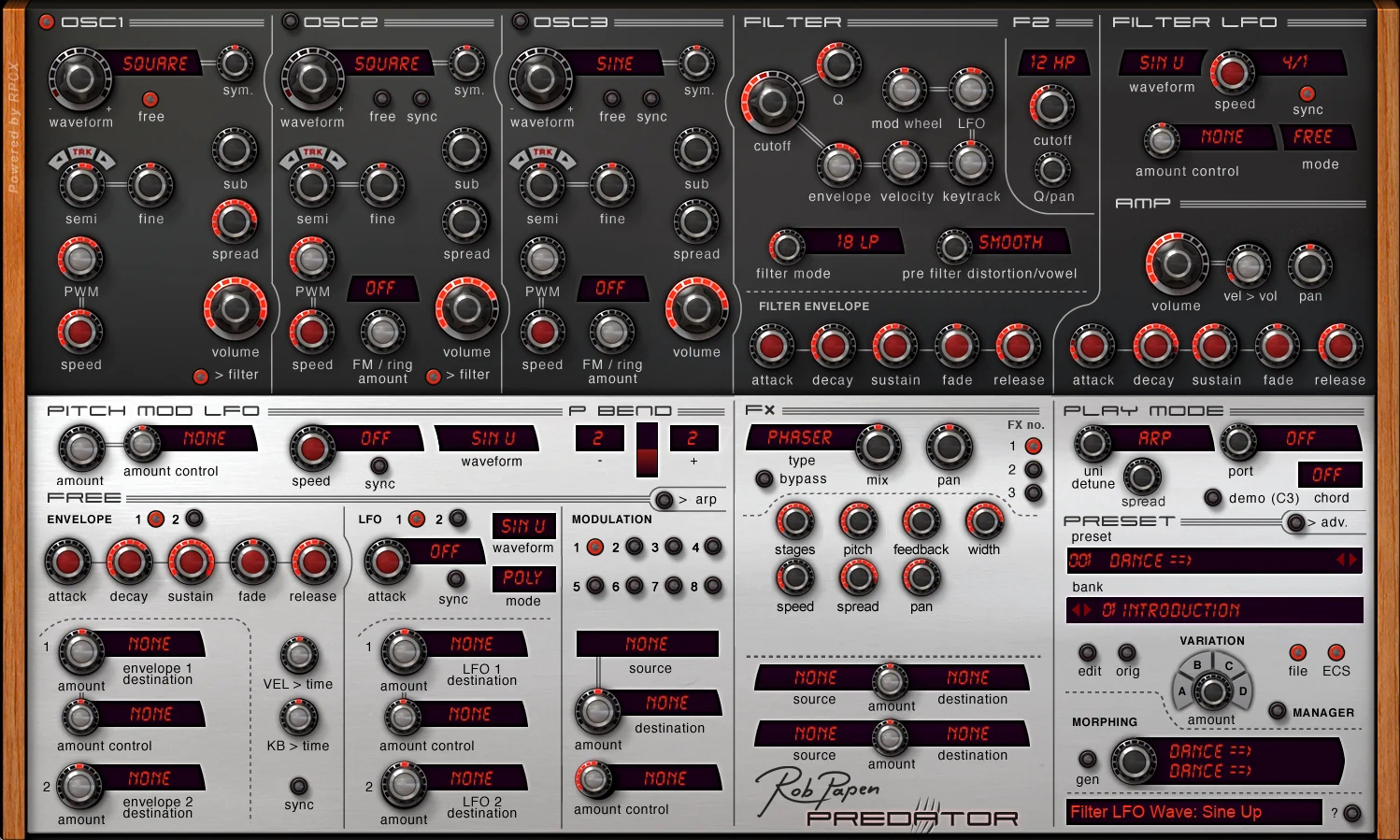
The current value of each parameter is displayed in a bright red typeface that mimics an LED digital readout, just like on a classic hardware synth. Hover your mouse over any control. Its name and value appear in Predator’s readout screen at the bottom right-hand side.
You can switch the readout’s font to a normal sans serif style and change the color to white. While the default red, digital-style typeface looks undeniably cool, I personally found the white, standard readout much easier on my eyes.
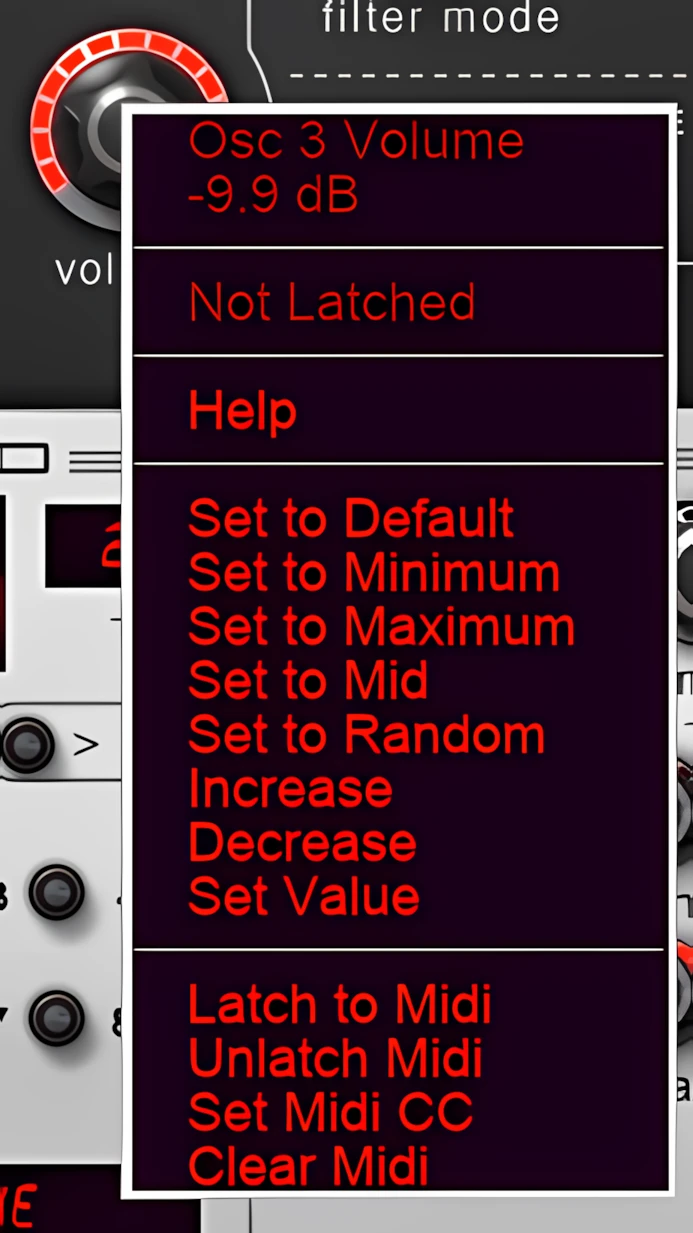
Right-clicking on any control brings up a handy pop-up menu that offers a full range of MIDI assignment options, including MIDI latch. From these pop-up menus you can also step parameter values up or down in fixed increments, instantly set them to zero or maximum, or manually type in an exact value for precise control.
Presets Management:
There is an ample selection of presets delivered with Predator, thoughtfully organized into 30 different banks. Each bank contains 128 presets. The factory sounds lean heavily toward modern genres such as Hip Hop, NY, Club, G-Funk, Jump, Hardcore, Breakbeat, various Trance styles, and DnB, among others.
That said, there are more than enough presets to suit nearly any musical style, including some great nods to the past, like 70s Disco flavors and 80s ARP-style rhythmic settings.
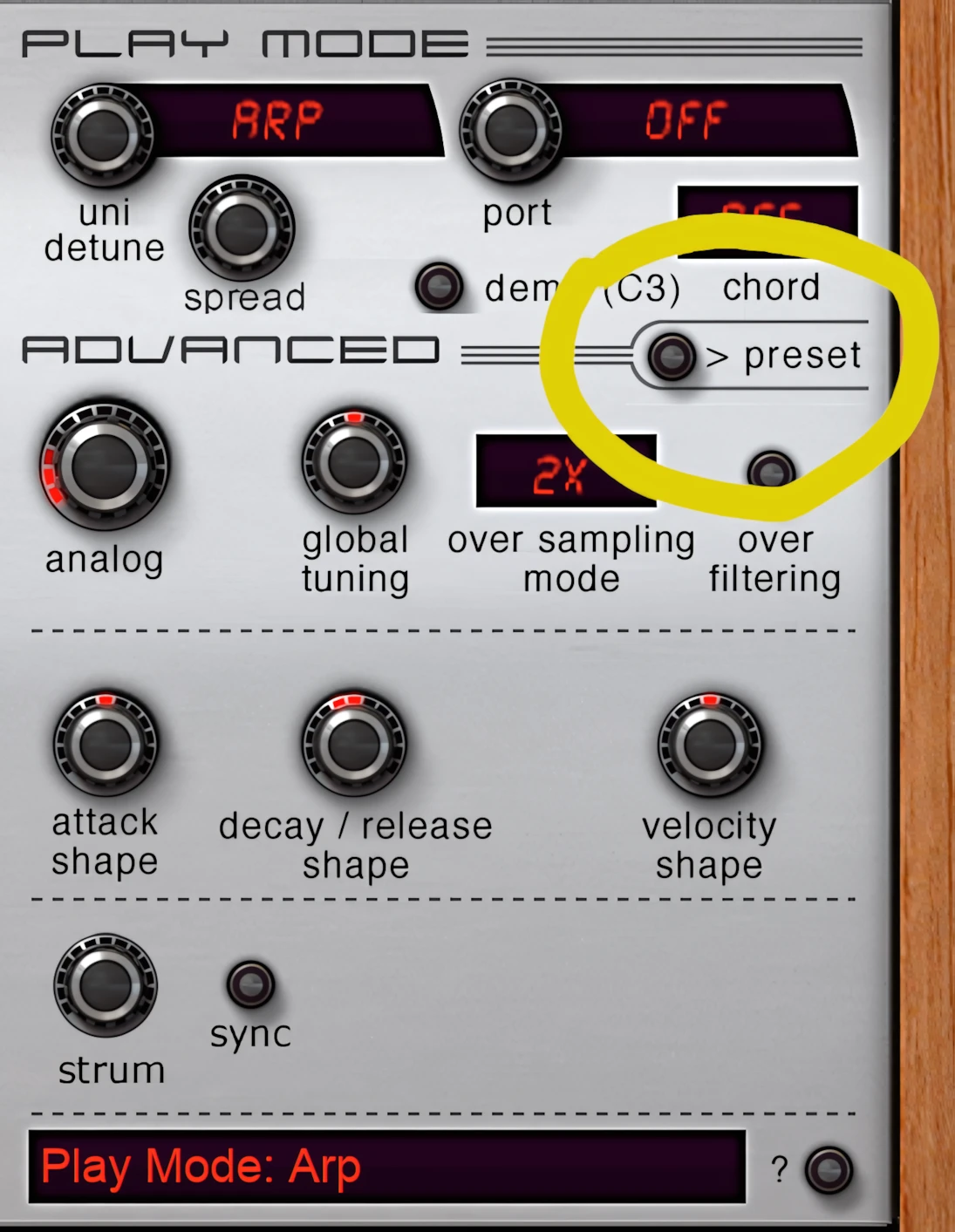
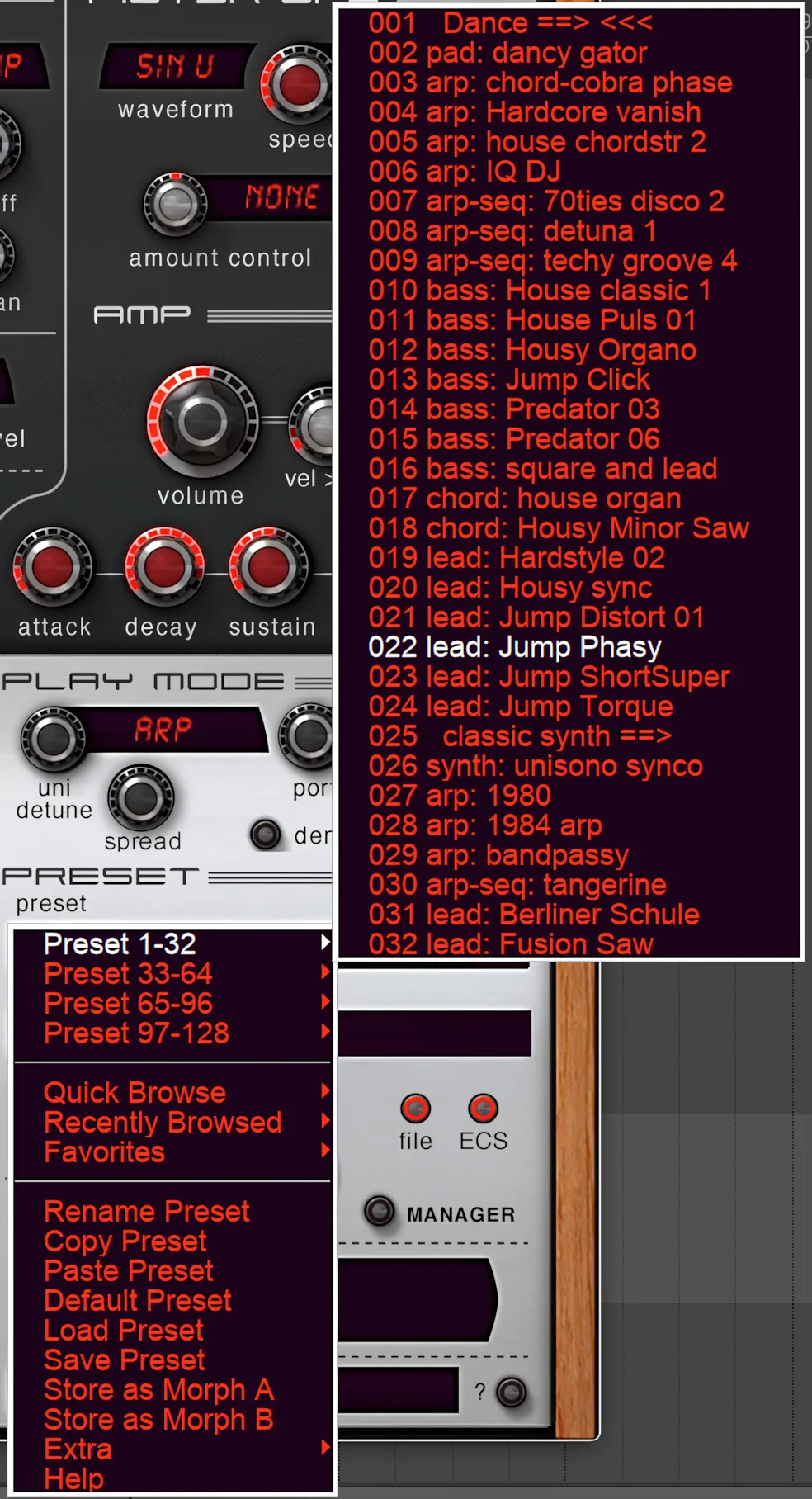
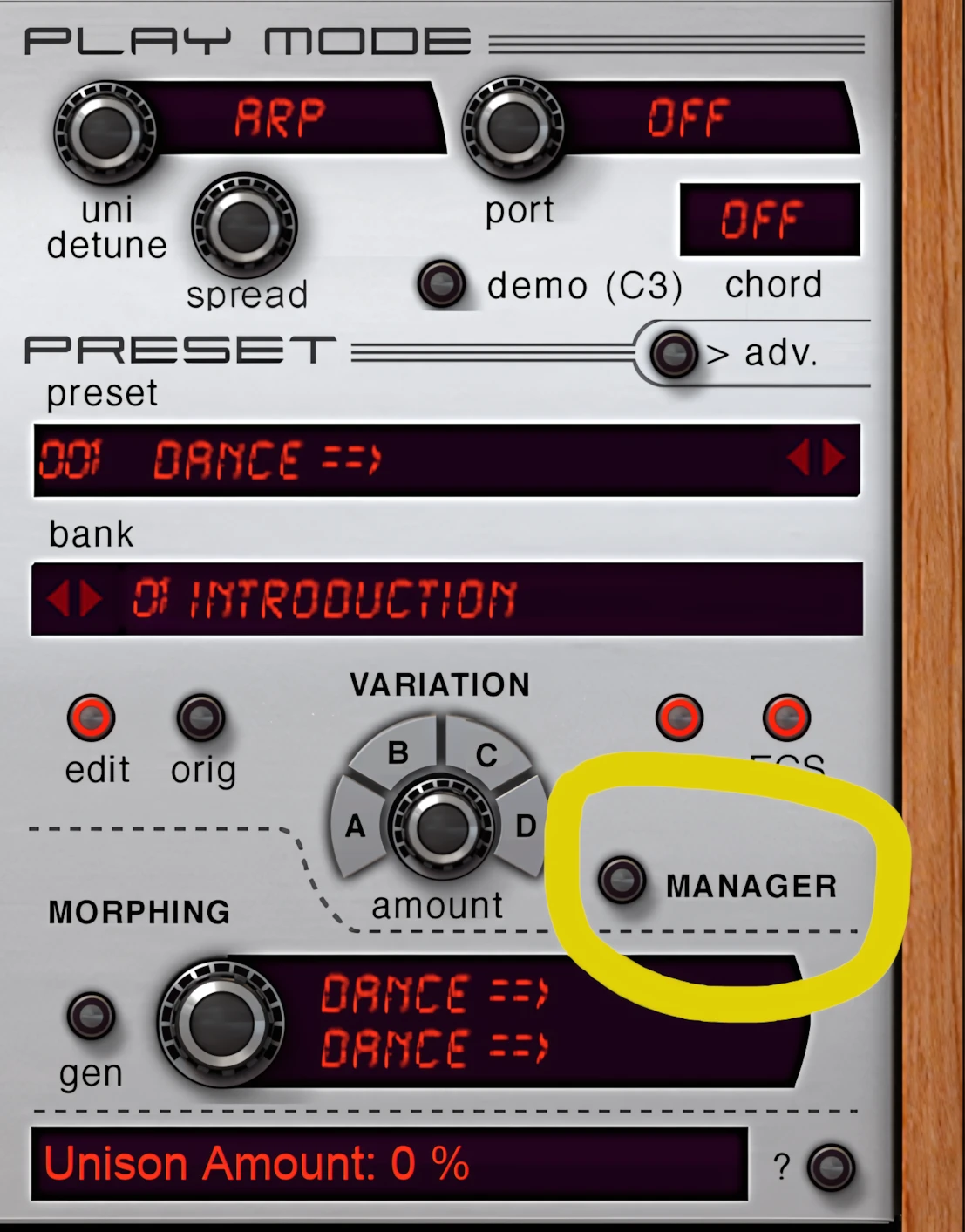
Once the PRESET section appears, users need only click the “Preset” and/or “Bank” screens to reveal full, cascading popup menus. Optionally, the user can organize, save, load and reset presets/banks using the full-featured Presets Manager. [Click to see screenshot]
Overall, I consider the Predator synth interface elegant and well-designed. Its typeface and controls remain easy to read, while its color theme stays gentle on the eyes. Furthermore, the vast array of features and controls sit readily accessible and prove easy to use.
Three Oscillators, Plus So Much More!
Three oscillators and 128 waveforms define the engine. Perhaps you wonder how the developer backs such a bold claim? Indeed, Predator drips with waveform variations: Saw, Square, Sine, Additive, and Spectral.
This palette of succulent sound synthesis spans the spectrum from classic VA warmth to apocalyptic post-modern textures. Users can tune these waveforms in semitones or fine-tune them granularly by cents.
An interesting feature unique to the Predator synth is the Sym (symmetry) knob, which allows you to shift a waveform’s midpoint. Many synth players are familiar with this concept from square-wave pulse-width modulation, but Predator goes further by applying symmetry to all of its waveforms.
This lets you dramatically reshape harmonics and formants for distinctive tonal variations. Thanks to its three FM operators, Predator can also be considered a capable FM synthesizer, opening the door to complex, evolving timbres beyond traditional subtractive synthesis.
Predator ventures even deeper across the digital landscape, moving well beyond standard waveform manipulation and into sophisticated pulse-width modulation territory. Better still, the synth allows users to shape each pulse with a dedicated LFO assigned independently to every oscillator.
In addition, you can individually fine-tune the speed of each PWM section for even greater modulation flexibility.
Predator expands its sonic arsenal further by incorporating frequency modulation, ring modulation, and a dedicated sub-oscillator. Moreover, users can directly control the symmetry of each waveform, opening the door to an even wider range of tonal textures.
To top it all off, the instrument includes a distinctive “Spread” function that creates richly detuned, multi-oscillation movement within each individual oscillator.
Run, Forest, Run!
The oscillators include a free-running mode, and Oscillators 2 and 3 can be hard-synced to Oscillator 1 for classic sync-sweep tones. If you are looking to keep the night wolves at bay out in the digital desert, Predator has you covered with generous pink and white noise generators, perfect for everything from synthetic wind and sweeps to gritty percussion and sound design textures.
Pre-filter Distortion:
The FILTER section houses a formidable pre-filter distortion processor. This unit can remain subtle, adding only light, pleasant saturation, or it can be cranked to deliver an edgy, dominating crunch. Recognizing the need for expressive control, Mr. Papen provided a dedicated knob to dictate how much influence the mod wheel exerts on this filter. Consequently, performers gain a significantly wider range of expressiveness and “movement” during live play.
AMP Controls:
Inside the AMP section, users enjoy abundant amplifier envelope control. The interface provides individual knobs for Panning, Level, Attack, Decay, Sustain, Fade, and Release. Furthermore, a dedicated velocity knob grants tremendous flexibility over keyboard dynamics and velocity sensitivity.
Ridiculous amount of modulation control:
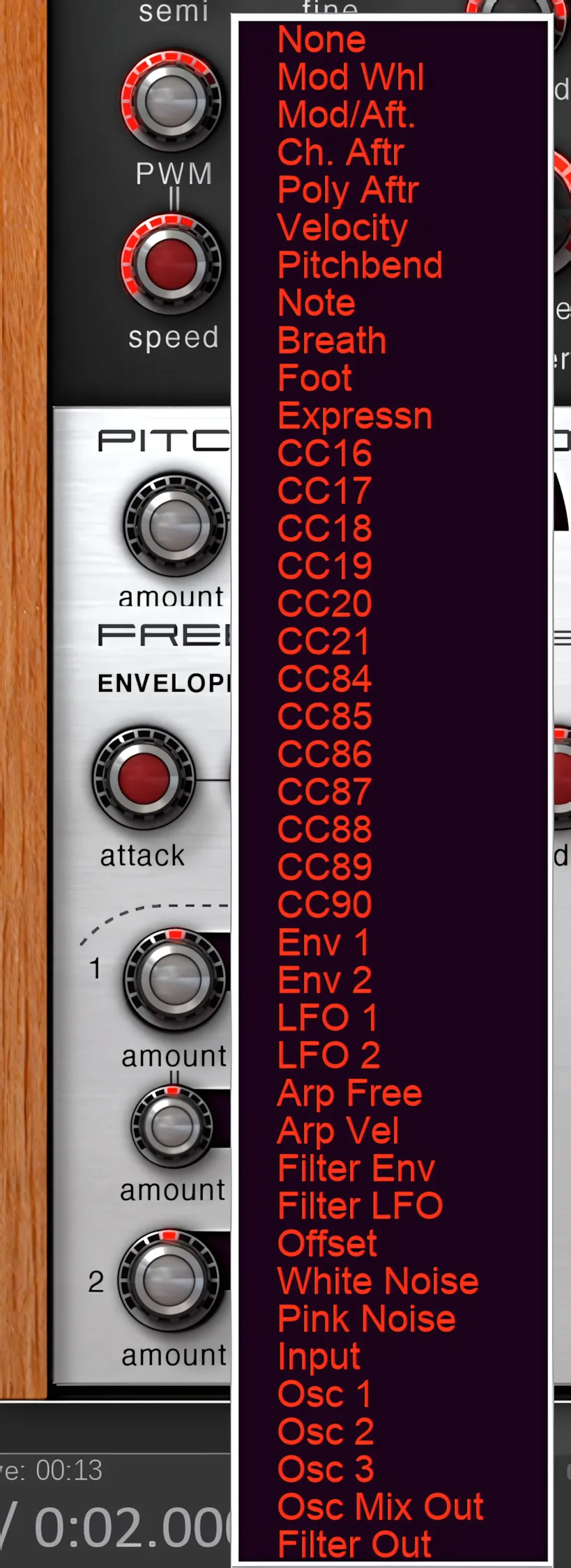
Predator packs a seriously generous modulation engine, boasting 40 modulation sources in total. In the Free Modulation section alone, you can route those sources to an impressive 65 different destinations!
This gives sound designers a huge amount of control over movement, expression, and evolving timbres, making Predator far more flexible than a typical virtual analog synth.
“This section holds two Envelopes, two LFO’s and a Modulation matrix with eight slots. The free modulation section is added to give you extra tools for additional sound shaping options. For instance, if you wish to make an FM synthesis sound you can address the Envelope to the FM amount inside oscillators 2 and 3. Maybe you would like a stereo panning effect by an LFO. Another option is to connect the arpeggiator free or velocity row to other parameters inside Predator.”
The modulation sources are all assignable per oscillator, giving you independent control over each of the three oscillators, and every modulation is fully MIDI-controllable. Thankfully, Predator ships with an exceptionally well-written user manual, because it would take countless extra pages to explain every nuance of this system in full.
Take a close look at the short video below: it reveals just how extensive the modulation and envelope assignment options are in Predator’s Modulation/LFO section. In sum, it showcases a depth of modulation control usually found only in high-end, hardware workstations.
These features include dual five-stage envelopes and a subsequent pair of LFOs; each routes to any available modulation destination. Mirroring the AMP section, users manipulate the five stages of the FREE MODULATION envelope shaping using Attack, Decay, Sustain, Fade, and Release control knobs.
What can the envelopes do?
Located directly beside one another, the “Vel Time” and “KT Time” knobs allow users to determine exactly how the envelope responds to both note velocity and note duration. More specifically, positive values shorten the envelope times for higher notes, while negative values lengthen the envelope response as notes ascend in pitch.
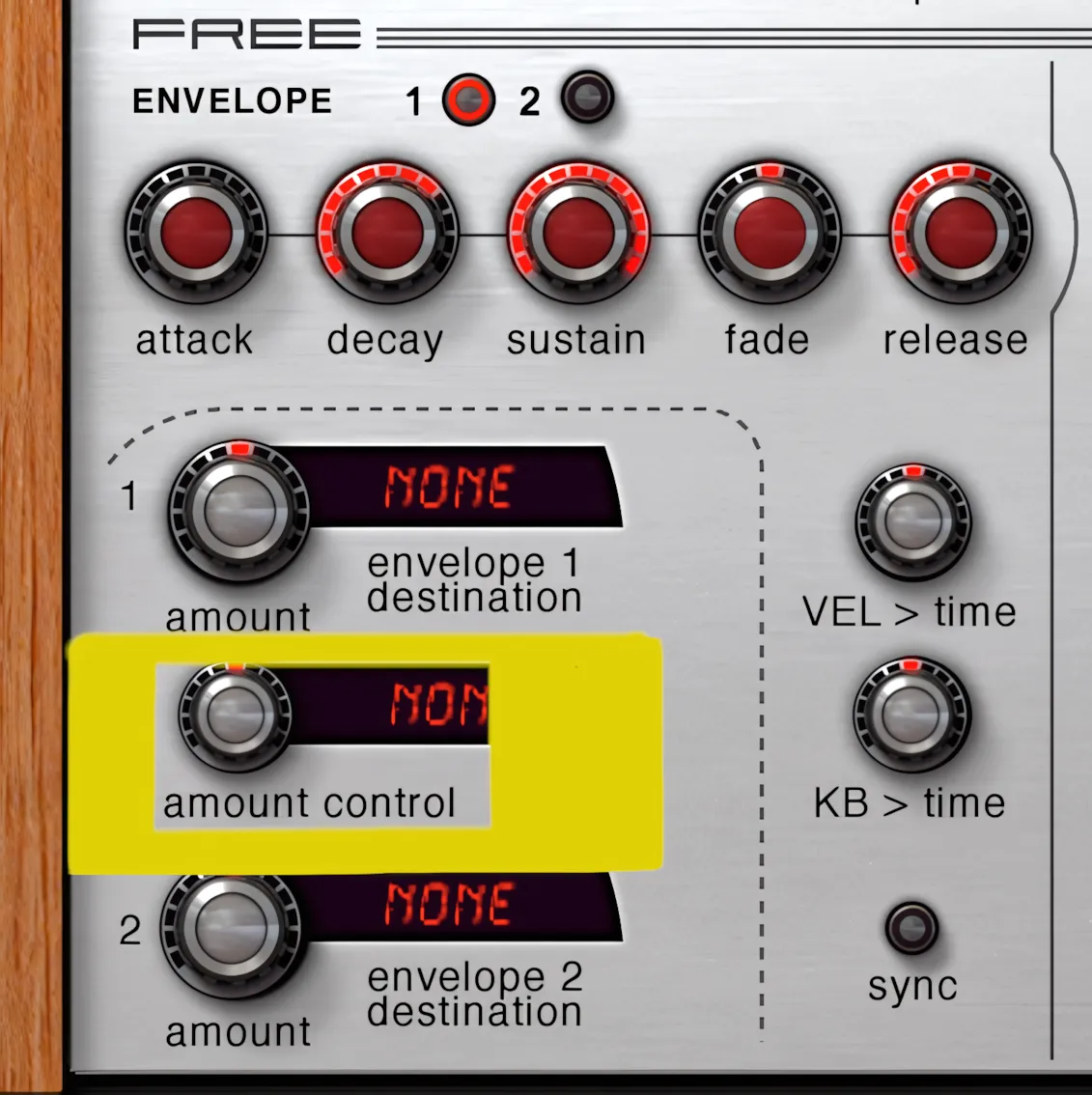
Beyond simple envelope shaping and routing, the instrument also allows users to adjust the overall envelope intensity via the “Amount” knob. Working hand-in-hand with this control, the “Amount Control” parameter lets users select the preferred controller source for manipulating the destination amount in real time.
Admittedly, the architecture might seem a little convoluted at first glance. However, after examining the screenshots below and revisiting this section, the workflow quickly begins to make perfect sense.
Arpeggiator of Continental Proportions:
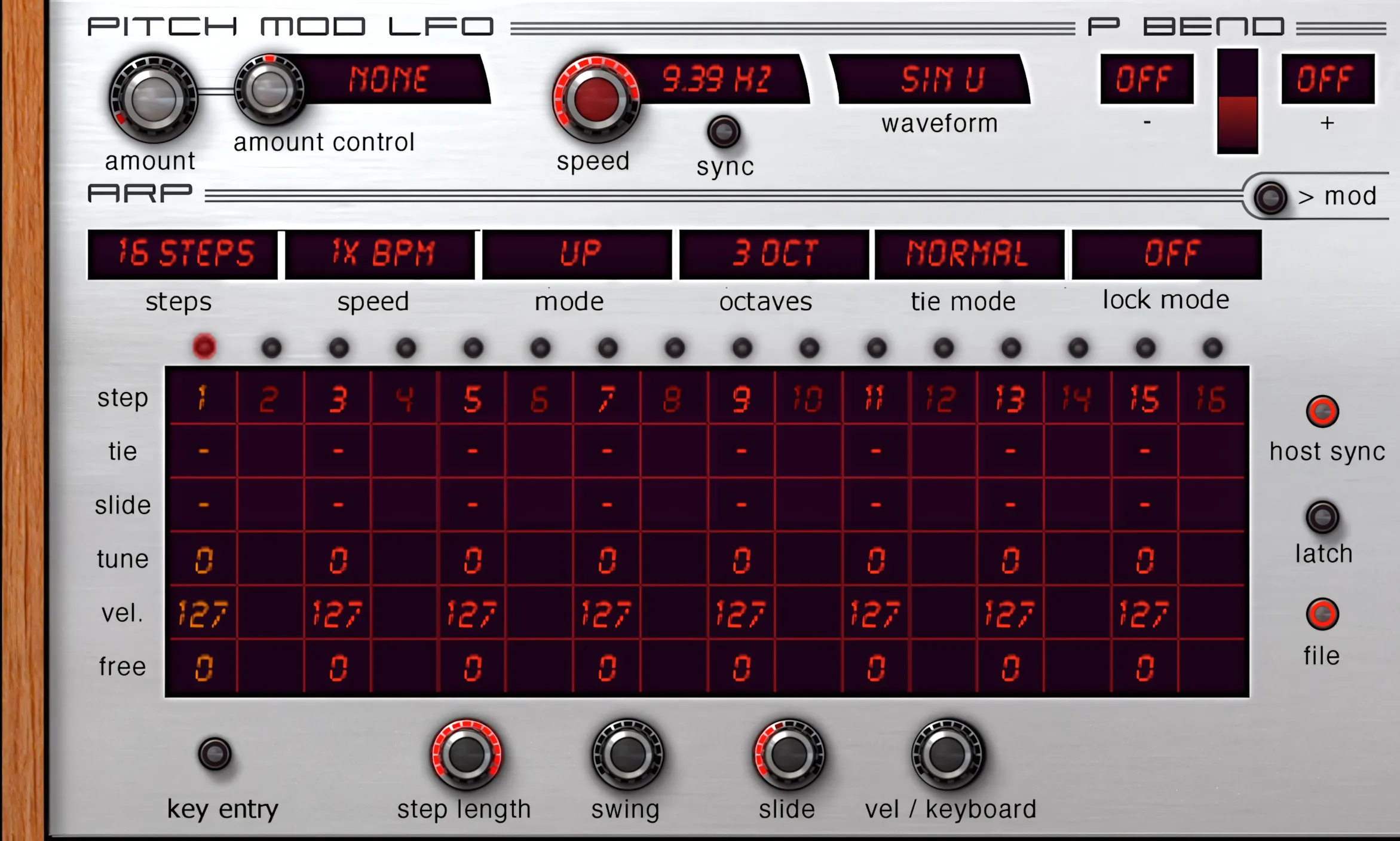
Predator offers a unique and powerful arpeggiator that blurs the line between traditional arp and full-on step sequencer. It’s rich in features, with options to tune individual steps and even tie them. Those functions can be addressed in two different ways for extra flexibility.
You can run it in the classic mode where it plays one note after another while you hold a chord. Alternatively, you can switch to the clever Chord mode, in which full chord shapes are triggered even when you press just a single key.
The built-in sequencer generates highly customized step sequences. For each step, users set the parameters to On/Off, Tie, or Slide, while the step count ranges from 1 to 16. Although the arpeggiator’s speed syncs to the DAW or VST host’s BPM, users can accelerate it to double, triple, or even quadruple the project tempo.
Furthermore, the arpeggiation direction becomes fully assignable: Upward, Downward, Random, Up/Down, Down/Up, Ordered, or Reverse Ordered.
In the Up/Down and Down/Up modes, the arpeggiator plays the notes in sequence then reverses direction immediately. Meanwhile, “Ordered” mode arranges notes from lowest to highest, whereas “Rev. Ordered” forces the arpeggiator to play them from highest to lowest.
Multiple Octaves:
The arpeggiator allows users to configure playback across multiple octave ranges with impressive flexibility. For example, when you set the octave range to “2,” the arpeggiator first plays the notes in their original register and then repeats them one octave higher for as long as the chord remains held.
More interestingly, the arpeggiator can also function as a “Free Modulator” within the FREE MODULATION section. As a result, users can create highly inventive rhythmic gating effects, animated filter sweeps, and a wide assortment of evolving modulation patterns.
In addition, the Tie modes — ‘Normal’ and ‘Special’ — introduce even deeper programming possibilities by enabling Slide, Tune, Velocity, and Free parameter settings within any step configured to use Tie arpeggiation.
Sound Quality:
Mr. Rich Fabrizio has publicly described Predator as a “super silky” sounding synth, and that’s absolutely on point. Pred doesn’t come across as a virtual-analog wannabe desperately trying to impersonate a vintage hardware classic. Instead, it confidently delivers rich, wide, modern tones with a character all its own, while still nodding respectfully to the great analog synths of the past.
Its detailed sonic palette feels like a tribute to the grand masters of analog history. With cheetah-like agility, Pred can leap from deep, mellow basses to lush, breathy pads, then straight into pulsing arp basslines and tasty, ear-grabbing effects without breaking a sweat.
It takes little effort to sculpt sophisticated sounds from Predator. Once users master Pred’s intuitive workflow, they find spicy digital textures just a few clicks and drags away. Crucially, they achieve this without getting weighed down by obscure parameter navigation or sinking into the quicksand of convoluted menus.
Thanks to its vast waveform spectrum, oscillated PWM, and assignable modulations, this synthesizer covers extensive ground—and does so with precision.
The more I experiment with Predator, the more I become captivated by the genuine warmth and shimmering character it produces. At the same time, Pred can just as easily unleash an aggressive growl with astonishing authority. When pushed harder, the synth becomes downright vicious, asserting its predatory presence with a dark, commanding roar.
In my view, Predator serves as an exceptionally effective bridge between the world of virtual analog synthesis and the expansive realm of modern digital additive and subtractive electronica.
High Quality LFOs and Oversampling = High Quality Sound
The herd of LFOs, filters, high-pass filters, effects, modulators, and envelope shapers are all absolutely top-notch. Thanks to clean, well-implemented oversampling under the hood, Predator’s sound stays clear, smooth, and free from harsh, unwanted digital grain, even when you’re pushing it hard with modulation and effects.
Predator unleashes deep, searing trance pulses and piercing glitches with aggressive precision. It dominates the mix with formidable Dubstep presence. Yet, this same beast yields to the player’s touch, laying down peacefully blissful ambient pads. To label the Rob Papen Predator merely “versatile” would be a grave understatement.
Audio Snippets:
Audio Snippets:
CPU Consumption:
I happily report that Predator conserves CPU and memory resources remarkably well. Admittedly, engaging all three effect slots alongside higher oversampling rates increases the system load noticeably. Nevertheless, this instrument delivers fantastic performance without breaking your budget or overloading your computer. Grin. Five stars!
Extra Value:
The complete collection of 21 different filters, modulators, vocoder, and effects is also available as a dedicated VST or AU plug-in, cleverly named “PredatorFX.” This means that when you purchase the Predator / EDM / Urban bundle, you are not only getting a superb soft synth, but also a high-quality suite of tasty, musical effects.
Better yet, PredatorFX can be used on any instrument or vocal track inside any compatible DAW. This turns the whole bundle into a powerful sound-design and mixing toolbox, not just a synth purchase.
Concluding Remarks:
During my journey into synthesizers, I realized that this realm fosters both goodwill and vehement disagreement. Much like Coke vs. Pepsi enthusiasts, or Mac vs. Windows debaters, many synth owners defend their chosen instruments with fierce loyalty.
In short, as a “non-synthesist,” I position myself as a truly objective third party. True, I enjoy playing synths and experimenting with them, yet I am fundamentally a guitarist and singer who happens to play keyboards as well.

Some might deem me unqualified to assess a synthesizer properly, yet I have mastered a great deal about them over the past few years. Fortunately, I remain free from the bias of being an ardent fan of any single brand or developer.
Instead, I trust my own ears: I love classic VA synth sounds. Specifically, the Oberheim OB-X stands as my personal all-time favorite. I also cherished the sounds of the Yamaha CS-80, the Roland D-50, and the Juno series.
To my ears, many of Predator’s presets and features immediately evoke memories of several of my long-time favourite synths. At the same time, however, the synth also made me feel like a modern club kid as I explored its edgy urban, industrial, and rave-inspired textures.
Better still, Predator refuses to stay confined within polite sonic boundaries. When called upon, this thing can become absolutely feral — twisting into bizarre tonal territory and screaming like a banshee with unapologetic intensity.
5 out of 5 Stars


:: Pros
- Excellent value when purchased as part of EDM or Urban bundle.
- Vast range of High Quality, envelope shapers, LFOs and modulators.
- Three powerful oscillators.
- Easy-to-use and intuitive work-flow.
- Attractive, professional user interface.
- Comfortable GUI dimensions and easy-on-the-eyes colors.
- HUGE assortment of categorized presets.
- Industry-leading Arpeggiator.
- Versatile synth that can be made to sound Super Klean, or Gritty and Tough.
- Comprehensive and well-written user’s manual.
- Prompt, professional product support.
- No dongles, call/response challenges.
- 32 & 64 bit (MAC & PC) VST, AU & RTAS
::Cons
- Not as ‘analogue’ sounding as some other VA synths.
- No choice to select individual instruments during bundle installation.
Visit the Rob Papen website. RobPapen.com
Intellectual Copyright – 2013 – All rights Reserved. This review may not be copied or reproduced in whole, nor in part, without express written permission from the author.

Leave a Reply