
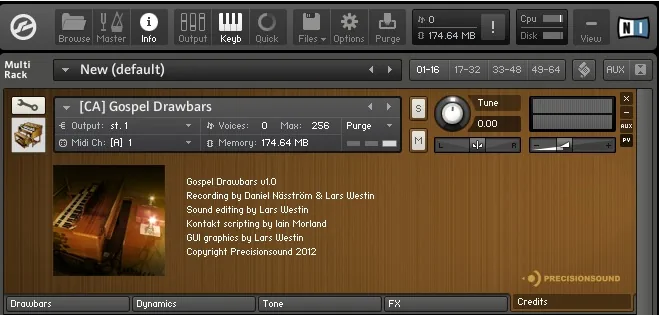
What is PrecisionSound Gospel Drawbars?
Gospel Drawbars emulates authentic Hammond organ sounds in Kontakt sample library format. It models the Hammond AB, one of the earliest Hammond organ models, circa late 1930s. This is one to carefully consider if you are looking for authentic vintage Hammond organ sounds, particularly for Gospel, Jazz, and Soul music production. In this deep-dive PrecisionSound Gospel Drawbars review, we’ll find out if it offers hands-on control over the instrument’s harmonic spectrum, similar to playing a real Hammond organ.
Here are some key features:
- Authentic vintage tone: Captures the characteristic sound of early Hammond organs used in gospel music
- Four drawbar-control tabs: Allows users to shape the harmonic content and tonal character
- Three full keyboard layers: Provides variety in voicing and texture
- Over 10 organ variations: Multiple preset configurations for different musical contexts
- Extensive presets: Includes many jazz and bass presets alongside the gospel tones
- 24-bit resolution: High-quality audio sampling
Introduction:
Various developers have launched several notable Hammond organ sample libraries and virtual instruments over the past decade. While some of these releases triggered widespread yawns of disinterest, a choice few commanded our absolute attention.
Now, I am excited to introduce the latest masterpiece from Sweden’s masters of sampling, Precision Sound: the extraordinary, “Gospel Drawbars.” This ear-tickling sample set delivers pure sonic inspiration, and you can load it directly into both NI Kontakt and Logic EXS24.
PrecisionSound has consistently delivered respectable sample sets in various formats since 2003. With each new release, the company clearly hones and refines its sampling processes. In fact, the moment I loaded this 1 GB sample set into Kontakt 5, I knew immediately that it shattered the mold of the typical, mediocre virtual Hammond wannabe.
Ultimately, you must experience the depth and richness of this authentic tonewheel sound to truly understand its power.
What makes this Hammond Organ library so different?
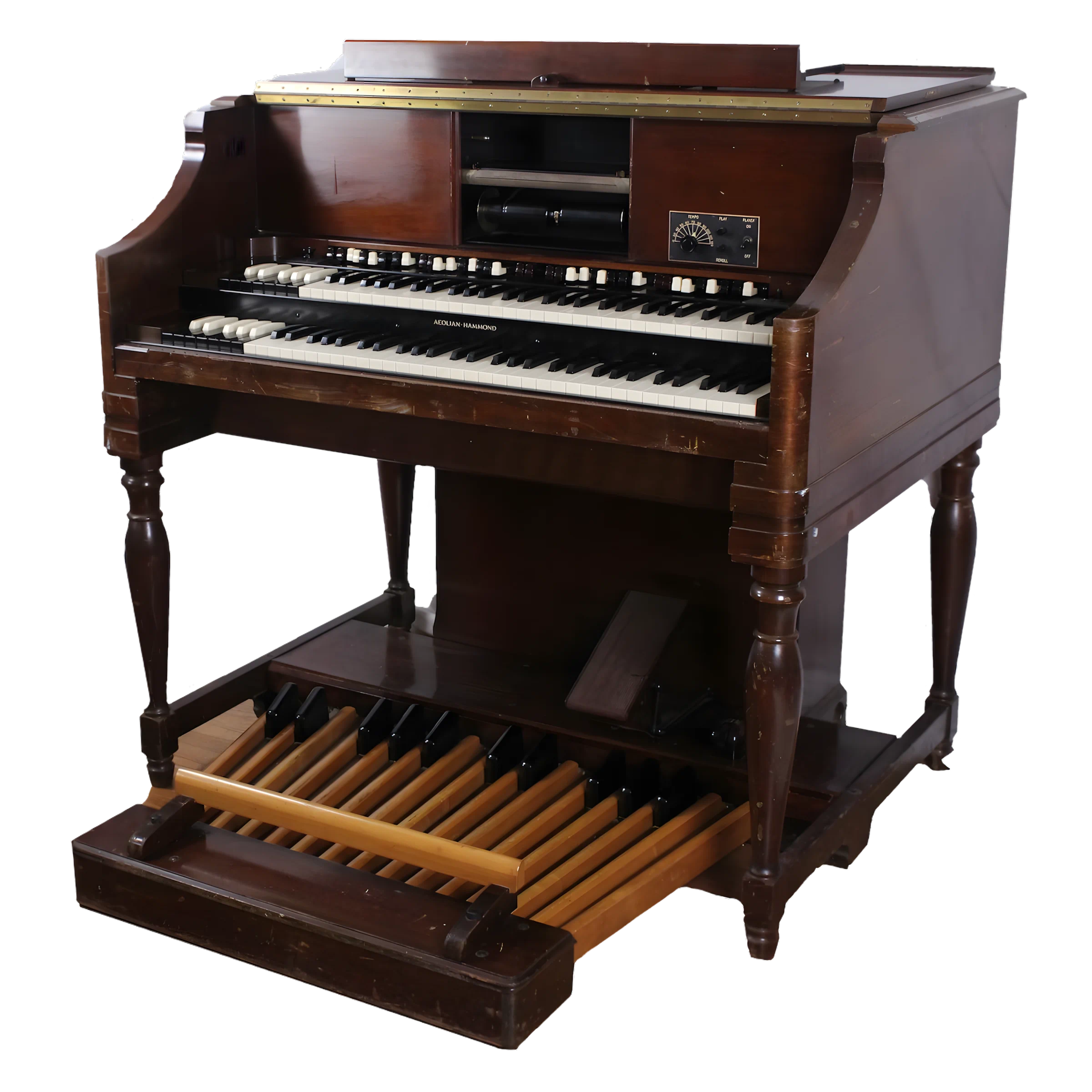
Gospel Drawbars shuns the typical B3 clone blueprint. Instead, it delivers a meticulously recorded, rare, pristine Hammond AB organ from 1937. As Hammond’s second historic offering, the AB stands as the direct ancestor to the legendary B3/C3 line. Consequently, this sample set absolutely overflows with vibe, character, and vintage charm. For just $69 USD, this deal almost defies belief, delivering one of the most unique Hammond organ experiences “in the box.”
Licensing and Authorization:
First off, if you already own Kontakt 3, 4, or 5, you have already bypassed the entire authorization process. Because PrecisionSound designed Gospel Drawbars as a nimble sample set rather than a formal, locked library, you face zero registration headaches.
The package contains over 950 stereo WAV files, which the developers recorded in pristine 24-bit/44.1kHz audio. Furthermore, PrecisionSound prepackages 22 distinct drawbar settings as standard .nki files, allowing you to instantly load presets into Kontakt and start playing immediately.
Immediately after purchasing the product, PrecisionSound emails a secure download link for the ZIP archive. This same email provides the necessary encryption password, which effectively acts as your unlocking code. Once you extract that initial folder, you will find a secondary RAR archive that opens instantly without requiring an additional password.
Visuals:
Gospel Drawbars grants you deep control over the instrument’s sound and behavior through four intuitive tabs: Drawbars, Dynamics, Tone, and FX.
Visually, the medium brown motif channels a decidedly “wooden” aesthetic, perfectly mirroring the classic materials of the physical organ.
Hi, you! If you like these kinds of reviews,
be sure to subscribe.
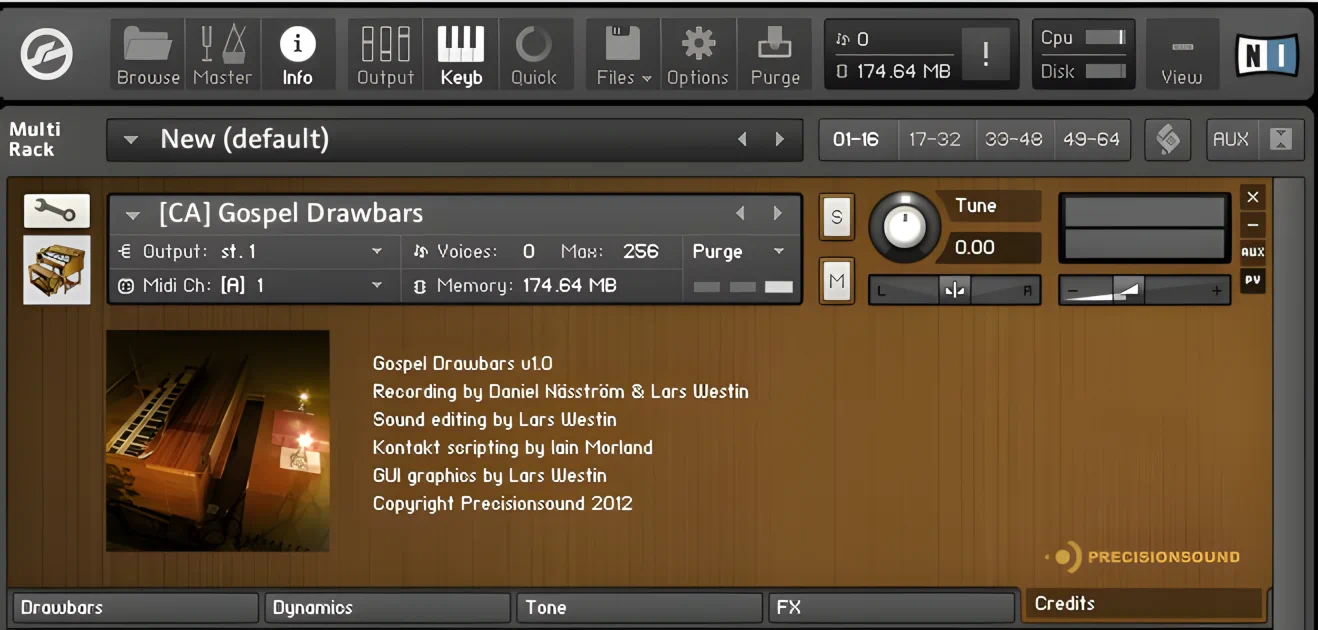
When it comes to operation, the virtual knobs respond smoothly to your mouse. Holding “Shift” during a click-and-drag allows you to dial in finer, precise settings. Finally, if you need to reset any control to its factory default, a quick “Ctrl + click” instantly snaps the knob back into position.
Drawbars
This panel features two operational modes: “Stack” or “Split.”
Stack mode combines both sets of drawbars. Conversely, Split mode forces each keyboard region to use individual drawbar settings. Generally speaking, I prefer “Stack” mode because it offers the most usability. In contrast, the predefined drawbar settings restrict your options too much. Specifically, they only utilize two, three, or four drawbars per slot.
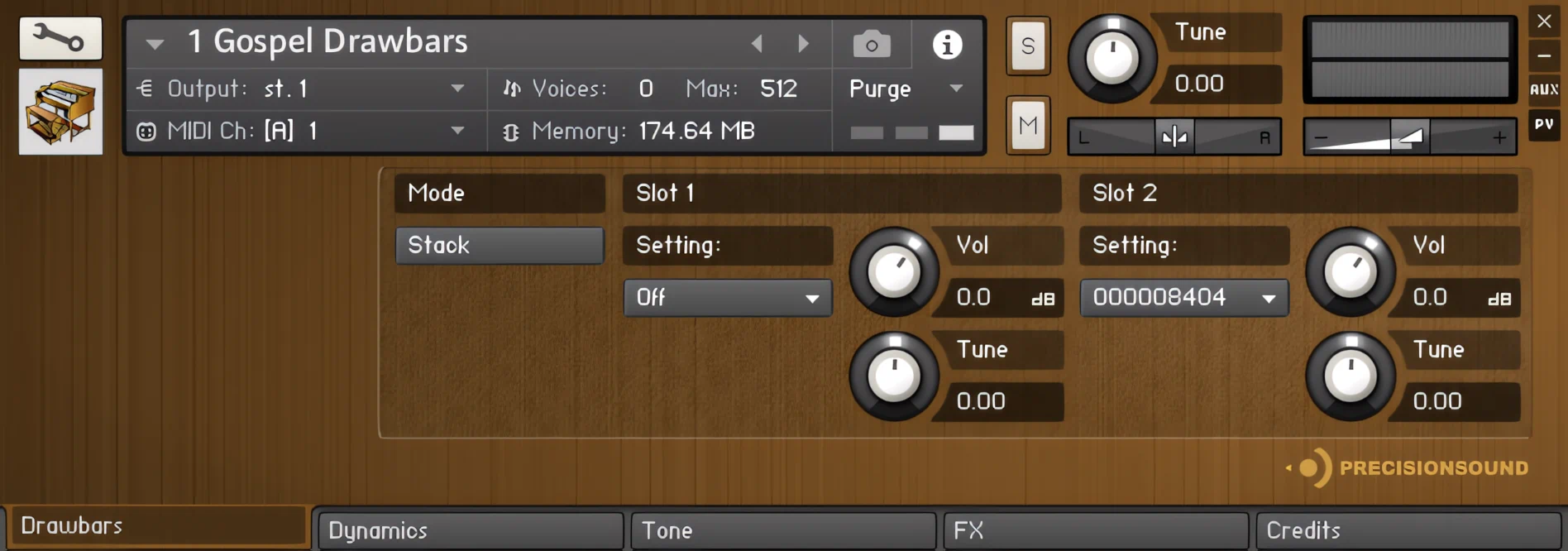
Speaking of slots, the system assigns a dedicated slot to each organ manual. Each slot features independent volume and tuning controls. Furthermore, every slot offers 10 drawbar settings alongside an option to mix in bass pedal sounds.
When you run the sample-set in split mode, you can adjust the split point up to C5. You can also configure the second slot to use sounds one or two octaves lower. This adjustment prevents the tone from sounding too shrill.
Finally, the system hard-maps the bass pedals to the lowest octave range of the keyboard, specifically from C0 to B1.
Dynamics
The Dynamics tab provides basic envelope-shaping control through “Attack” and “Decay” knobs. At default settings, the instrument delivers a pleasant, well-defined percussive quality. Naturally, you can mellow out the sound completely by increasing the Attack and Decay times.
Additionally, the “Release” levels knob lets you dial in the key-off sound to taste. Because the default value of -12 dB sounds a bit too strong, I prefer to lower it by another 3 or 4 dB.
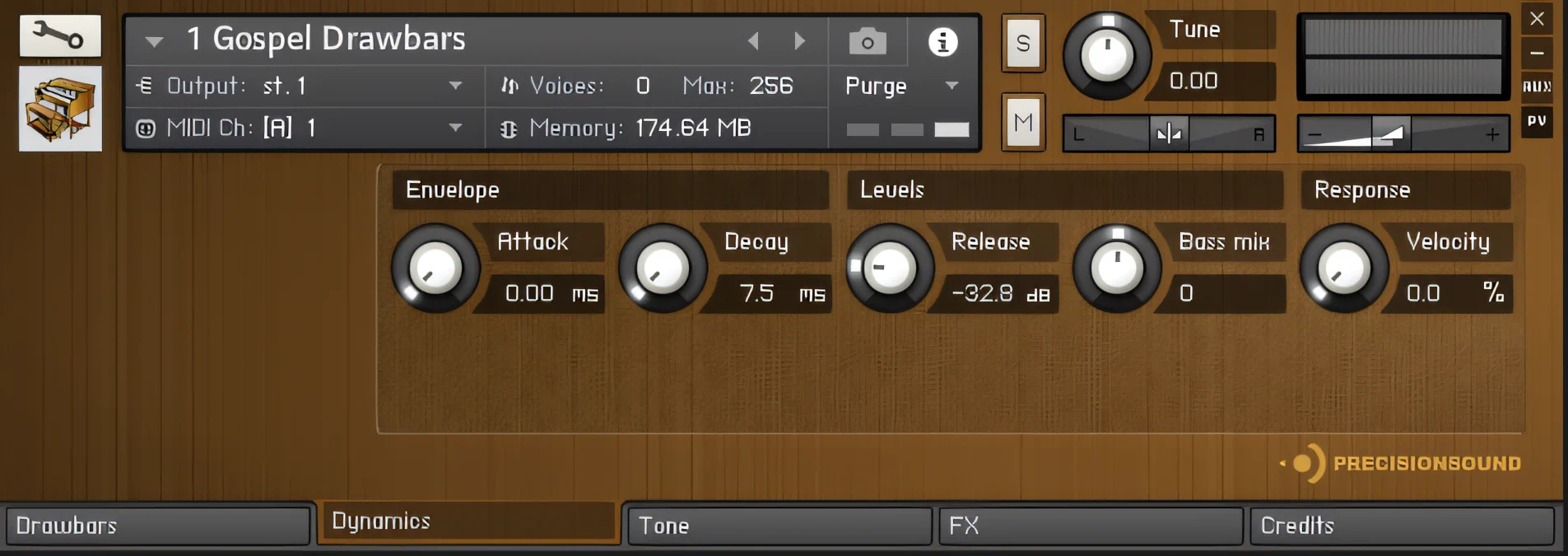
The “Bass Mix” knob blends the ratio of Pedal 16 within a -/+ 12 dB range. Rotating the knob fully counter-clockwise (-12 dB) isolates the Pedal 16 tones. Conversely, turning the knob fully clockwise (+12 dB) outputs the MixturPedal alone. For an equal blend of both sounds, simply leave the knob at its default center detent.
Finally, the “Response” knob determines how the instrument responds to keyboard velocity. At 0 percent, keyboard velocity and playing dynamics do not affect the organ’s behavior. In contrast, adjusting the knob to 100 percent creates a more piano-like dynamic response. While the default sits at 0, adding a small percentage of velocity sensitivity contributes a wonderful degree of expressiveness.
Tone
This section gives you basic, three-band EQ control (-/+ 6 dB), Stereo-width parameters, and Rotator adjustment. Though subtle, the EQ effectively smooths and tweaks the instrument’s basic tone.
PrecisionSound recorded the sampled Hammond AB organ through a vintage Leslie cabinet in stereo at slow rotation. Consequently, this sample-set produces a rich, expansive “chorale” sound.
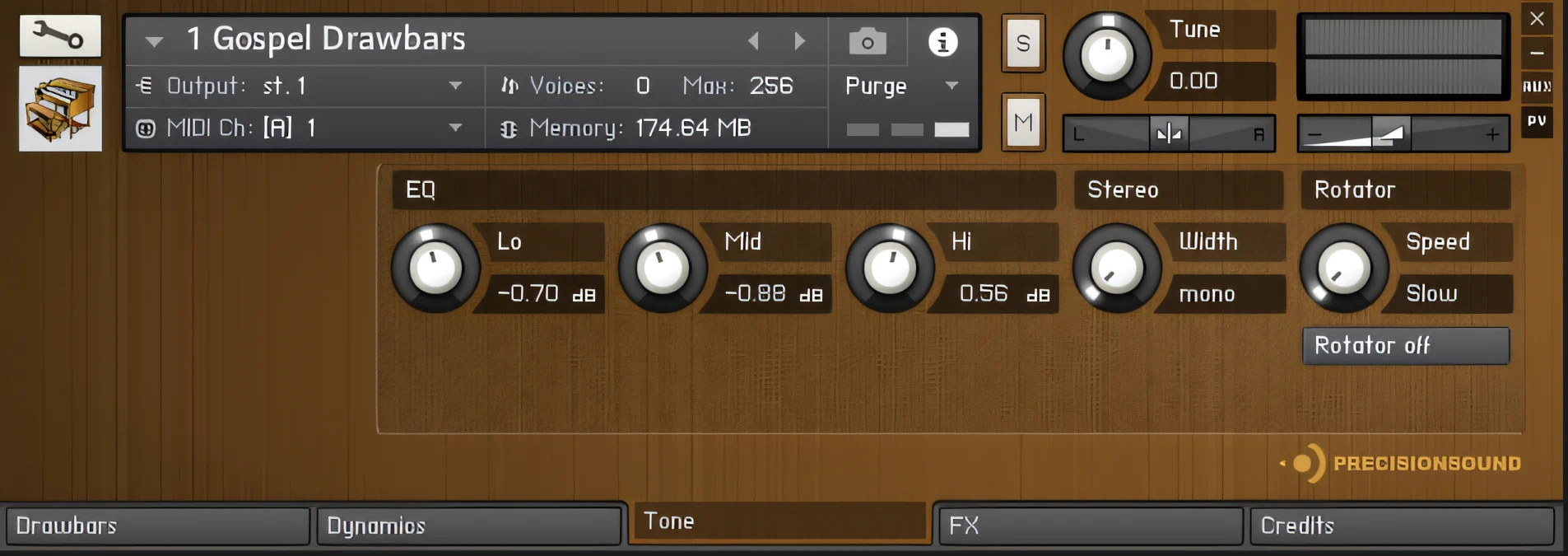
Furthermore, I agree completely with PrecisionSound’s advice to set the Stereo knob to “mono” when using a Leslie effect. This rule applies to both the built-in Kontakt rotator effect and external Leslie emulations. For example, it works quite well with the fantastic LX122 Premium by Xils Lab.
FX:
The team at PrecisionSound included a fantastic bonus with this virtual organ. They provided a set of Impulse Response (IR) files from the coveted Bricasti M7 collection by Acousticas.
Each of the 13 IRs sounds spectacular. They range from Halls, Cathedrals, and Rooms to Plates and my personal favorite, Spring reverbs. In particular, the “Rusty Spring” IR will surely catch the attention of any real Hammond player.
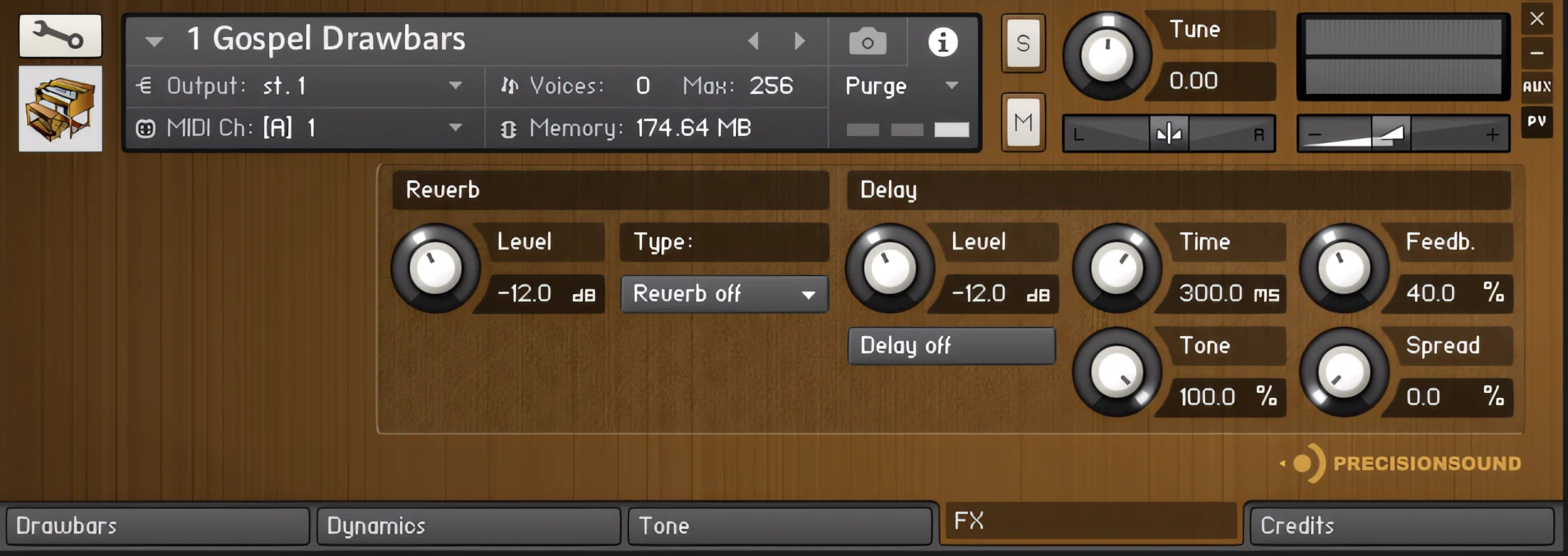
The excellent Delay feature places Delay Level, Time, Tone, Feedback, and Spread controls directly on the panel. Native Instruments’ Kontakt engine famously includes exceptionally high-quality effects, and this Delay effect proves it perfectly.
Furthermore, this tool solves a common mixing problem. If a reverb adds too much density to your mix, the Delay effect offers a great alternative. Delay adds movement and body to the sound without cluttering the frequency space.
Sound Quality:
We are finally getting to the good stuff! This instrument sounds rich, lush, deep, and absolutely drips with vintage tonewheel character. Furthermore, the upper notes prove that this sampled organ is over 75 years old.
I can definitely hear some old tonewheel leakage, and it sounds super cool! In fact, this specific leakage makes you want to play. If you love real Hammond organs, I promise that this sample-set will become one of your go-to software instruments.
The lower register delivers a full, round sound packed with cozy harmonics. Meanwhile, the upper end exhibits incredible zeal and inspiration. If you master the drawbar combinations, tonal adjustments, and octave settings, this instrument will reward you.
Specifically, the “Gospel Drawbars” organ produces incredibly expressive and satisfying sounds. It sounds old, yet timeless. Ultimately, I consider this library a “Stradivarius” of virtual Hammonds.
I own and play multiple virtual Hammonds. As an active Gospel Hammond player, I long considered GSI’s “VB3” the absolute best option available. I also admire NI’s “B4 II”, NI’s “Vintage Organs”, and UVI’s “Retro Organs.”
Nevertheless, my jaw dropped the moment I played a 3-6-2-5 progression on this Hammond AB sample-set. I immediately followed it with a hybrid blues minor/pentatonic run.
I have one peeve though, and it’s a big one.

Gospel Drawbars sounds great, there’s no denying it. However, it also quickly disappoints for its lack of fast Leslie samples. Simply put, everything begins to sound phasey and somewhat garbled once you process the library through a Leslie plugin. So, as long as you’re content with the original slow (chorale) samples, you’ll be very pleased.
I strongly recommend that PrecisionSound revisits the original instrument and records a complete set of fast (tremolo) Leslie samples. Creating a Kontakt library that smoothly transitions from fast to slow Leslie tones will be very difficult, but doing so would make the instrument far more playable and useful.
CPU Consumption:
The library uses a typical, manageable amount of CPU and memory. Most 24-bit/44.1 kHz Kontakt samples run smoothly on most nearly any up-to-date computer. In my typical recording projects, I often load eight to ten Kontakt libraries at once; though they don’t all play at the same time. My current production system runs on a humble 2nd‑gen Intel i3 dual‑core CPU.
Story: How I discovered PrecisionSound
I discovered PrecisionSound while searching for an authentic-sounding vintage “Mark II Rhodes” sample library. Until then, I hadn’t encountered this impressive company. I’ve long treasured the Scarbee Vintage Keys Collection, which includes the Rhodes Mark I, Wurli A-200, Hohner Pianet-T, and Hohner D6 Clavinet.
Yet I needed something more—a truly exceptional Rhodes Mark II library to complement my beloved Scarbee (Native Instruments) VK collection. That’s when I found the PrecisionSound website, and everything changed.
The PrecisionSound website eschews flashy design, yet this understated aesthetic actually works. At first glance, I dismissed PrecisionSound as a niche operation run by passionate eccentrics. Then I discovered the “Dusty Electric MK II” link—and everything shifted.
The audio samples captivated me. I watched the YouTube video with genuine excitement. I purchased it immediately, especially since the 50% sale made it irresistible. Remarkably, that modest library became my go-to Rhodes Mark II sound ever since.
“Funky Electric P 200” immediately captivated me as well. This superb collection nails the legendary Wurlitzer A-200 electric piano with stunning authenticity. I kept buying PrecisionSound libraries—and I haven’t stopped. Each sample-set earned its permanent spot in my in-the-box instrument collection. They’ve transcended mere experiments. They’ve become absolutely essential to my sound.
Yes, PrecisionSound seems to embody “artsy-fartsy” sensibilities—and I celebrate them for it. Their instruments defy convention. Each one radiates distinct character, vibrant color, and infectious charm. They prioritize uniqueness over mass appeal, and that commitment shines through every sample-set.
Concluding Remarks:
When I discovered the “Gospel Drawbars” announcement, I felt pure elation. The anticipation consumed me like a child spotting a gleaming bicycle in the backyard on graduation day. I couldn’t contain my excitement. This wasn’t just another release—it represented exactly what makes PrecisionSound so captivating.
I have two suggestions for PrecisionSound to consider.
First, I’d urge them to include organ samples with the Leslie set to “fast” rotation. The current organ samples absolutely shine with exceptional quality. Yet the collection would gain tremendous depth if PrecisionSound also captured the Leslie operating at fast speed.
Here’s my vision: release “Gospel Drawbars II” incorporating key-switched Kontakt scripting. This approach would let players seamlessly transition between slow and fast Leslie rotation samples. This strategy outperforms relying solely on Kontakt’s built-in Rotator effect, which can’t replicate the authentic mechanical nuance of the real thing. Such a release would elevate PrecisionSound’s already exceptional standard even higher.
Second, PrecisionSound must implement user-adjustable drawbars. This represents a critical leap forward. Predefined settings simply don’t serve serious musicians. Real Hammond players demand the power to adjust drawbars in real-time. They shape their tone dynamically, and PrecisionSound’s interface should honor that creative control.
If real-time adjustments exceed current technical scope, finer harmonic controls would prove essential. This single enhancement would dramatically unlock the library’s creative potential. The difference between good and exceptional instruments lies precisely here—in giving musicians true sonic agency.
4 out of 5 Stars


:: Pros
- Deep, rich, expansive true-to-form Hammond organ sound.
- Good Price vs. Value ratio.
- Huge degrees of vintage tonewheel organ charm.
- Built-in drawbar presets offer a good variety of tones.
- Smooth, easy-to-adjust knobs.
- Easy-to-use GUI layout.
- User’s manual available in PDF.
- Friendly, proactive product support.
- Light on CPU and memory.
::Cons
- The inclusion of fast (Tremelo) Leslie samples are needed to complete this otherwise excellent instrument.
- User-adjustable drawbars would take this sample-set through the roof.
- The drawbar presets are a little bit limited. More drawbar presets, using a wider range of drawbars would be helpful.
Visit the PrecisionSound website. Store.PrecisionSound.net
Intellectual Copyright – 2013 – All rights Reserved. This review may not be copied or reproduced in whole, nor in part, without express written permission from the author.

Leave a Reply