
What is LX122?
Xils-Labs’ LX122 emulates the famous Leslie rotating speaker cabinet – used primarily with Hammond organs and keyboards – that creates a distinctive Doppler effect through rotating horn and drum components inside a wooden cabinet. In this Xils-Lab LX122 Premium Review, let’s see just how good it is.
Key features:
- True Stereo Dynamic Engine – Simulates room ambiance and how different spaces affect the sound
- Detailed controls – Adjust drum-ribbon age, horn diameter, and a “Diffuser Out” control that mimics removing the horn’s metal grille for a darker tone
- Room modeling – Various small-to-large room environment simulations
- Tube amplifier character – Emulates smooth, tube-based amp warmth
- Both the rotating horn and drum components are modeled
Intro
Many software developers have produced Leslie cabinet emulators for admission to the rotator roster: Amplitude’s “Rotary 147”, Native Instruments’ B4 & Vintage Organs built-in Leslie sim, Guitar Rig’s “Rotator”, and “Spinner(LE)” from fxPointAudio are all worthy of mention. Most Hammond/Leslie aficionados will nod in unanimous agreement that GSI’s VB3fx has been the bar by which all other software Leslie clones must be compared with.
Until now.
Xils Lab’s new LX122 and LX122 Premium VSTs are, in this reviewer’s opinion, a couple of the better ITB virtual Leslie cabinet emulator(s) available. When I was first informed that this new heavy-weight prospect was poised to enter the Leslie cabinet championship ring, I was dubious.
As an ardent and faithful admirer of GSI’s VB3, I was intrigued, whilst skeptical, that any product could possibly sound as good — let alone sound better. VB3’s proven TKO record breaking run, due largely in part to its built-in Leslie cabinet simulator, has struck a chord of wariness in any would-be contender.
Weighing in at the MSRP of 69€/$88 USD, this upstart contender for the Leslie emu championship belt is available for a small introductory price of 45€/$58 USD. LX122 Premium is only available until December 5th, 2012, at this incredible welter-weight price.
Stick n’ stay. It will be exhilarating to see just how well this new entry into the illustrious championship VST ring fairs off. If you’re a serious Hammond/Leslie aficionado, you won’t touch your browser’s “back” button until you’ve carefully read this concise, 12 round review in its entirety.
Visuals:
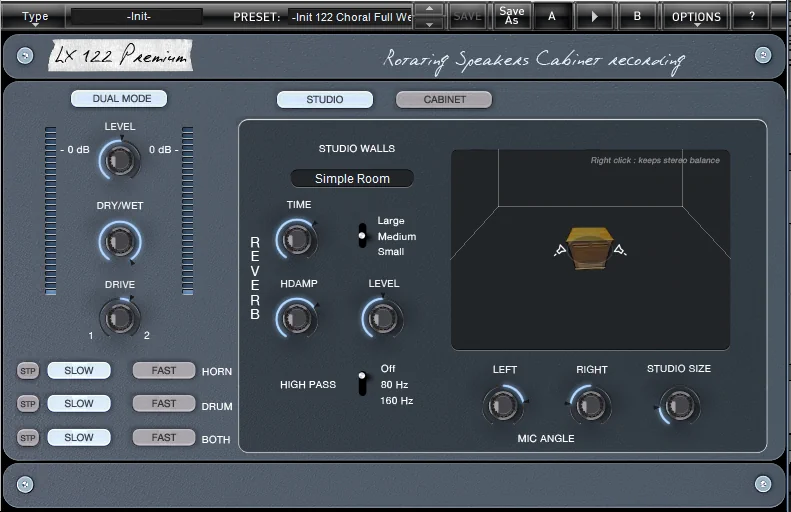
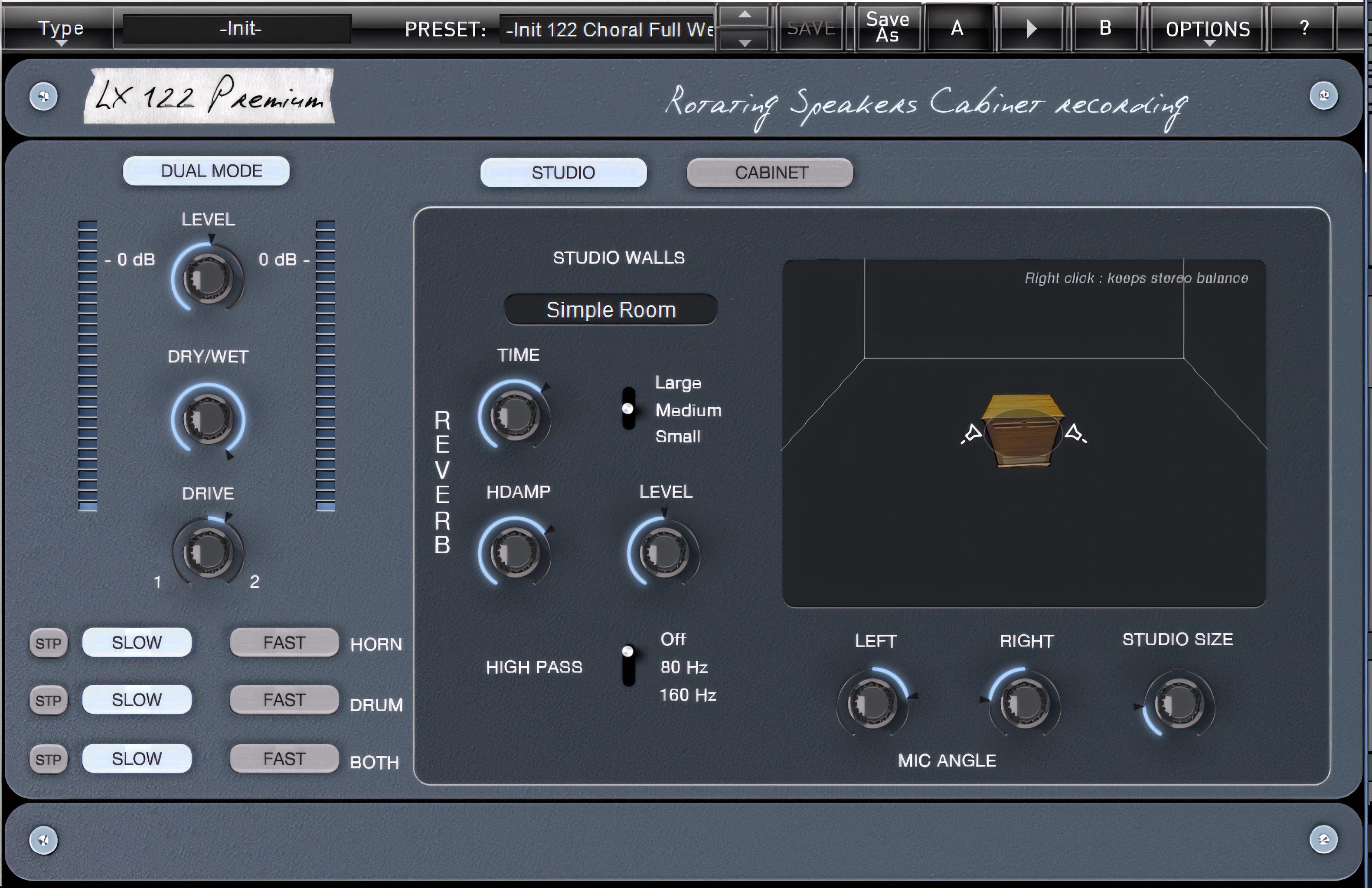
The plugin presents a solid, easy-to-view GUI that provides a lean, well‑laid‑out workspace. The interface offers comfortably sized dimensions of 780px by 520px. The GUI appears intentionally styled to resemble a metal amplifier panel on the rear of an old Leslie cabinet, rather than mimicking the wooden cabinet itself. However, there is a simple 3D perspective of a wooden Leslie cabinet in the mic/room configuration window.
The charcoal-colored knobs show up clearly against the slate-grey background. All controls are clearly labeled in moderately sized, antialiased white sans serif text. The labels all maintain typical naming conventions and make sense to anyone who’s even slightly familiar with Leslie cabinet configuration. Clean, clear, legible and straight forward – just the way we like it.
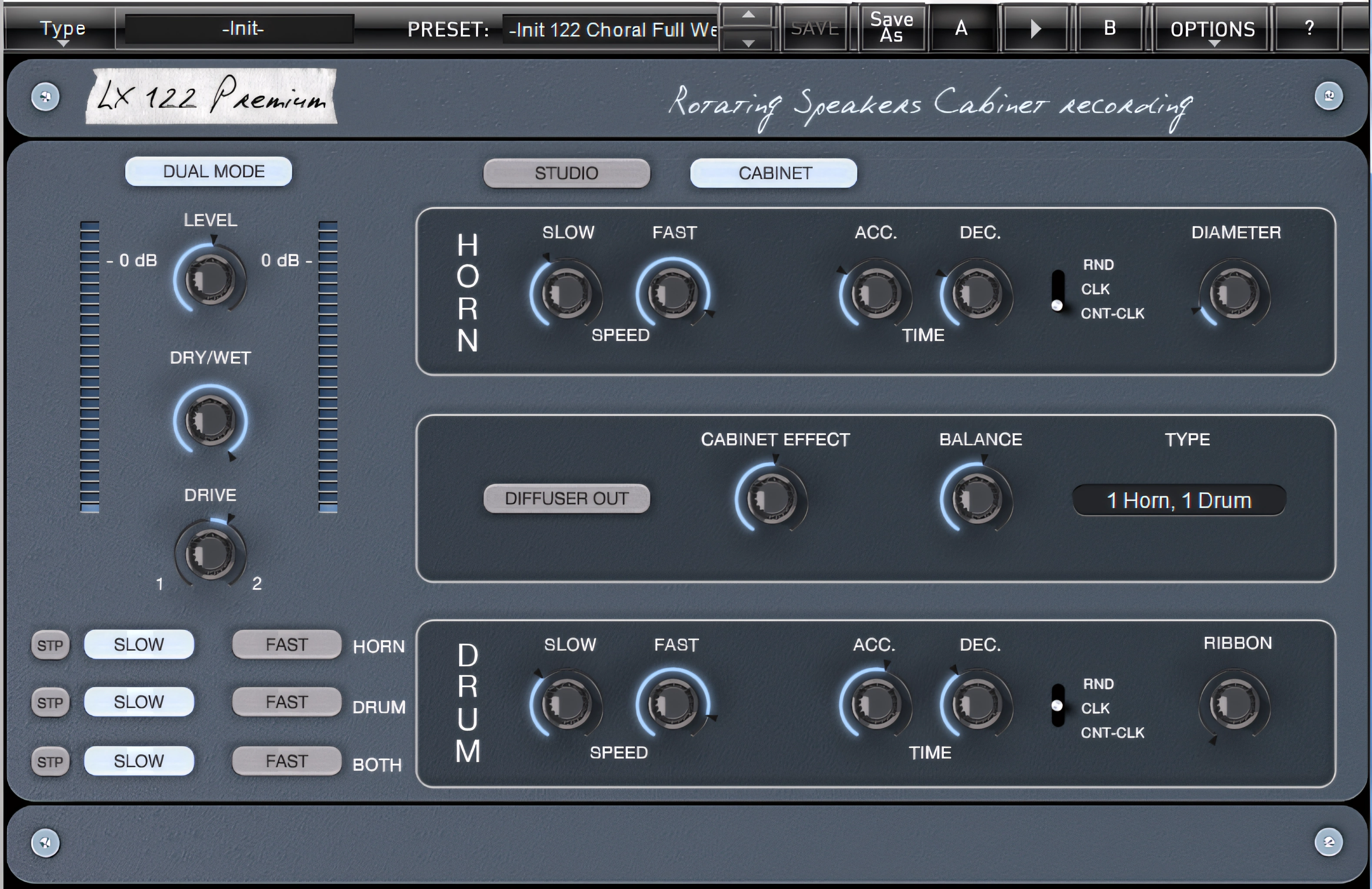
In this reviewer’s opinion, the developer’s choice of color and GUI design infers strength and reliability – just like a real (140lb) road-tested Leslie 122.
But . . .
Is there real, honest-to-God quality under this solid, attractive interface, or is this simply a case of marketing gymnastics and just a pretty face?
Hi, you! If you like these kinds of reviews,
be sure to subscribe.
Stereo Imaging and Depth Perception:
How wide do you want to go with the sonic imaging of a rotator cabinet?
Imagine placing your stereo speakers next to the far most walls, and the sound still extending beyond those points. This ‘thang’ can create a swirling, pseudo “3D ish” impact so wide that you might find yourself ducking; the massive boomerang stereo/surround effect is quite convincing.
Xils Lab’s proprietary 64‑bit processing, branded as the “True Stereo Dynamic Engine” (TSDE), takes conventional stereo imaging and reinvents it with some serious programming muscle behind the scenes.
Microphone Placement:
Deep, baby, deep. Go ahead – place your microphones all the way against the back wall if you want. The cabinet itself is effectively “placed” in the center of a virtual room. This musical marvel is amply supplied with FOUR virtual rooms; Simple, Medium1, Medium2, and Complex. Each convincing room algorithm is configurable in small, medium or large sizes. Beyond that, you can manipulate a virtual room’s width via the “studio size” knob. (Please note: the most realistic reverb/room option, “Complex” is more CPU intensive.)
Convenient click/drag mousing allows you to freely position the stereo-pair of microphones wherever you want within the virtual room. An incredible degree of control is available over mic placement. You can angle each of the microphones independently a full 180°.
Want to ensure that your stereo imaging is exact? Simply right-click on one of the two virtual microphones, et voila! — the mics are perfectly adjacent again. Need one mic spaced further and directed away from the Leslie cabinet, and the other mic close to the cabinet and on axis? It’s easy to arrange that as well.
There are many virtual mic placement and room sizes available to you with the Premium version of LX122. The standard version uses the same core processing engine and sounds great, but it’s limited to a single room type with a fixed mic position. However, you can adjust the microphone angle in the standard product.
Sound Quality:
Ambience high pass filtering? CHECK! Quality high pass filtering is selectable at (3) switch positions: Off, 80hz, and 160hz. No nasty ol’ boomy room sub tones here. The ambience quality is good. Well, very good, actually. Even when using the CPU-friendly “Basic Room” setting, the realism of the virtual space is very convincing.
You can truly hear the difference when repositioning microphones or altering the room size. I will add, all knob-turning results in smooth changes utterly au gratis of unexpected “jumps” in effects or tonal quality.
It’s all in the Cabs:
While experimenting with the LX122 (Premium) cabinet controls themselves, I readily perceived the natural “woody” warmth of a real Leslie. You know, that electro-mechanical “organic” quality of 40 watts of tube-driven timbre heard through a 15” paper woofer cone, revolving metal drum, topped with a whirling horn — all encased in a louvered, wooden cabinet.
My virtual environment? VB3 cranked with its built-in Leslie sim disabled and piped into LX122 Prem-ee-YUM! Through my Sennheiser headphones, I was sonically transported to a full‑blown, rollicking Pentecostal camp meeting. LX122 was drowning out the 5 piece Chicago-blues combo down Tinpan Alley. It sounded so fine, that a bunch o’ the brothers done came up from the juke joint.
In all seriousness, the tonal balance and sheer “weight” of a real Leslie 122 cabinet have been carefully captured and convincingly approximated in this outstanding new plugin. The “believable” factor of Xils-Lab’s modelling is impressive.
CABINET EFFECT knob gives you control over how much emulated “internal reflection” is heard. Lesser amounts of cabinet effect result in the individual speaker components sounding more direct (not quite so spacious). As a Gospel player, I know what it’s like to have a Leslie right behind me or directly alongside of me while playing. I absolutely adore the LX122’s ability to give me that same “feeling” – fewer internal reflexions and more direct sounding.
Keeping it in Balance:
The use of the BALANCE knob allows you to finely tailor the amount of horn/woofer balance that you are listening for. You can achieve edgier rock tones by pushing the horn forward in the mix and adding a strong amount of drive. I must also mention that even when you favor the horn in the balance, the tone stays pleasant and avoids any brittle, annoying harshness.
In summary, the LX122 delivers a tonal quality that feels smooth, warm, woody, and, most importantly, authentic.
Features:
You can move the microphones independently in all the rooms, creating an impressively large stereo field.
Custom-build your own unit with or without the Horn or with or without the Drum. You have six options available to you. (1) The default, rotating horn & a rotating drum; (2) a rotating horn & stationary woofer; (3) a stationary horn & rotating drum (4) stationary horn & drum (much like the old Leslie “Tone cabinets”) (5) horn only (6) drum only.
Change the Horn diameter! (NOTE: you can’t do that with a real physical 122 cabinet.) In my tests, playing mostly Gospel-bluesy material, the horn set at .18m yielded the most pleasant, and believable results. I personally felt that the doppler effects were slightly over pronounced at the default setting of .20m. However, you can achieve some very wild stratospheric warble effects with extreme settings.
LX122 Premium allows you to control the “stretch” of the belt, very believably emulating age.
In most of the real units, the drum rotates clockwise while the horn is turning counter-clockwise. LX122 includes a selector that lets you model the individual components to randomly change their rotary direction. This adds yet another heretofore unsurpassed degree of physical modelling realism.
On real unit, the horn has a small metal “dummy” part that spreads the high frequencies omni directionally, resulting in a more mellow sound. The LX122 provides a virtual feature to allow a more “straight in your face” effect by removing the diffuser. This feature is specific to the LX122 Premium only.
Inertia and Tone:
Inertia a la deluxe! Engineers use the term “inertia” to describe the unique effect of a Leslie cabinet’s rotary acceleration and deceleration. LX122 Premium facilitates the user with the absolute most control over inertia; it hasn’t raised the bar, it IS the bar.
You can easily dial in the extent of horn vs. drum acceleration with individual horn & drum acceleration/deceleration knobs. Personally, I look for a moderate acceleration rate of the horn, followed by a slower, delayed drum acceleration. However, I also like the deceleration of the horn to be a little slower than its acceleration rate. This makes for a believable, smooth Leslie effect.
Authentic Tube Amplification Simulation. If you’re looking for authentic, over-driven sonic texture, this beauty delivers! We aren’t talking about screaming, Jon Lord tone; rather, we’re hearing the evocative genuine Leslie 122’s tube sound character — complete with rich tube microphonic overtones.
If you’re looking for that searing “Deep Purple” tone, you’ll have to crank a B3 organ through a higher-gain Marshall head, just like Jon Lord did. However, if you are used to playing through a real Leslie cabinet, you know that vintage Leslies deliver pure tone dripping with 1st‑order harmonics and creamy overtones, rather than “in your face” distortion. Both variantions of LX122’s built-in “Drive” emulation retain velvety, detailed, and harmonically saturated tone.
Tone, baby, it’s all about the tone.
CPU Consumption:
Using light to moderate settings of “CABINET EFFECT”, and “BASIC” or “ROOM 1” reverberation keeps the CPU consumption nice n’ manageable. This plugin delivers truly impressive high‑quality room and ambiance simulation, but it can only realize that startlingly realistic potential if your PC has plenty of CPU power under the hood.
As a brief aside, I encourage Xils Lab to further develop their reverberation algorithms as stand-alone plugins. They seriously impressed this reviewer. Perhaps some more optimizing would prove beneficial too. 😉
Are you glad that you stuck around to hear the last bell? Clearly, Xils Labs takes the belt home tonight. By reviewer’s decision, LX122 is a formidable new heavy weight challenger for the world Leslie simulation championship title (as of the time of this publication – Nov. 28, 2012).
4 out of 5 Stars


:: Pros
- Generally a good Leslie 122 emulation.
- High quality, natural room ambience.
- Very rich, warm, smooth sound quality.
- Nice stereo imagery and perceived depth.
- Extensive rotary component configuration control.
- Attractive, easy-to-use graphical interface.
- Included high pass filters on room ambience.
- Wide, deep sound stage.
- Very broad range of mic placement options.
- Excellent simulated tube-driven amp.
- Serial protection only. No dongles, call/response challenges, nor invasive piracy protection overhead.
- 32 & 64 bit for MAC and PC.
::Cons
- Weighty CPU load when using complex room ambience. Increased “CABINET EFFECT” also induces higher CPU load.
- LX-122 is a good sounding Leslie emulator overall, but I feel that a couple of other choices, such as MeldaProduction’s “mVintageRotary” and PSP’s “L’otary2”, get us a little closer to authentic Leslie sound.
Visit the PhotoSounder website. Xils Labs Web Site
Intellectual Copyright – 2012 – All rights Reserved. This review may not be copied or reproduced in whole, nor in part, without express written permission from the author.

Leave a Reply