
ABG Head Case Big Review (Part II)
Effects & Features:
Throughout my entire bench-testing and review process, I have come to greatly admire AcmeBarGig’s built-in DSP effects. Alas, the predecessor, “SHRED”, allowed users to easily bypass the amp head or cabinets, but this feature is now missing. Why is this important? To be honest, the quality of the effects is so good, that I would very gladly incorporate them into other amp sim chains.
As it turns out, AcmeBarGig provides the user with an even better way! ‘Head Case – Consolidated Cabs’ and ‘Head Case – Effects Rack’ are available as individual VSTs. This facilitates convenient incorporation of Head Case’s FX SECTION and/or cabinet IR manager (including IFACE™) into a track’s signal chain without having to load up the entire amp suite.
For example, one of the absolute finest single unit amp sims I have ever heard is the FREE Poulin LeXTAC. Inspired by the Bogner Ecstacy, it is a very good emulation of that Californian boutique tube amplifier. In conjunction with an IR loader (such as IFACE™) loaded up with RedWirez Impulse Responses, it’s a very respectable amp sim. I eagerly welcome the ability to make use of ‘Head Case – Effects Rack’ and IFACE™, with LeXTAC or other external amp sims.
Rack FX
Naus II:
This dynamic filter effect is capable of subtle, interesting filter effects up to extreme ‘outer dimension’ weirdness.A user can choose one of the dozens of included presets or create their own. The effect’s waveform screen enables the user to ‘draw’ user-defined filter curves. You can tempo-sync the filter to your DAW’s project, and it lets you choose any value from 1/16th note all the way up to a full measure.
DIG 2.5 Delay:
Here we are provided a very capable and high quality, stereo digital delay. It includes easy-to-use features such as tempo sync (from 1/16th note to a full measure), tap tempo, and of course, manual delay time control. As with the other Head Case rack effects, independent controls are provided for each stereo channel.
There are individual level controls for both the processed and also dry signals. With a single mouse click, you can set both channels to use the exact same delay time.
RETRO STEREO CHORUS:
My esteemed web visitor, you really must try this product. If you dig chorus, this effect alone makes Head Case worth having. No, I’m not exaggerating. Competitors even sell stand‑alone chorus effects at the same price as this entire amp suite.
This RETRO STEREO CHORUS is wide, deep and luxuriant. The range of chorusing it is capable of is nothing short of spectacular! Even at moderately excessive settings, this effect retains a pleasant, musical quality (grimacing at my using clichéd’ terminology).
Personally, I would be willing to put this chorus effect up against a classic Roland JC-120 amp, a Peavey Classic Chorus 212 amp, a Boss CE-2 effects pedal, or even the perennial Roland Dimension D rackmount unit.
PING PONG DELAY:
I loved ‘playing’ with this one. “Dis is one bee-yuu-tee-ful little sweetheart right here.” Immense, effective, clean digital repeats in spacious stereo splendour. Idiot-proof to dial in. ‘Nuff said.
MOUNTAIN REVERB:
This is a decent, usable reverb effect. I see this module as the weakest performer among the seven effects included in the Head Case FX section. I don’t say this because it’s so bad; rather, the other six are so very, very good.
I’d estimate the sound quality of this reverb to be on par with that of the “Studio Reverb” included in Native Instruments’ Guitar Rig Pro amp suite. MOUNTAIN REVERB does produce slightly synthetic sounding ambience effects with more liberal settings. As long as you keep the effect’s parameters set moderately and slightly on the conservative side, this reverb will handle typical electric guitar reverberation duties very well.
Hi, you! If you like these kinds of reviews,
be sure to subscribe.
SHIVER TREMELO II:
I really liked the original Shiver Tremelo. As a matter of fact, you can hear it in use on the rhythm guitar track of the 4th cut on my upcoming Gospel/blues album. (The Gospel, Just a Little Bit Louder). SHIVER TREMELO 2 ventures into mysterious avenues not traditionally thought of, as regards tremolo effects.
The same group of presets available to you in the NAUS II filter are available within SHIVER TREMELO 2. Also, as with NAUS II, the user can draw tremolo shapes. “You unlock this door with the key of imagination. Beyond it is another dimension – a dimension of sound, a dimension of sight, a dimension of mind.”
STOMP FX
HEAD BASHER COMPRESSOR:
An excellent classic guitar compressor. With extravagant settings, you can make this effect reproduce the common ‘splat’ sound that many well-known guitar compressors suffer from (MXR Dynacomp and Boss CS-3 come to mind).
However, AcmeBarGig did a great job of coding this virtual pedal to exhibit a more ‘boutique’ quality. Judicious manipulation of the ratio, attack, threshold, and release parameters can verily smooth-out the sound of your guitar’s dynamics. The guitar’s natural tone stays intact while the effect controls the signal’s dynamics with almost complete transparency.
D-RANGE (NOSE DRIVE):
This is a good old-fashioned overdrive pedal that kinda reminds me of a vintage TS9 on steroids. It exhibits even-tempered, full-ranged overdrive that does not suffer from unruly, brittle harshness.
This nifty little chunk of virtual metal enhances the sustain of bent notes very sweetly. Chords do not get ‘washed’ out and indistinct. This is a supurb overdrive. One of the best I’ve heard in ANY amp sim.
SKULL DRIVER:
This pedal is somewhat ‘cartoonish’ looking, in a halloween-costume kind of way. SKULL DRIVER does not visually fit with the other more realistic-looking effects in this sub section of Head Case. Guitarists involved in the death metal genre might not agree with me.
Please don’t think that I’m “stomping” all over SKULL DRIVER, it certainly is slick to operate. This ominous-looking little device produces excellent fuzz-like distortion.
Those who suffer from too many ‘four-set-nights‘ fatigue won’t be the least bit puzzled, as it simply utilizes only one ‘skull’ knob. You guessed it – Drive. In contrast to the Nose Drive pedal, I find that this one works best for classic “Big Muff”‑style tones.Searing, between-the-eyes, and focused!
GONAD DELAY:
AcmeBarGig have eschewed status quo conventionalism. I admire their adventurous spirit, but the names of some of the various components within Head Case sound a little “Beavis & Butthead ish”. Nevertheless, don’t let the name fool you.
The quality of this analog-like delay is comparable to many of the greats: Electro-Harmonix’s Memory Man, the Boss DM-2, T-REX’s Replica, and et cetera. The user is amply supplied with FIVE delay modes in addition to the default ‘original’. There is lots to play with here — it’ll keep ya as busy as a hungry Saint Bernard in an open bag of Dr. Ballards.
HAWK TUI FLANGER:
A few years ago, I saw a video clip of Zack Wylde playing lead guitar for Ozzy Osbourne. Having seen that video, I can understand how ABG could come up with yet another unconventional label; “Hawk Tui”.
I’m not gonna dis ABG; does anyone remember the old PhishPhone DeEsser named ‘Spit Fish’? I don’t typically use flanging effects. I’ve found most flangers to be the Uruk-hai cousins of their more attractive chorus relatives.
An attribute that I really appreciate about AcmeBarGig’s virtual flanger stomp, is that it is truly MUSICAL-sounding, and can be very subtle. Oh yeah, Baby! – the typical, strong reso effects are there too.
Set this cube on stronger settings, and you’re ducking jet planes. But, for those who tend to gravitate towards chorusing and phasing effects, this flanger is absolutely ideal. Like the multiple algorithms that GONAD DELAY offers, there are SIX flange variations to compliment the default mode.
LAINEE CHORUS:
Ahh, my favourite – the classic chorus. The detuning effect of this FOOT STOMP is more pronounced than its exquisite rack mount big brother, ‘RETRO STEREO CHORUS’. However, dialling the ‘rate’ and ‘feed’ knobs back to approximately 11 o’ clock (or a little lower) resulted in lush, convincing chorus with a lovely airy quality on top.
Speakers and Cabs
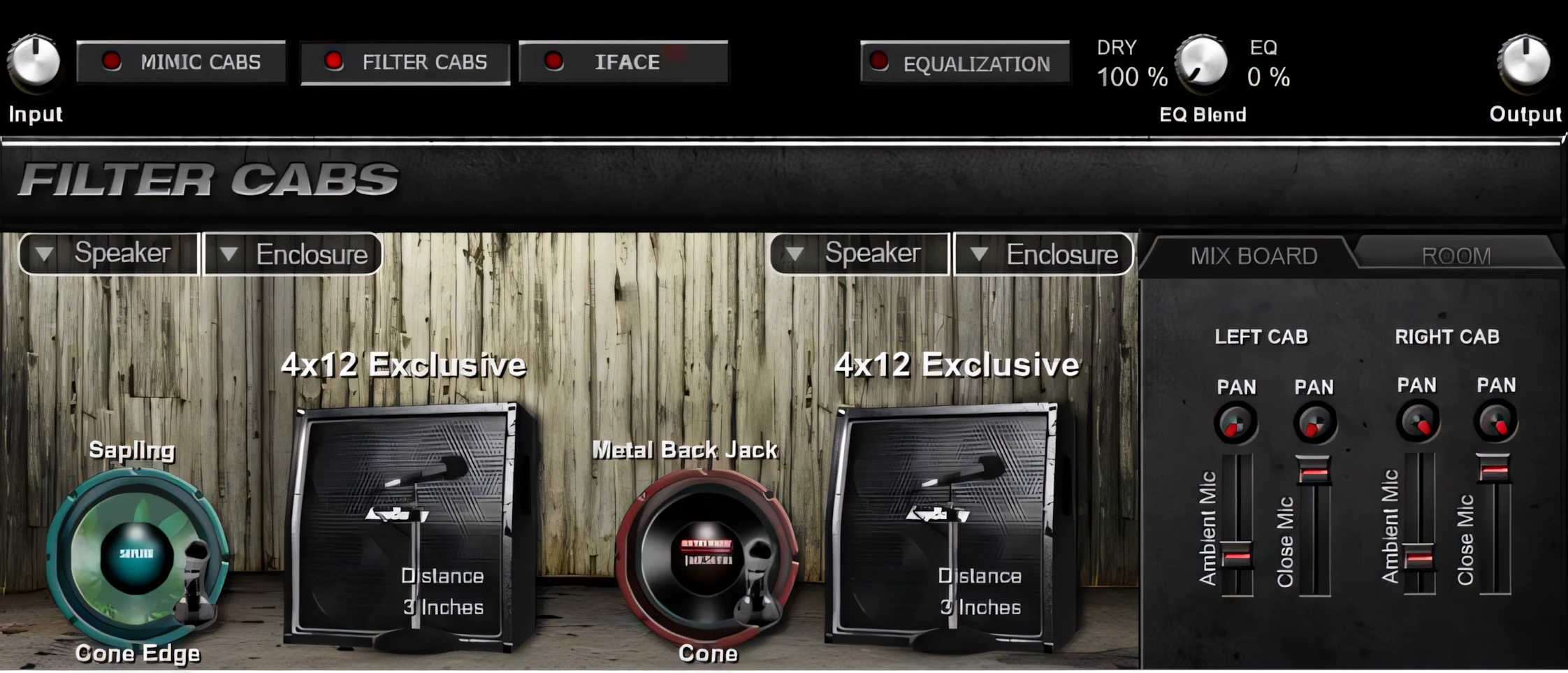
The SPEAKER/CABS subsection consists of three distinct impulse response loader modules. The MIMC CABS and the FILTER CABS groupings are both accompanied with realistic-sounding room options.
The cornucopia of virtual room options are almost too many! These options include a variety of flooring and wall surface materials, as well as different room sizes.
The first CABS grouping, AcmeBarGig’s terrific-sounding MIMIC Cabs, gives you a total of six cabinet choices. This, being the default, is a simple, no frills approach that produces happy results with minimal muss n’ fuss.
We’re given three ‘On Axis’ and three ‘Off Axis’ options. These time-honoured Catharsis cabinet/speaker IRs are sure to suffice anyone looking for big, deep, dropped-tuned “GONAD DELAYS”!
Rock-solid bottom end, punchy mids and proportioned highs are the flavour of the day here, kids. Country and rockabilly players may need to choose the FILTER CABS or IFACE™ though. MIMIC CABS are voiced to compliment hard rock and high-gain sounds.
Ken McLaren, the primary programming genius behind Head Case, defined the MIMIC cabinets for me as such:
“Quite a while ago we did a release with our friends, Alaine Poulin (LePou), and Ryan Harvey (Catharsis). Cabinet A, B, and C are just resampled copies of the Catrharsis IR collection.”
When ON Axis
Cabinet A = 1on-pres5
Cabinet B = 1on-pres8
Cabinet C = 1on-preshigh
When Off Axis is selected
Cabinet A = 2off-pres5
Cabinet B = 2off-pres8
Cabinet C = 2off-preshigh
“The original Catharsis IR set was only available at a sample rate of 44100, we have resampled them to 44,100, 48,000, 88,200, and 96,000 samples/sec.. They are installed in a folder under AcmeBarGig\Cabinets\Catharsis. if anyone wants them for applications outside head case.”
FILTER CABS
You’ve heard of Magix’s Vandal amp sim? It is completely modeled and doesn’t use IRs for speaker/cabinet emulation. It was my former understanding that Magix was alone in this approach to speaker cab simulation.
As it turns out, Magix wasn’t alone in this approach. The FILTER CABS module also delivers a fully modeled speaker emulation, while the room and ambience effects rely on algorithmic processing similar to “freeverb.”
To my ears, the FILTER CABS module serves up respectable, decent sounds. If offers a good range of speaker types and speaker cabinetry. In particular, I enjoy the sounds reproduced by AcmeBarGig’s own ‘Enhanced 4×12’ and ‘Enhanced 2×12’ cabinets. The mic positioning and distance controls are fully featured and offer the same range of placement options as its IR-based counterparts.
FILTER CABS doesn’t knock my socks off though. MIMIC CABS is more realistic sounding, albeit a little bottom heavy and not quite versatile enough to cover all musical tastes and styles.
IFACE™ CABS
IFACE™ makes browsing and loading RedWirez IRs (Impulse Response) a breeze – a wisp, actually. If you haven’t any RedWirez IRs, or if you haven’t correctly set the path to your installed RedWirez location, a large, flashing message in bold print fairly pulsates unmistakably: “REDWIREZ PATH NOT SET. Use the ‘Set RedWirez Path from Start Menu”.
What this is actually trying to tell us, is that there is a menu item, contained within the AcmeBarGig Start Menu folder entitled, “Set RedWirez Path”.
The Set RedWirez Path utility lets a user browse their local hard drive for the folder that contains the RedWirez/BigBox (or SpeakerBox) directory. Once the path is correctly set, you can browse your RedWirez IR collection within IFACE™.
** Just so’s ya knows, RedWirez IRs is one of the best quality speaker/cabinet IR libraries available. 😉
Once you have an IR selected, you can easily adjust mic position and distance, just as you would within the MIMIC and FILTER CABS sub sections. This is by far the simplest IR loader, specific to RedWirez IRs, that I have ever used.

There is a caveat, however. IFACE™ statically lists all the IRs included in the complete RedWirez BigBox collection. For those whom have purchased a few individual IR sets, this can be somewhat confusing. Future revisions of IFACE™ could be designed to intelligently scan the user’s library and display only the IRs that are actually present on the hard drive.
Head Builder – What is It?
By AcmeBarGig’s Admission:
“At the core of Head Case is its ability to allow you to craft your own amp head and share that head with others.”
Head Case – Builder, in a nutshell,is a virtual amp chassis’. It is the specialized core epicenter powering the Head Case software suite. It is this power core that enables advanced (or maybe even adventurous) users to configure and pseudo-create customized amp heads. Using any of the amp head templates delivered with Head Case, the user can tweak, redesign, and customize to their heart’s content.
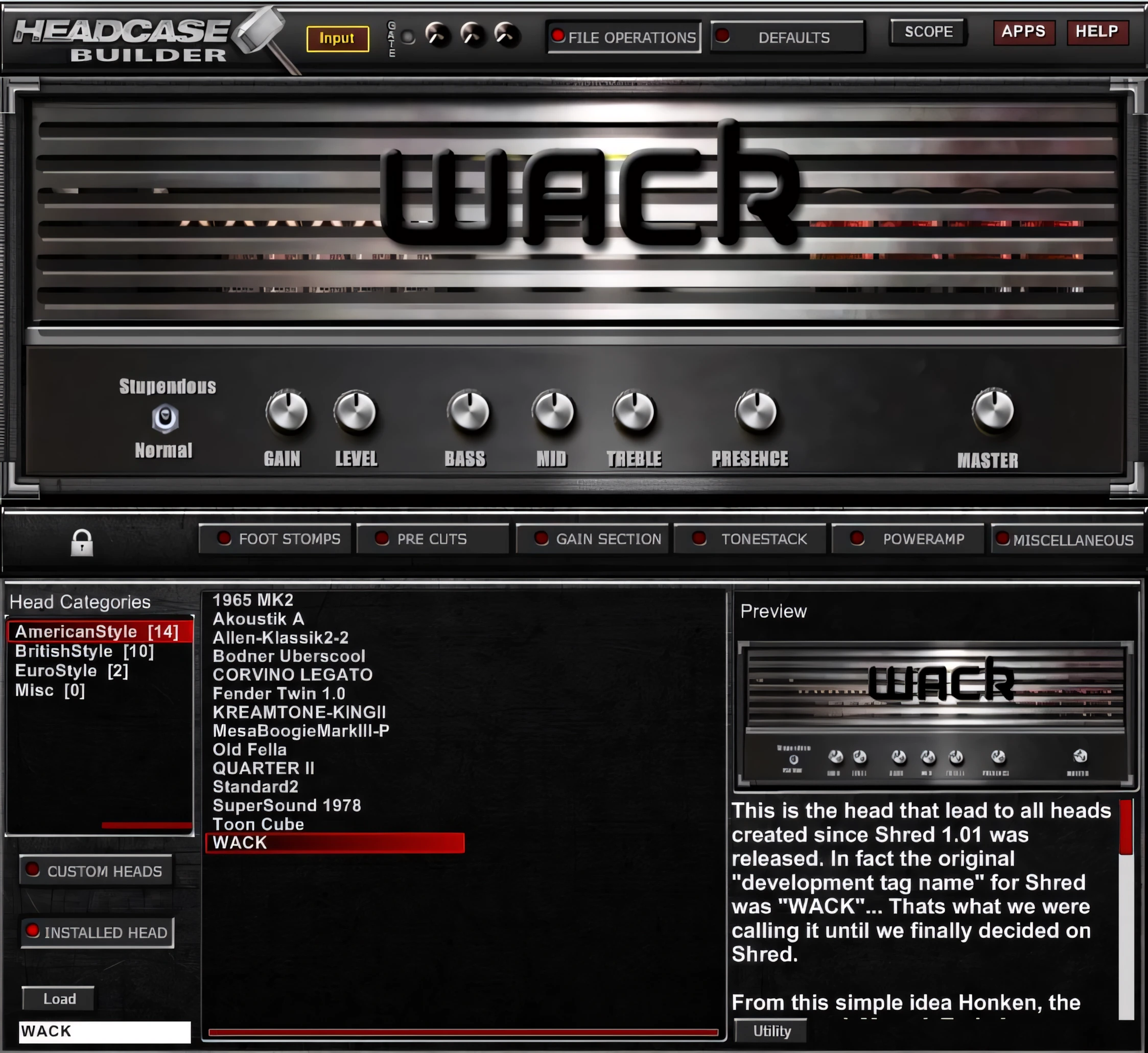
Any would-be amp designer has artistic accord over Preamp type, Tone Stack type, Preamp placement, Frequency curves, Gain-staging, and Power amp settings. Once you become more familiar with the plethora of configuration options, you can unlock a staggering level of flexibility and amplifier emulation.
A limiter in the Power amp section prevents unwanted digital clipping when activated.
“Head Case – Builder” is not available as a standalone add-on; it can only be launched as a VST plug-in.
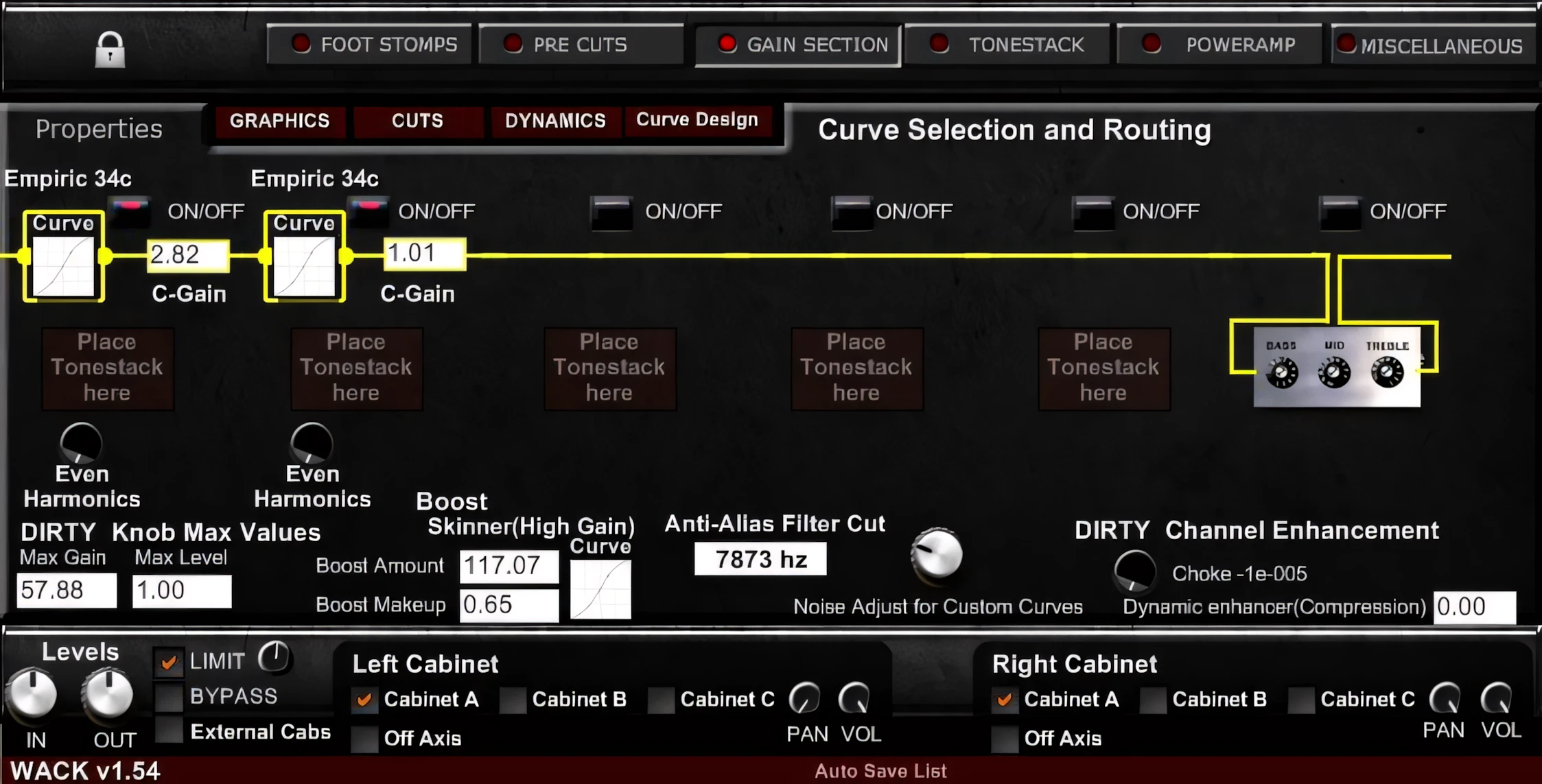
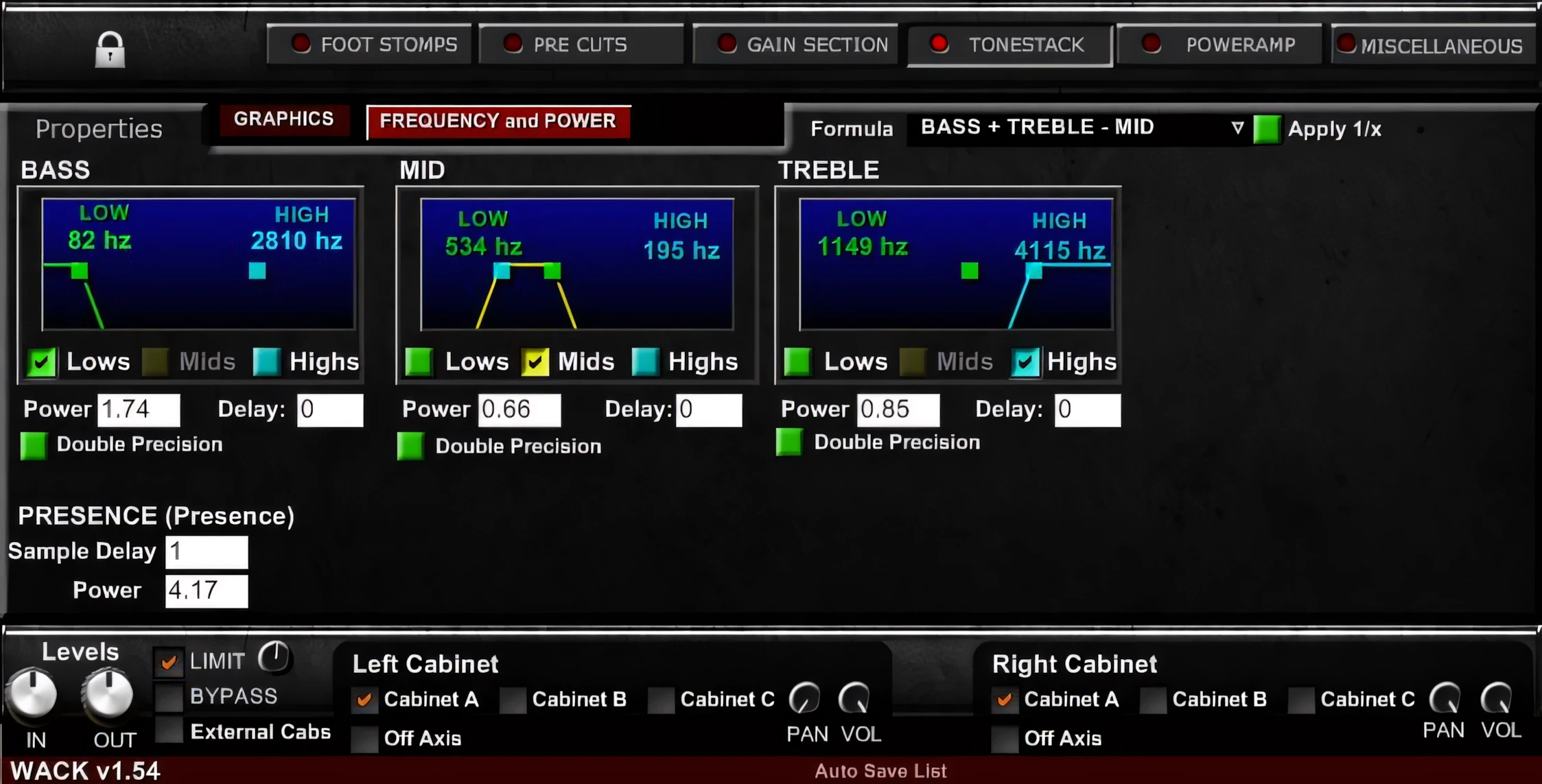
AcmeBarGig has developed a high-level pre-processor scripting language, not dissimilar to Flash script language, called BUC. BUC relays dynamic, real-time instructions to Head Case about every loaded amp head.
Over the better part of the last three years, ABG have been working diligently to improve the efficiency of the dynamic language and Head Case performance. Still, the load times are noticeable and considerably slower than say, Guitar Rig Pro or Amplitude.
To quote AcmeBarGig’s Ken McLaren:
“I want to make sure that people understand that the schematic is dynamic in nature. In other words, the schematic is being built at the time of loading. Head Case has no idea what the amp is, that it is loading, so it has to build and process the schematic dynamically. Heck it does not even know what the graphics or tubes(curves) look like. Is there a Mid knob? etc..”
“So in comparing the HC suite with static suites, the static suites already know what their schematics are, how many tubes the gain stage has, the position of the tone stack, etc. It stands to reason that those will be lightning fast. Having said that, our new suite changes heads in less than 5 ms. ! Changes presets in about 13 ms.”
FrankenAMP II is the name of ABG’s component-swapping technology. It facilitates effortless mixing and matching of components from installed amp heads.
With the newly saved amp still open, the user right-clicks the gain knob and selects “Quarter II” from the list of installed heads. Et Voila! The newly customized version of “Ol Fella” contains the gain stages of “Quarter II”.
For example: Let’s say we want to borrow the gain stages from the “Quarter II” and place them into the “Ol Fella” head. You open “Ol Fella” in the Head Case Builder and immediately save it under a new name. This step enables edits; otherwise, the system prevents changes to existing compilations.
Adjustments made to the channel ‘max output’ might have to be made in the Power amp section after customizing. This is because the various heads have differing volume levels. Unfortunately, the Head-Builder hasn’t a fool-proof feature to make this edit automatically.
FrankenAMP II is available for customizing overdrive stomps, and ALL amp head knobs as well. It is also accessible in some other spots throughout the design environment. (Just look for an odd-looking small icon).
Head Case Image Render Utility:
A novel and unique aspect of the Head Builder process is the ability to export the customized amp head as a jpeg image. That’s right, a jpeg image!
The JPEG saves all pertinent data for the customized amp head, much like MP3 tags embed within an audio file.
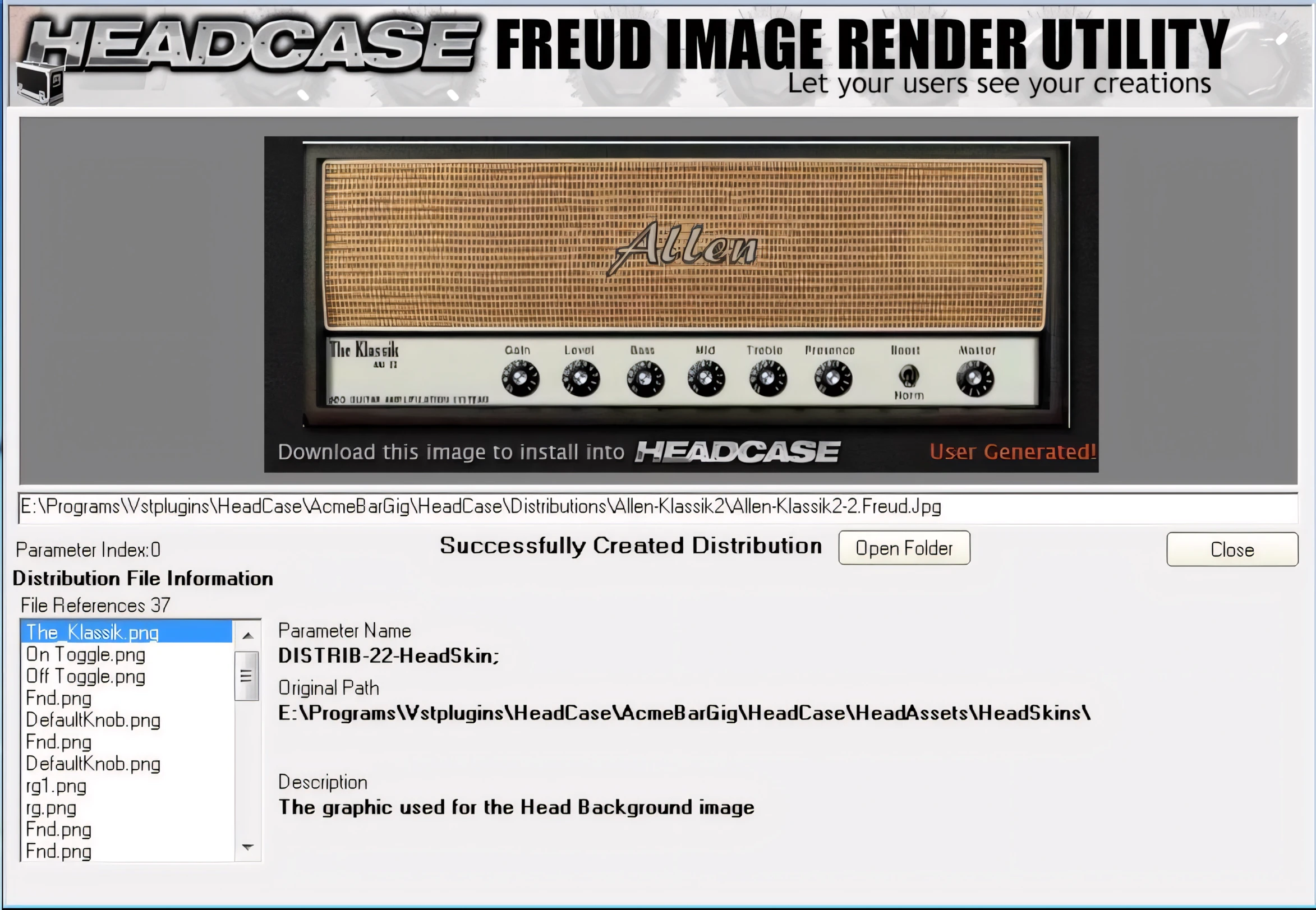
The jpeg not only contains the obvious – the graphics interface of the customized amp head – it also contains the complete, dynamic data that Head Case will use to install and load the new creation. This includes the Tone Stack, Preamp, Power amp, Gain-staging, EQ curves, and et cetera. The concept is brilliant.
Head Case is developed with more than one programming language:
- BUC is written in C++ and Basic.
- Install Head is written in C++
- Make distrib is C++ driven.
- Synthmaker was used as a GUI front end and interface to the VSTs.
- All the audio coding was written in Assembly Language.
CPU Consumption:
There is a lot going on underneath Head Case’s hood. The dynamic nature of this plug-in’s schematic requires a moderately strong, modern multi-core processor. Most nearly any Intel i5 or i7 (or comparable AMD CPU) will be able to handle this amp suite with relative ease.
The CPU demand does become noticeable with any more than three or four simultaneous instances; especially when using a larger number of effects and/or DAW automation.
Most amp sims provide a “Quality” setting, allowing the user to select between HQ mode and a quality reduced mode; thereby easing CPU stress. A reduced quality option would be a useful feature in Head Case as well; especially while tracking, or usage on older (and less powerful) systems.
Concluding Remarks:
Head Case provides such a massive creative canvas that it almost defies categorization. In particular, the “Head Case Builder” can spark your imagination so intensely that you may spend more time designing custom rigs and sounds than actually performing.
The features-tweaking and levels of customization are far beyond the scope of any other amp simulation software suite currently on the market (as of the time of this publication). And available for only $60!
Within Head Case, there is a nifty, convenient app called ‘Help’. Guess what it’s for?
Seriously though, clicking the Help button takes you directly to the impressive “AcmeBarGig Asylum” online repository, where you’ll find a well-organized collection of professionally produced tutorial videos covering both the “what-for” and the “how-to” of the software.
Many of the video tutorials provide tasty bits n’ bites on topics concerning building customized amp heads, tone stacking, and et cetera. Unfortunately, the software does not include a locally installed or downloadable user manual. Thankfully, according to AcmeBarGig, this is one of the features that we can look forward to in a future release.
Not yet available in 64 bit.
Head Case is a 32 bit ONLY software suite. It uses native code, and is reported by many users to operate well as a 64 bit bridged application. By all reports, using a DAW like REAPER, with its acclaimed built-in bit bridger, or a utility like jBridge, allows you to use Head Case as a pseudo 64 bit plugin within any DAW that doesn’t natively support 32 bit plugins.
In my opinion, an amp sim—especially one of this caliber—deserves visuals that resemble real guitar amplifiers, speaker cabinets, and effects hardware.
Some of the dark, mystical imagery and model names used on certain virtual amp heads might be best left out of future releases. In this reviewer’s opinion, those graphics should be replaced with visuals that more clearly imitate real-world hardware components.
Head Case is very stable and works well. Nevertheless, it is still under continuing development and refining. In the near future, AcmeBarGig plan to fully implement a virtual Amp head browser/installer app that operates from directly within Head Case.
This proposed built-in app will simplify the process of browsing for, and subsequently installing new amp heads. The potential of this concept goes well beyond any similar ‘presets sharing’ feature of any other amp sim software currently on the market.
It is entirely plausible that Head Case will garner a substantial position of notoriety within the amp suite market, if the Head Case developers ‘keep it between the lines’.
Faster load times, professional graphics, easier head browsing/installation, and a well-written user’s manual – these will greatly aid in perpetuated and continued success for Head Case. I have high hopes for AcmeBarGig; I honestly believe that there are great possibilities ahead for them . . . in the Tone Stack Zone.
Honourable Mention:
Over the few weeks that I had been bench-testing, experimenting with, and reviewing Head Case, I have enjoyed the open, transparent customer support provided by Mr. Ken McLaren. Ken is the lead developer/co-founder of AcmeBarGig. His support and informative communication made my review process very pleasant for me.
4 out of 5 Stars


:: Pros
- Immense Range of Control.
- Vast Degrees of Tweaking and Customization via “Head Case – Builder”.
- Generally Well Designed GUI.
- Overall Sound Quality is Very Good.
- Some of the Absolute BEST Guitar Effects in ANY Amp Suite.
- Superb Stereo imagery.
- Top-Grade Impulse Response Loader(s).
- Familiar controls & easily configured.
- No dongles, call/response challenges, nor invasive piracy protection overhead.
- THE BEST Price vs. Quality Full-Featured Amp Sim Available.
- Fast, Friendly Customer Support.
::Cons
- Some Unprofessional naming conventions.
- Needs Professional Graphics for Some Factory-Installed Components.
- No User’s Manual.
- Not available for MAC – only available in 32 bit Windows format.
Intellectual Copyright – 2013 – All rights Reserved. This review may not be copied or reproduced in whole, nor in part, without express written permission from the author.

Leave a Reply