
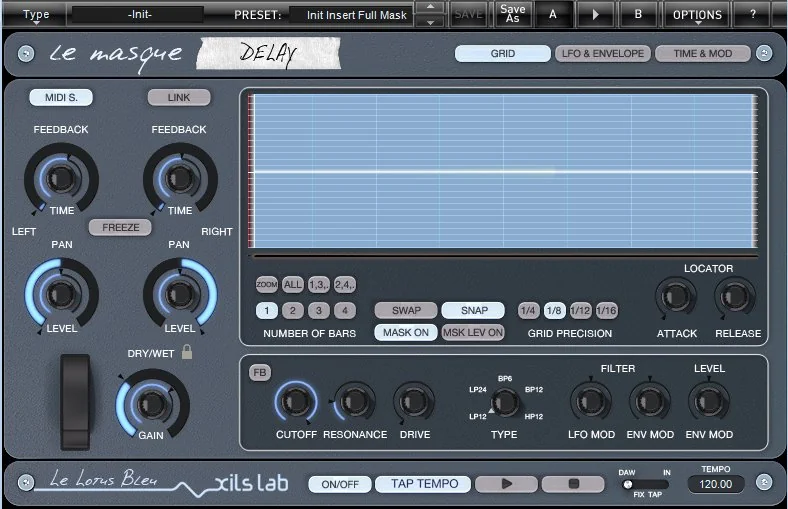
What is Xils-Labs Le Masque:Delay?
Le Masque is a cool, forward thinking, timeline-driven delay plugin with a distinctive and unique approach to audio processing — specifically with regard to tempo’d repeats. The plugin offers a surgical approach to delay effects compared to traditional delay plugins that process the entire signal uniformly.
Le Masque:Delay lets you specify (in a very accurate way) which part (or multiple parts) of the dry signal will be processed by the Delay unit, and its components, and its modulators. Using what Xils-Labs calls, ‘Masked zones‘, you can theoretically arrange a grid and assign audio parts to processed by the Delay Unit. All the audio data outside of the Masks remain unchanged. The Grid is synced to your Daw, or to its internal clock.
- Mask-Based Processing: Instead of applying delay to the entire audio signal, you draw “masked zones” on a synchronized grid. Only the portions of audio within these masks get processed through the delay engine, while audio outside the masks passes through unchanged.
- Precision Control: This allows you to target specific elements in your mix—for example, applying delay to just a snare hit, or specific parts of a rhythm section, rather than the whole track.
- Polymorphic Design: It can function as a traditional digital delay or as a highly customizable effect depending on how you set up the masks.
Introduction:
Reviewer’s Log: stardate 19.02.2013
Delivering the quality that one expects from Xils-Lab, and perhaps exceeding those expectations, the recently upgraded Le Masque Delay 1.5 docks itself into your DAW with the grandiose entry of the Starship Enterprise NCC-1701-C. To celebrate the momentous occasion, Xils-Lab are making Le Masque Delay 1.5 available until February 28th, 2013, for only 44€25 ($58). The MSRP will be 59€ ($77) after that stardate.
Wincing at my own flayed attempt to use kool Star-trek-ian terminology.
By Xils-Lab’s admission:
“Le Masque Delay inherits the renowned XILS-lab filters and all the experience accumulated from the making of Virtual Analog synthesizers and audio effects. But, Le Masque Delay can also perform like a regular Delay”
Beware! This review is involved. Those who suffer from A-D-D might find it a bit lengthy – there’s a lot to cover. 😉
Some droids may put Le Masque Delay into the “weird, dude, I don’t know how to work it” category, but remain at your station! I have some relevant logistics data that will keep your attention transfixed for the next few continuum. By the end of this reviewer’s report, you may even engage the internet transporter (known as a web browser) to transport you to the Xils-Lab coordinates for a worry-free cyber transaction.
Why worry-free?
No dongles. No C/R challenges.
You authorize Le Masque Delay with a personalized license code received via email. The email arrives shortly following the purchase transaction.
To say that Le Masque Delay is an innovative new concept is an understatement.
Hi, you! If you like these kinds of reviews,
be sure to subscribe.

My fellow Trekkies will (hopefully) appreciate the style of creative writing that this article is written in. Non-trekkies might not. No, wait! Only Moms, wives and girlfriends fail to appreciate classic sci-fi.
“You aren’t a ‘girl’ are you, MR. Worf?!”
Visuals:
There’s a lot to look at across Le Masque’s three switchable panels; no worries though, you needn’t be startled. Especially for those of you whom are familiar with the myriad of knobs on a typical synth, this will all seem familiar to you in no time. If you aren’t a Vulcan synth technician, it may appear to be a little overwhelming at first.
“My God, Jim! I’m a musician, not a synth programmer.”
The plugin’s interface shares the blue/grey theme of its other Xils-Lab plugin consortium. This blue/grey color scheme and design, lends itself to being unobtrusive and easily focused upon.
The visuals are not without a certain degree of eye-pleasing style, but it seems to me that the emphasis by Xils-Lab is placed on functionality and work-flow; in contrast to the now-common practice of visually emulating vintage audio components with photo-realism. In this case, the interface design is entirely appropriate. This is most definitely NOT an emulated Electro-Harmonix bucket-brigade echo stomp box.
The GUI’s dimensions are 788px wide by 508px high. All button labels are clearly visible in white, 12pt. anti-aliased text. The spacing between each element is comfortable and each graphical element is easily seen.
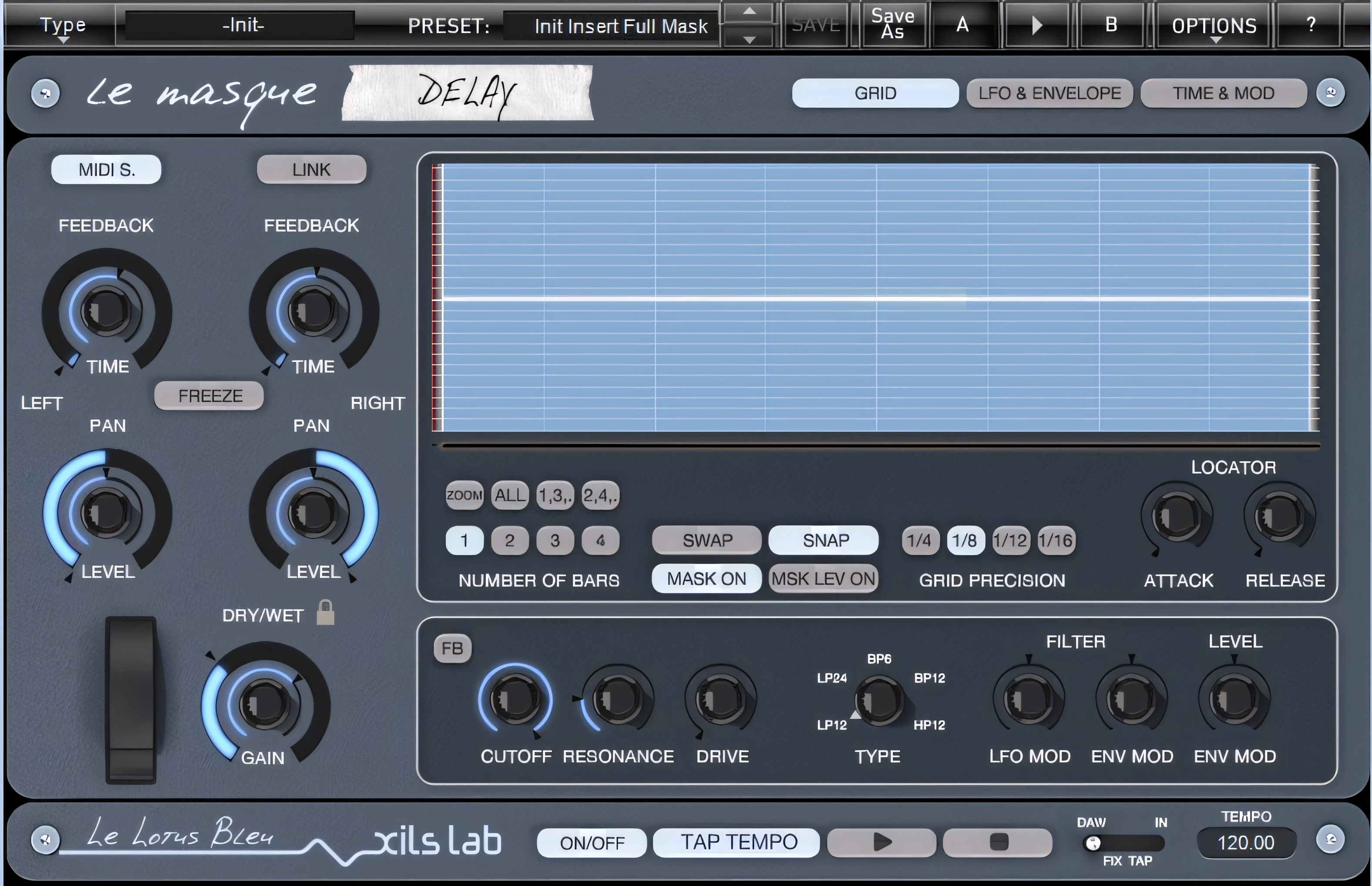
The symmetrically arranged button knobs are smoothly adjustable. Holding down the ‘shift’ key while moving any knob allows for fine, granular adjustments. Each virtual knob is haloed with a bright, ‘neon-blue’ indicator ring that gives the user immediate visual cues of each knob’s current setting.
Presets Aplenty:
Le Masque Delay ships with an large factory preset library (over 120 presets). The presets are well-organized in six distinct categories. These are readily accessible from a graphite-colored toolbar along the top of plugin’s shell. In sum, the menuing system features crisp, white serif text against a dark background, eliminating the need for eye-straining squints.
The main panel, “GRID”, is easy to work with. To set a mask zone you merely click & drag. To remove a mask zone, you simply right-click on it. The masks appear in the same bright neon-blue color as the knob rings, giving the interface a cohesive, modern look. Meanwhile, the GRID can be configured to 1/4, 1/8, 1/12, or 1/16 time intervals for flexible rhythmic control.
Sound Quality:
Surreal, my good web friend, surreal. The sound quality of this plugin is tremendous; surreal, even.
Xils-Lab have obviously included the lush, warm, analog-esque quality that their perennial VA synths are famous for. It does not suffer from any discernible audio aliasing or unwanted audio artifacting. Nevertheless, its prime directive is to produce utterly modernistic sounds; so how can one claim that it merely sounds “good”?
LeMasque:Delay can sound vast and aurally provocative. It can sound crazy weird (in a very likable way). Le Masque innovatively warp-speeds beyond traditional delay plugins to a sonic stratosphere that besets all but the most musically adventurous. To say that it sounds “good” would be a grave injustice to the programming ingenuity powering this impressive software appliance.
Stereo Width & Dimension:
Le Masque Delay is not your Grand Dad’s vintage tape echo unit. Ensign, this is a stereo-field energizer of stellar proportions. The plugin features independent feedback, time, pan and level controls for both the left and right sides of the stereo spectrum. The degree of perceived spatial placement is extensive, eks-ten-zzive.
Anything from subtle, controlled effect, to outright aural disturbance is possible just a few mouse clicks n’ turns away.
You can manipulate the stereo spectrum of your processed sound as extreme as your imagination can take you. I suspect that you’d have to utilize a completely 3D or surround sound processor to give greater degrees of stereo delay effect.
Warning! Giving the Le Masque plugin to a techno/house/trance junkie may result in long-term euphonious addiction. 😉
Now then, I am presenting you with a choice at this juncture, Neo: You may continue reading, or continue on your merry way.
Should you choose to read only the next two paragraphs, I’ll share my opinion and a brief overview. For those with a bold spirit and a genuine interest in the finer technical details, I cordially invite you to dive into the complete in-depth digest.
Overview:
This plugin is deceptively massive! Le Masque Delay is the secret photon weapon of delay in any VST folder. From elegant, subtle echoes, or synth-like modulated delays, to extreme rhythmic resonance repeats, Le Masque Delay is capable of captivating the listener in wonderment.
Le Masque invokes creativity.
For example: A user can apply unique delay processing on a common, simple drum loop, and inventively devise tones and beats that are an exciting fusion of oscillated synthesis and rhythmic furor.
Want to know the WHYs, WHEREFOREs, and what’s under the dilithium hood?
“Keep sharp, Ensign; follow me to page 2.”

Leave a Reply