
What is Sound Magic NEO Reverb?
Sound Magic’s Neo Reverb is a hybrid reverb plugin that combines two different reverb technologies to create its distinctive sound characteristics — algorithmic and Impulse Responses. This is a concise review of SoundMagic NEO Reverb.
The unique aspect of Neo Reverb is its method of converting true stereo impulse responses into algorithms, which allows it to combine the advantages of both reverb types. This means you get the realistic spatial characteristics of convolution reverbs, with the real-time control and lower CPU usage typical of algorithmic reverbs.
Eight Reverb Algorithms: The plugin offers eight distinct reverb types:
- Hall
- Concert Hall
- Room
- Plate
- Chamber
- Ambience
- Space
- All-purpose mode
Neo Reverb is a brilliantly unique approach to convolution reverb. Neo Reverb is an interesting marriage of algorithmic-like features joined to the natural space prowess typically dominated by convolution reverbs. It is, of sorts, a hybrid reverb plug-in. It is a novel take on the “static” convolution reverb and it does prove itself to be a very interesting concept.
I generally find the sound of Neo Reverb’s impulse responses to be agreeable and varied enough for most reverb/ambience needs. NEO Reverb bundles 137 IRs of natural spaces grouped into six main categories. These range from tight rooms, ambient spaces, chambers, plates, rooms, halls, outdoor spaces and even a couple of caves.

The outdoor IRs did not sound like natural outdoor spaces to me, but actually sounded much like the hall IRs. To be honest, I don’t find that there is quite enough difference between some of the IRs. The ones that I consider to be the nicest-sounding, are the smaller, intimate room and ambient spaces.
Two Processing Options:
There are two algorithmic types to choose from: The “Neo Reverb” type and the “Old Style”. It isn’t clearly defined in the user’s manual what the differences between Neo style and Old Style are, but it sounded to me as though the Old Style disables the modulation and perhaps some of the additional effects filtering.
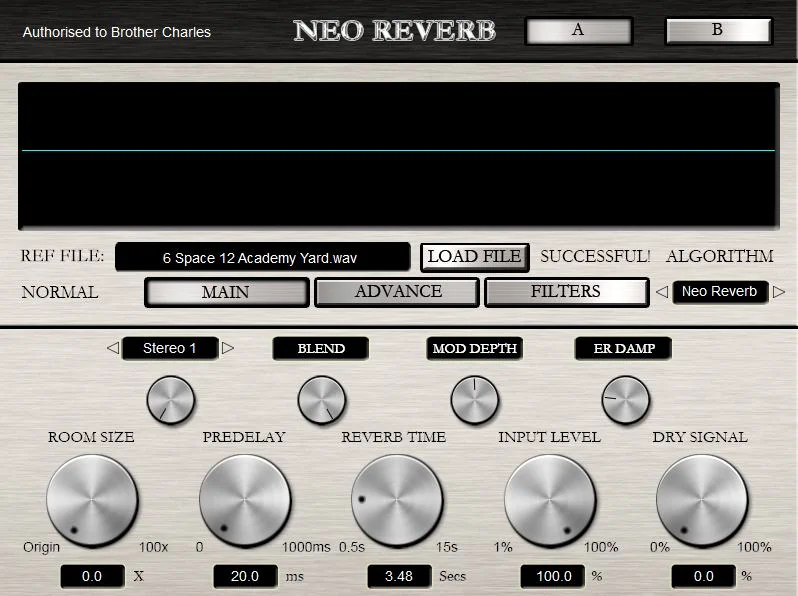
The interface is quite functional; albeit a little dated looking (synthedit GUI). Veering from the typical Graphite Black GUI design that most Neo series plug-ins show off, this plug-in’s interface is a highly-contrasted silver and black motif.
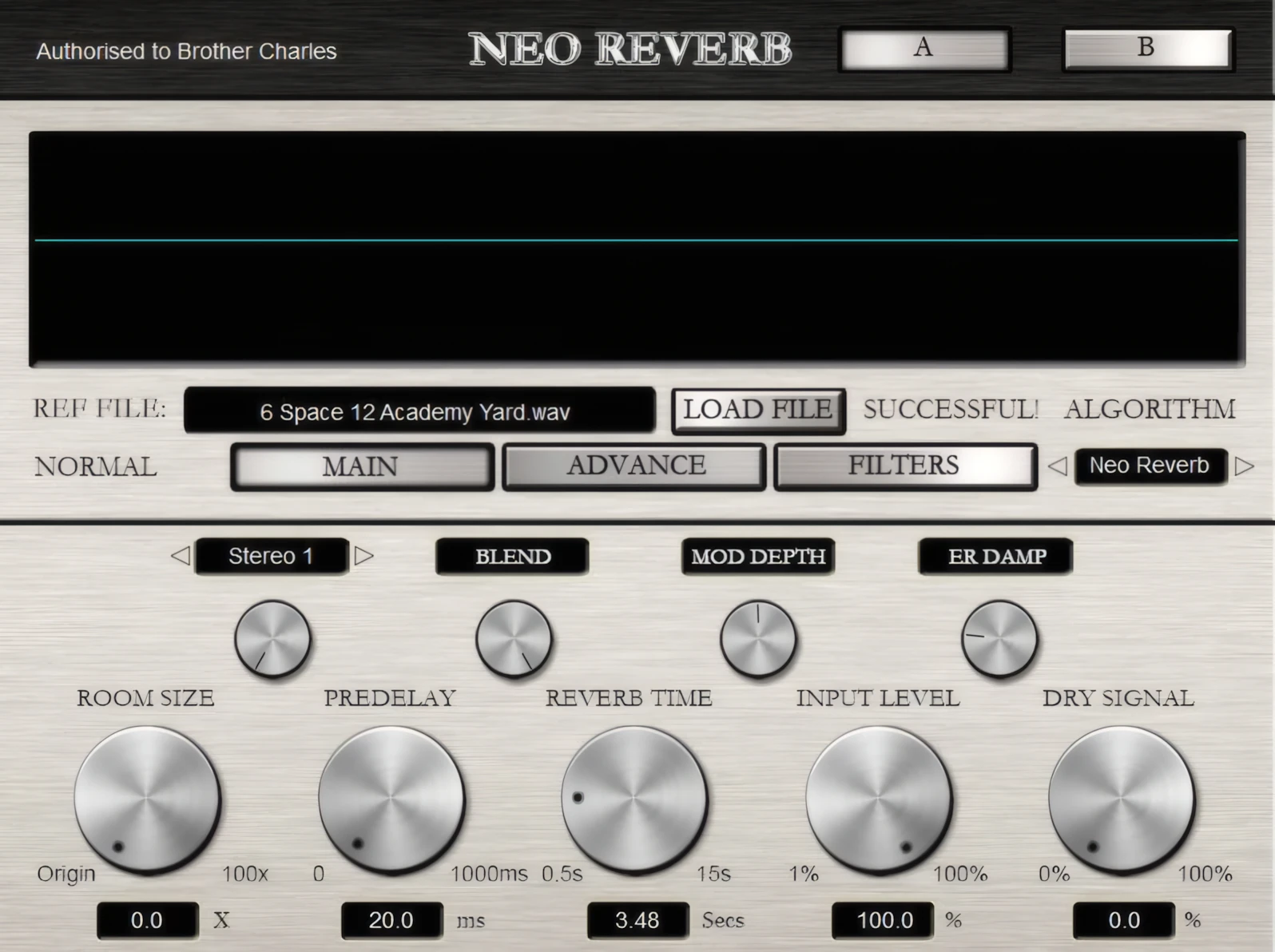
The background approximates an anodized silver fascia, featuring black accents and large, easy-to-read silver knobs. The typeface and text display elements are quite large — which is nice for anyone whose eyesight needs a bit of help.
Easy A/B comparisons are made using the two large buttons named respectively, along the top.
The plug-in is written in assembly language, but sits in a Synthedit shell. The SoundMagic folks are working hard at preparing native, 64 bit versions of many of their plug-ins for future release. For example, they have very recently released a native, (non Synthedit) 64 bit version of Neo EQ 2.
Neo Reverb supplies most of the parameter controls that one would expect to find on any good algorithmic reverb plugin. As a matter of fact, there are about 40 different controls spanned over the three tabbed panels.
Neo is a convolution-based reverb that should be considered a ‘hybrid’. SoundMagic claims that the impulse responses that are shipped with this plug-in are IRs that have been ‘converted’ into algorithms. “Converted into algorithms, George — what does that even mean?”
Hi, you! If you like these kinds of reviews,
be sure to subscribe.
SoundMagic Neo Reverb Sound Quality:
In this review of Sound Magic Neo Reverb, I find general sound quality of the plug-in is pretty good. However, even with all of its features, I would NOT classify this convolving reverb in the same calibre of say, Native Instrument’s Reflektor.
I really wanted to like this reverb, but no matter what I did with it, it just seemed to “ride-on-top” of the source. Do you know what I mean? Many of today’s top reverb plug-ins are highly acclaimed for their ability to surround or wrap around the source.
I recently wrote a full review of SKnote’s algorithmic reverb, VerbTone, that fits very well into the “surrounds the sound” category. This reverb is not synthetic-sounding, it just doesn’t wrap the sound quite as much as I would like.
But, and this is a big BUT, I absolutely love the Studio IRs. I put my favorite little blues piano clip through “Studio C” @1 second, and my FX send level set to 35 percent in my DAW. It’s a beautiful room sound. As a matter of fact, it’s a fantastic studio room sound – very, very convincing.
This one does not sound as though it’s riding on top of the source at all; rather, it’s a subtle ambience that gives the source more breath and liveliness.
Concluding Remarks:
The concluding remarks of this brief review of SoundMagic Neo Reverb are concerning its CPU consumption. On my 6 year old dual core AMD system, this little scallywag required 40 percent of my CPU! Simply instantiating an instance of the plugin on a single track, my DAW’s CPU consumption jumped from 3% to 40%. On a modern, (6 core) Intel i7 3930, the CPU consumption was almost 3.5 percent. 2C Audio’s Aether runs on the same system at only 0.8 percent.
Neo Reverb is a great concept; a really GREAT concept. However, it reminds me of a tri-athalon participant who swims 6km, then jogs 6km, and finally, cycles for 18km, but just can’t quite make it past the 17 km mark.
I am not declaring that this is a bad plug-in. On the contrary, Neo Reverb is quite good. However, SoundMagic’s pricing is a little too aggressive for the degree of quality on offer, in my opinion. As a result, I feel that this plug-in would be a better buy if it were priced 20 or 25 percent lower.
Secondly, higher-than-average CPU demand makes this one a bit of a tough sell. The reverb doesn’t “wrap around the sound” quite as much as I would like to hear. I honestly believe that if SoundMagic remedies both of these concerns, this plug-in will breeze right past the 17th km mark to the finish line. – €99/$129 (USD)
Meanwhile, the following Soundcloud clip showcases a direct comparison between Neo Reverb and famous expensive hardware reverbs (Lexicon 480L and TC System 6000).
3 out of 5 Stars


:: Pros
- Cool, unique approach to combining algorithmic processing with Impulse Response technology.
- Clean, transparent audio quality.
- Ease of use.
- The Studio Room IRs really stand out.
::Cons
- Expensive for what it is.
- Amateurish, synthedit GUI.
- High CPU usage.
- Some of the IRs sound really good, but too many of them sound alike.
- Outdoor spaces tend to just sound like extra large halls
Visit the Sound Magic website. NeoVST.com
Intellectual Copyright – 2013 – All rights Reserved. This review may not be copied or reproduced in whole, nor in part, without express written permission from the author.

Leave a Reply