
What is FC-70?
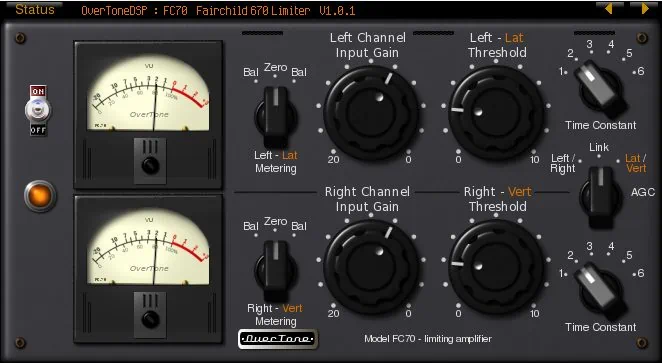
The Overtone FC70 is a vintage limiter plugin that emulates the legendary Fairchild 670 tube limiter, one of the most sought-after analog compressors in recording history! The Fairchild 670 is considered one of the most expensive and rare compressors ever made, originally used on classic recordings from the 1960s-70s. In this thorough OverTone FC-70 review, we’ll check if this nifty plugin makes the famous sound accessible without the $30,000+ price tag.
Key Features:
- Controls: Threshold, attack, release, ratio, and output gain (replicating the classic Fairchild interface)
- Modern Additions: Side-chain input, optional saturation, and 64-bit processing
- Character: Emphasizes the “smooth, effortless dynamic control” and “uniquely musical character” of the original hardware
Introduction:
Many of us already know the well-established, somewhat expensive modeled plug-ins that promise authentic Fairchild 670 sound and performance. For example, UAD promotes its “Fairchild® 670 Compressor Plug-In,” and IK Multimedia showcases its “Vintage Tube Compressor/Limiter Model 670”. Those are two of the most prominent Fairchild emulations on the market.
Now, OverTone enters the scene with its recently released FC-70. Likewise they promise a faithful digital emulation of this famous studio hardware compressor.
A few months before this article, I enthusiastically reviewed PTC-2A, the vintage EQ sibling of the FC-70 from OverTone! I absolutely loved that plug-in. So, as soon as I heard that OverToneDSP planned to launch a Fairchild emulation, I immediately felt eager to give it an in-depth inspection.
I came away thoroughly impressed. Not only was the wait completely worthwhile, but I am absolutely fired up to bring you in on the experience. I am sharing everything I discovered. Even better, for the modest price of just £25, this outstanding performer delivers incredible value and undeniable musical muscle.
Without question, FC-70 deserves a place in every serious producer’s toolkit — or, at the very least, a proper audition. So go ahead and download the demo. Once you hear it for yourself, you may very well discover just how truly “sterling” this ambitious newcomer really is.
What is all the hoopla about the fabled Fairchild 670?
So, the 670 was, and certainly still is, an indulgent synergy of tubes and copper-wound balanced transformers. It embodies the stuff that legendary sound is made of. Remarkably difficult to distort and super fast in response timings, the famed Fairchild 670 stands out as the very first truly “modern” compressor. It literally re-framed the audio dynamics hardware industry by presenting itself as the first device capable of operating without thumps, distortion, or noise.
Ah, the warmth and goodness of two independent compressor/limiting amps heating up and bearing down on a poor, unsuspecting audio signal.
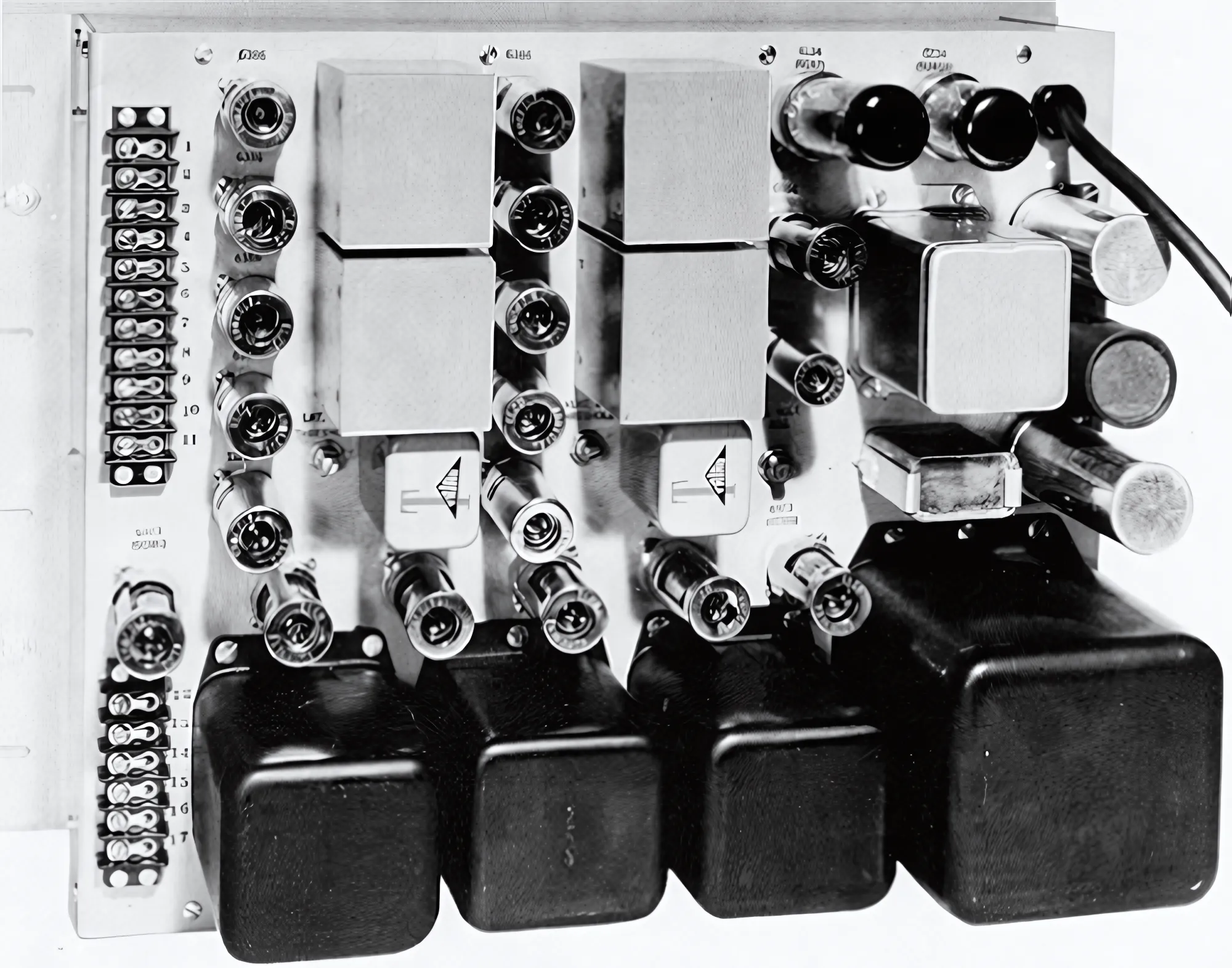
A Fairchild 670 doesn’t merely control sound; it actively helps create it. Unfortunately, I am not among the lucky few who can afford to purchase one of these collector’s items—a rarity that commands prices upwards of $35,000. (Yes, you read that correctly: thirty-five thousand dollars).
Fortunately, thanks to brilliant developers at UAD, IK Multimedia, and now OverTone, we can experience this legendary sound on a $1,000 computer. Truly, technology is wonderful.
To quote Mike Start, the founder and lead developer at OverTone:
“Some emulations will attempt to add ‘warmth’ and ‘grunge’ that comes from components that are now 40 – 50 years old, whereas what I’ve set out to do is to capture the ‘essence’ of what made these units great originally.”
“New valve (tube) equipment actually has a really nice ‘clean’ and ‘open’ sound (when its not overdriven). So what you get is a Fairchild or a Pultec which is brand new; although it will have a traditional warm ‘tube’ sound when overdriven, just like the originals.
Hi, you! If you like these kinds of reviews,
be sure to subscribe.There will be a difference between this emulation and other company’s emulations, just as there is a difference between a modern re-build of a Fairchild and a ‘vintage’ original.”
Everything Old is New again . .
Since the mid-2000s, the industry has witnessed a reinvigorated admiration for classic studio hardware staples. This resurgence embraces everything “analogue,” ranging from compressors and equalizers to channel strips, amp simulations, and virtual instruments. Nevertheless, many trend-followers fail to realize a crucial point.
Back in the day, when manufacturers produced “Fairchild” and “Teletronix” compressors, engineers and producers did not aim to create ‘vintage’ or grungy sounds. Instead, they strove to craft better, cleaner, and more distinct recordings. Consequently, it is almost amusing to hear the remarks and read the comments from many audio community members who assume that vintage, classic sounds automatically equate to ‘saturation’ and ‘color’.
While subtly distorted analogue circuitry indeed pleases our ears with harmonic-enhancing effects, original hardware designers never intended this outcome. In fact, saturation remains a side effect that can prove detrimental to certain musical genres.
Q: Why is FC-70 Important – why should I care?
A: “FC-70 is fast, clean, open, and a flexible vintage-styled compressor. Great strides were taken to ensure that it adheres to the original hardware’s schematic and design. This compressor is easily interchangeable with other Fairchild 670 emulations costing much more.”
Licensing and Authorization:
The compact 7.5 MB downloadable zip package conveniently includes both 32-bit and 64-bit installers for Mac and PC systems. Simply extract the archive, launch the appropriate installer for your setup, and you are ready to go within minutes.
Better still, the downloaded archive already contains the complete full version of the plug-in. However, until you authorize it with a valid license file, the software operates in demo mode.
Once you complete your purchase, the developer promptly delivers your license/activation key directly to your email inbox. From there, activation could not be easier. Simply extract the license file and drop it into your plug-in folder — for example: “C:\Program Files\Steinberg\VSTplugins” — and the plug-in immediately unlocks for full operation.
Best of all, the developer completely avoids the usual authorization frustrations. There are no tedious call-and-challenge procedures, no intrusive copy-protection systems, and absolutely no dongles required.
Fast, painless, and refreshingly user-friendly — a solid 5 STARS!
Visuals:
FC-70 closely mirrors the look of an original Fairchild 670 compressor. While the interface does not fully qualify as photo-realistic, it still features a pleasing degree of subtle 3D-style protrusion, bevelling, and shadowing. that effectively lifts it out of the realm of a flat, static 2D design.
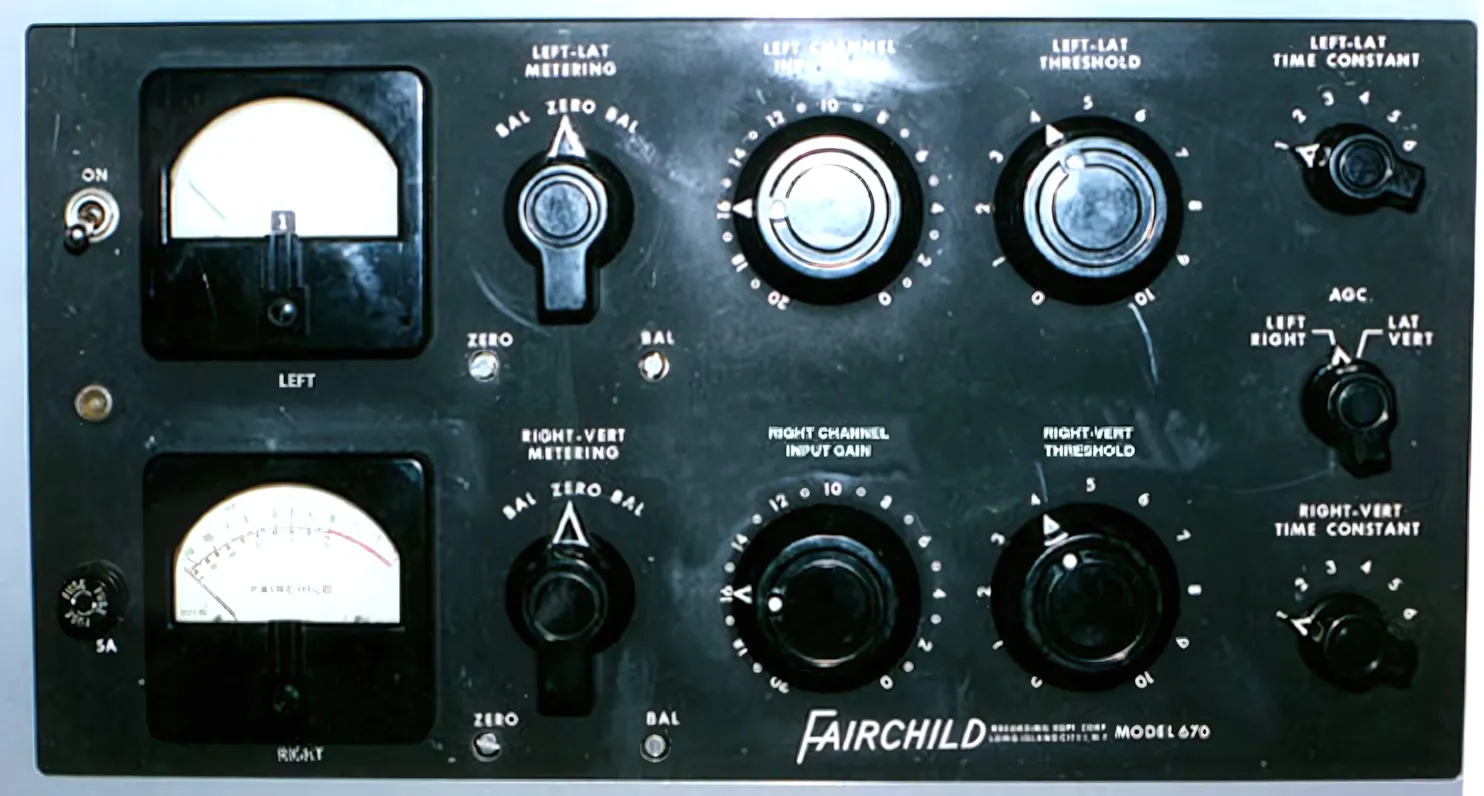
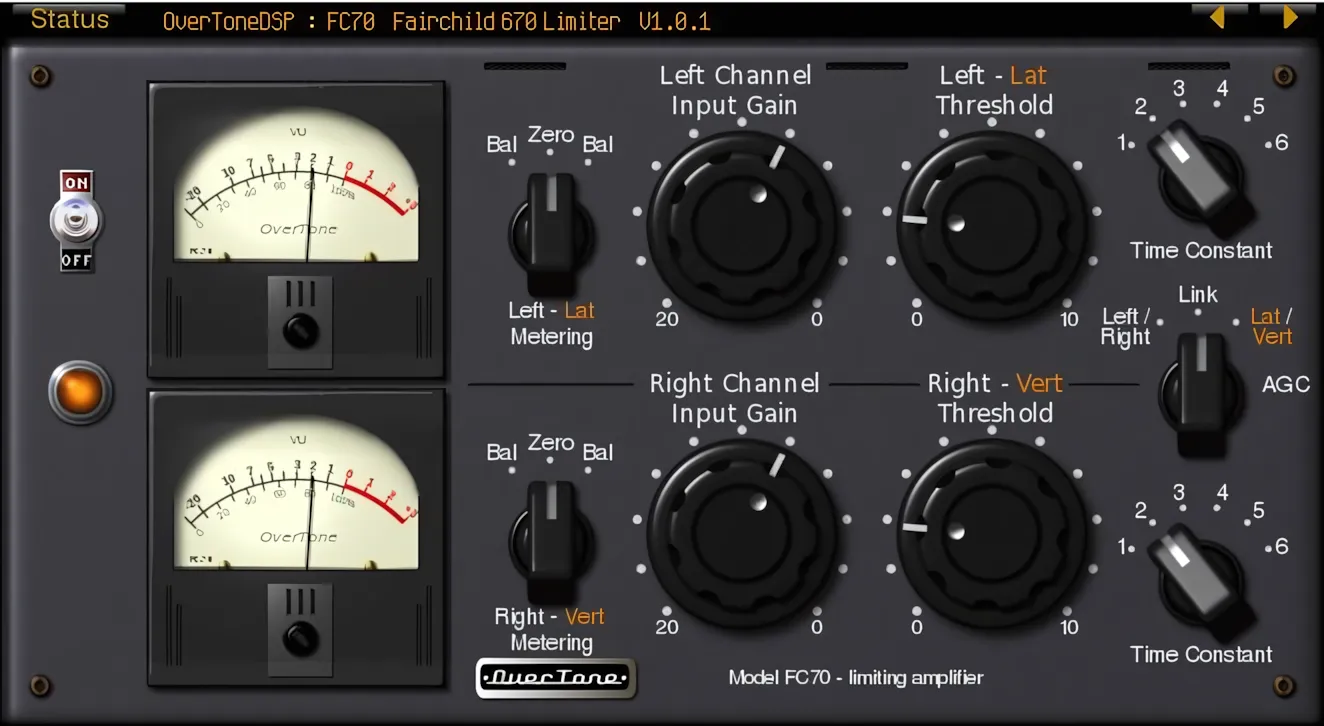
You immediately notice eye-pleasing attention to detail in the “old” corner screws and the softly glowing amber power indicator. Furthermore, while the compressor is turned “off,” it actually engages a true bypass mode, so it does not consume any stray CPU cycles.
The developers have programmed the knobs to mimic the feel of weighted dials, complete with a small amount of “inertia.” As a result, the design delivers a much more realistic, tactile in-the-box experience.
As you turn a knob, the interface instantly displays its value in the status bar at the upper left. Furthermore, clicking any knob reveals its precise current setting.
Although the interface does not appear to offer a quick way to reset any knob to its default value, the large, smoothly operating controls keep this from becoming a real drawback.
The built-in preset manager offers just five presets. So what? After all, this plugin emulates one of the world’s most intuitive compressors. 😉
Sound Quality:
Picture this: It’s 1969, and the studio owner finally lets you convince him into springing for a Fairchild compressor/limiter amp. You hoist the 50-lb. piece of analog machinery into place, flip the switch, and wait six or seven minutes for it to warm up.
Then, you launch your state-of-the-art stereo recording and immediately discover more headroom and dynamics control than you ever imagined possible. However, the moment you push it too hard, your tape succumbs to nasty distortion. Uh Oh!
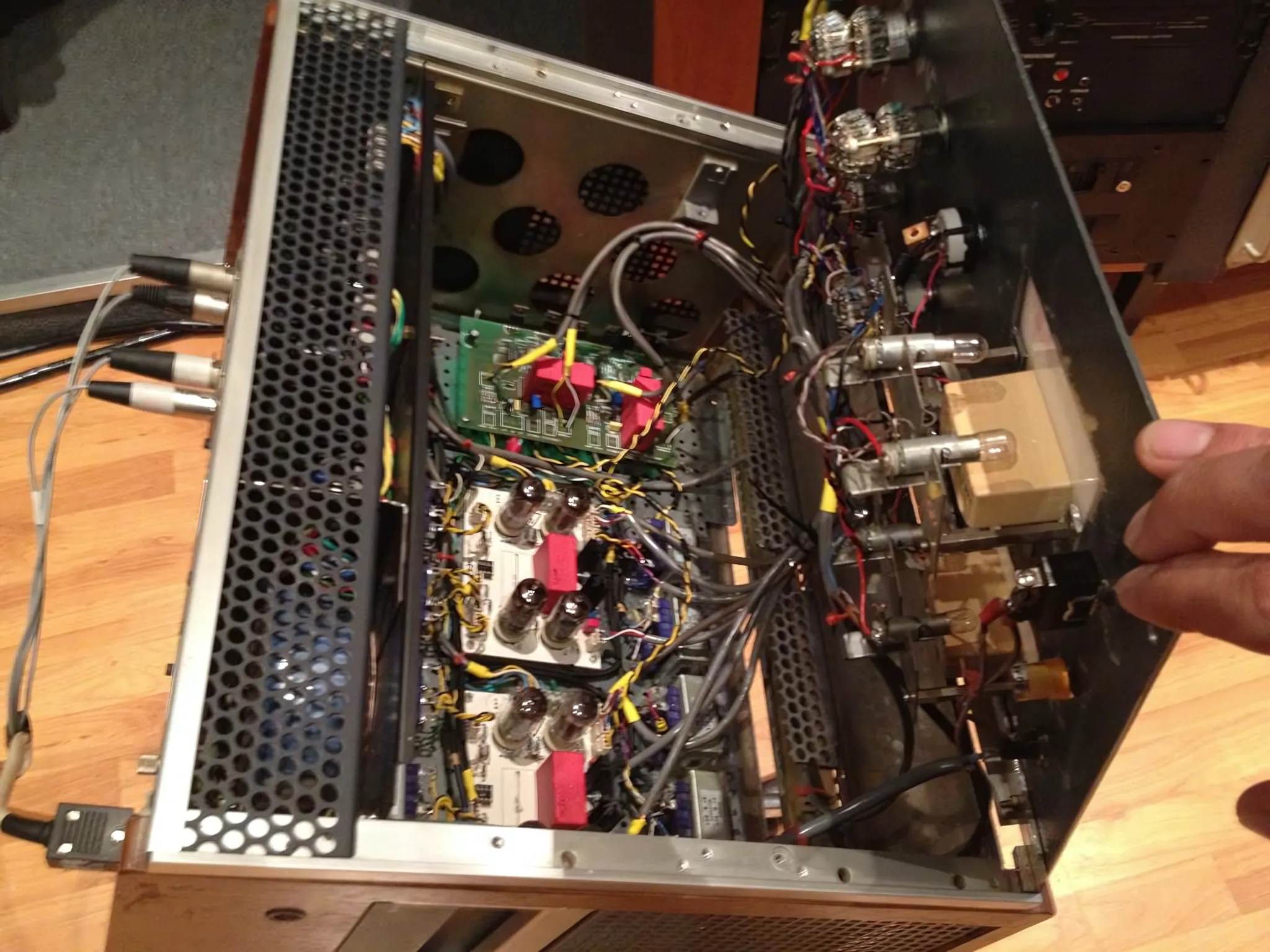
As the studio’s lead engineer, you know exactly what to do: a tube refit. After all, the studio owner purchased a used unit that ran for hours daily for over four years. You power down the system, then spend twenty minutes removing the panels and extracting all twenty tubes. Next, you install brand-new 6386s, 12BH7s, and 12AX7s. Once you secure the panels, you heave the beast back into the rack and power it on. Finally, you wait anxiously for six minutes, resume playback, and sigh with blissful relief.
I declare for the record, right here and now, that the FC70 delivers the sound of a pristine, analogue compression giant outfitted with brand-new tubes. You can push it into overdrive, yet this versatile compressor maintains a remarkably serious “clean” vibe. Watch the YouTube video linked at the end of this article: this unit makes drums sound absolutely incredible!
CPU Consumption:
What CPU drain? This brilliant piece of United Kingdom ingenuity showcases exceptionally efficient programming from the ground up. In fact, almost any reasonably up-to-date computer should have no trouble running this compressor across dozens of tracks simultaneously without breaking a sweat. Simply put, the performance-to-efficiency ratio here is outstanding. 5 BIG, BRIGHT STARS!
Furthermore, while many modern computer users have grown accustomed to the point-and-click convenience of Windows and OSX, the developers at OverTone operate on an entirely different level. These are hardcore, deeply technical C++ programmers who live and breathe low-level optimization.
After all, OverTone emerged as an extension of LinuxDSP — and that pedigree clearly shows throughout the software’s remarkably lean performance.
These chaps do not merely install an operating system and click “Next, Next, Next, OK.” Quite the opposite. When their systems require tweaking, they dive straight into the guts of Linux itself, optimizing and recompiling the OS kernel for maximum efficiency.
Having previously worked as an assistant Linux system administrator myself, I can confidently say these developers genuinely know how to engineer software properly. Their expertise shines through in every aspect of this compressor’s rock-solid stability and feather-light CPU footprint.
Concluding Remarks:
I proudly support OverToneDSP because they consistently craft their products with impressive care and precision. They actively maintain and update their plug-ins whenever users report unforeseen bugs or quirks. And they do so promptly.
Moreover, OverTone keeps its pricing very reasonable while still delivering a custom-built GUI engine that looks attractive, runs fast, and remains light on system resources. As a result, I, for one, have no hesitation in giving OverToneDSP a solid Five Stars and Two Thumbs Up.
5 out of 5 Stars


:: Pros
- BEST-in-CLASS plug-in performance.
- Careful emulation of original H/W schematic and design.
- Affordable.
- Very open, clean, vintage compression sound.
- Built-in preset management.
- Attractive user interface that closely resembles the original instrument.
- Smooth, high quality knobs.
- Easy-to-use & Easy-to-learn.
- Well-written, comprehensive user’s manual.
- Friendly, proactive product support.
- Regularly updated and maintained.
- No dongles, call/response challenges, nor invasive piracy protection overhead.
- 32 & 64 bit for both MAC & PC (AU or VST)
::Cons
- This plug-in may make other Fairchild 670 emulations obsolete. *Cheeky Grin.
Visit the OverTone website. www.ACMT.co.uk
Intellectual Copyright – 2013 – All rights Reserved. This review may not be copied or reproduced in whole, nor in part, without express written permission from the author.

Leave a Reply