
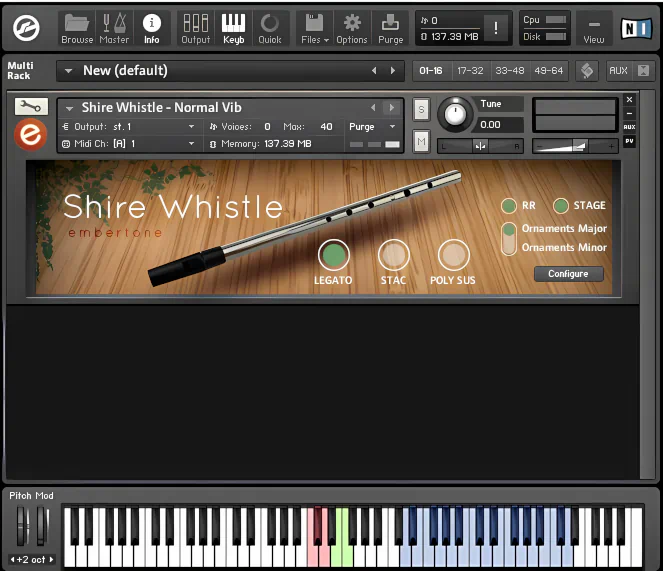
What is Shire Whistle?
Shire Whistle is a virtual instrument that recreates a traditional Irish feadóg (whistle). Its enchanting tone is reminiscent of the flute and whistle sounds you hear in the Lord of the Rings movies. It lures the listener in with its authentic charm and sonic character. In this detailed Embertone Shire Whistle review we’ll take a look at its key benefits such as:
- A sample-based virtual instrument designed for composers and producers seeking authentic Irish folk sounds
- Virtualized traditional Irish whistle with comprehensive articulations
- Designed to deliver an “Irish-spirit” sound for cinematic, folk, or world music projects
- Sample-based tones rather than synthesized, providing more authentic acoustic character
Story Time:
My Scottish roots run deep, and I grew up just 100 yards from the Atlantic shoreline in Englishtown, Cape Breton. Those Celtic instrument sounds? They tug at my heartstrings every time. They whisper home to me. And Embertone’s “Shire Whistle”? That’s exactly the kind of instrument that does the trick.
Now here’s the magic part. I slip on a pair of Sennheiser headphones, and suddenly I’m transported. The scent of salt brine seems to drift on the evening air. Distant gull cries echo off the point, beyond the lighthouse. Okay, maybe my brain is playing tricks on me—but honestly, who cares? If my headphones can summon a ghostly coastal breeze, I’ll take that miracle any day.

Mountain spruce and tender meadow moss stretch out to the south. Busy bumblebees hum their busy tune, while flittering sparrows call to each other in a joyful chorus. But wait—what’s that sound drifting just over the crest?
Ah, yes! It’s “Shire McGuire” pouring out thanks and merriment. He celebrates another blessed day of growth in his beloved garden and vale. His wizened fingers dance across the holes of his most treasured keepsake: his father’s Irish whistle.
Honestly, if that whistle could talk, it would probably brag about having the world’s most skilled finger-dancer. But hey, who are we to argue with pure joy?
Introduction:
EmberTone captured the essence and charm of this poetic instrument, then lovingly wrapped it up for us as a Kontakt sample set. This blessed little gift costs only a wee bit of coin from a trader’s sporran. In fact, it’s no more than $20 in Middle-earth dollars. (Well, it’s in USD, actually.)
I will review three of Embertone’s dandy little sample sets: Shire Whistle, Sensual Sax, and Chapman Trumpet. Today, I focus specifically on Shire Whistle. Each collection produces fine-quality sounds.
Embertone brewed these fledgling sampling efforts, and they will surely delight your ears. But don’t let the word “fledgling” fool you into thinking they are novices. They actually hung out their shingle back in July, 2012.
Let’s be honest: for the price of a fancy-schmancy overpriced coffee, you get a magical whistle that transports you to a fantasy valley. That’s a deal even a hobbit couldn’t resist!
At first glance, their website promises authentic legato and glisses. I can personally vouch for that claim. The library offers a nice, cool pool of 16 Round Robin staccato variations. These will please everyone except the nastiest of “orcs.”
Hi, you! If you like these kinds of reviews,
be sure to subscribe.
Even the grumpiest orc would struggle to find a fault here. Honestly, if they can’t satisfy you, you might just need to check your own musical taste buds!
However, I must share a small piece of unfavorable news right away.
These Kontakt collections are fairly small by modern standards. This size stems directly from the fact that each set contains only a couple—or maybe three—velocity layers. The Round Robin variations are nice, but the lack of velocity layers poses a challenge. You might struggle to place these instruments in the foreground of a mix.
Don’t panic, though! Even a tiny instrument can steal the show if you know how to coax it. Think of it as a whisper that demands attention rather than a shout that gets lost in the noise.
I honestly consider Shire Whistle the most capable of holding a first-chair position among the three Embertone sets I’ve mentioned. The others sound wonderful, yet they rarely command the center stage.
A judicious application of a MIDI-controlled expression pedal helps immensely. It contributes a better range of control and lessens the negative impact of limited sample velocities.
Think of it this way: the pedal is like a secret weapon that turns a good soloist into a star performer. Without it, the whistle might just be a charming background player; with it, it steals the show!
Installation and Authorization:
Upon purchase, Embertone sends you a direct download link via email. You’ll receive this right away, so you can start exploring immediately. The single RAR archive weighs in at just 290 MB, which means it zips down from the Embertone server in no time.
Getting started couldn’t be simpler—just extract the archive into your Kontakt instruments folder. (Wherever that mysteriously lives on your hard drive!)
Now here’s the important part: you’ll need a full, licensed version of Native Instruments Kontakt to play these samples without interruption. The free Kontakt player, meanwhile, hits a hard stop after 15 minutes (Kontakt 5), so factor that in when planning your purchase.
Visuals:
“Shire Whistle” greets you with a pleasant, easy-to-understand interface that actually feels good to look at. The designers have blended soft sandalwood, willow, and meadow green into a cohesive, calming aesthetic. Understated shadows and subtle lighting effects work together to create a peaceful, restful atmosphere—no jarring visuals here.
Three subdued buttons let you switch effortlessly between Legato, Staccato, and Polyphonic Sustained modes. Better yet, you can also trigger these modes via keyswitches, giving you flexibility depending on your workflow.
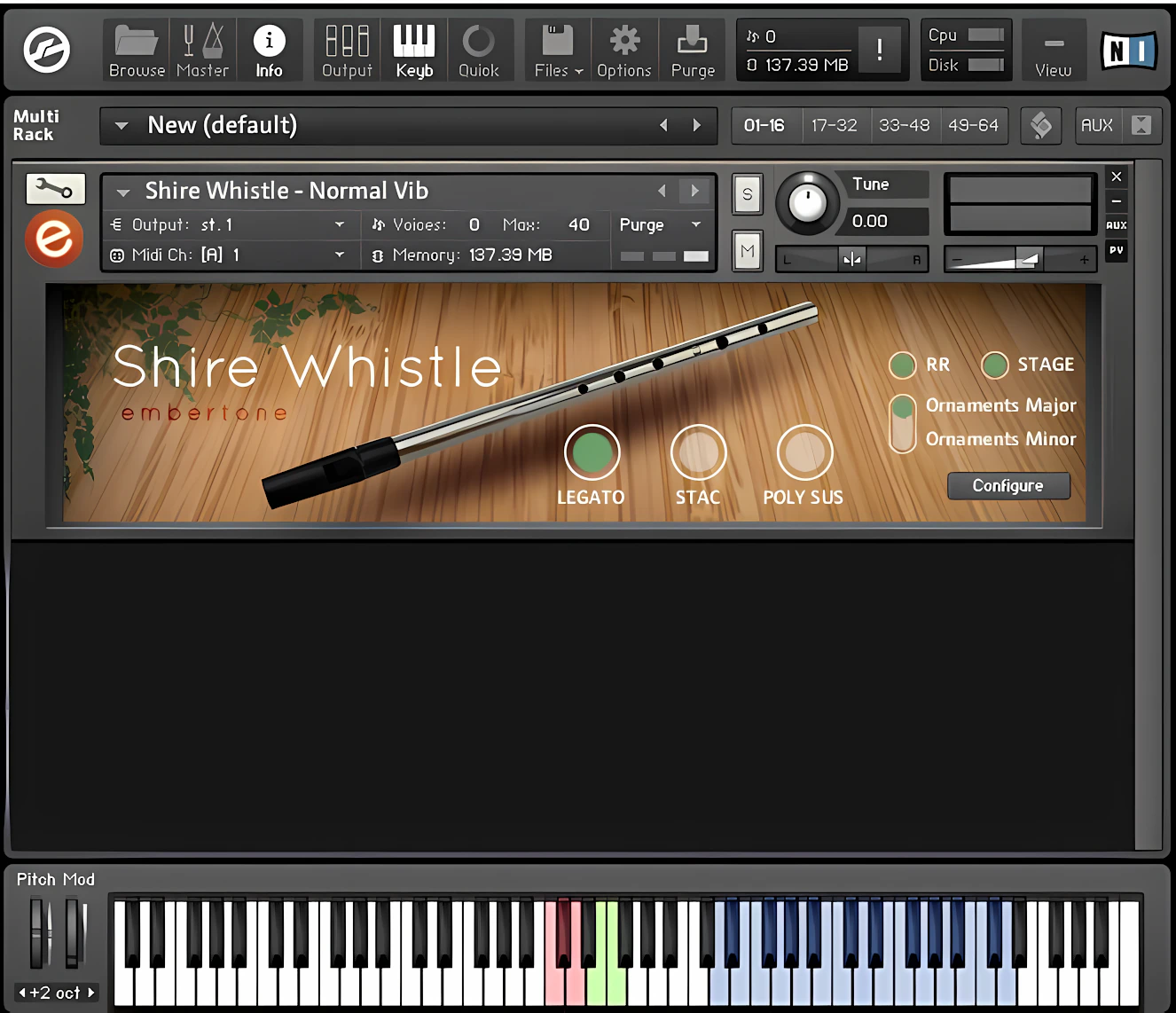
The right side of the GUI features four evenly spaced buttons: RR, Stage, Ornaments Major, and Ornaments Minor. These give you quick access to Round Robin variations, convolution reverb, and trill notes. You can choose whether trills follow minor or major key steps, depending on your musical needs.
A few important options:
Tap the Configure button, and a “hidden” configuration panel springs to life. Here, you can assign custom MIDI Control Changes for Dynamics and Vibrato—though Embertone has already set sensible defaults for you. CC11 handles Expression, while CC1 controls the Mod Wheel, so you’re ready to play right out of the box.
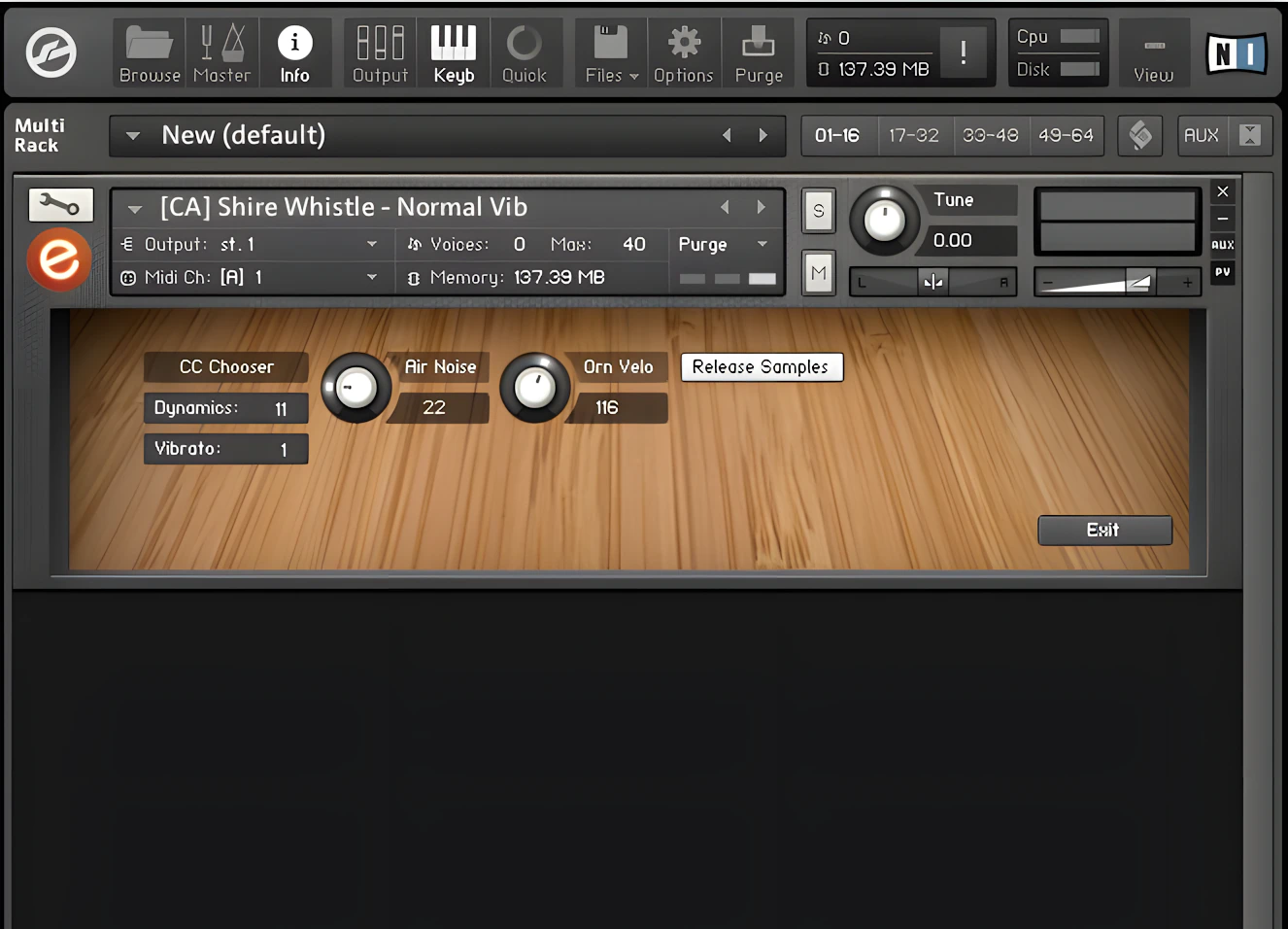
Two knobs let you fine-tune the “air” effect and set the velocity threshold for triggering ornamental notes (trills). The default velocity setting of 115 works beautifully for most players, though I dialed back the “air noise” during my testing to suit my preferences. Of course, your setup might call for different settings—that’s the beauty of having these controls at your fingertips.
The “Release Samples” button toggles additional “note release” samples on and off. Whether you enable this feature depends on your system’s performance headroom. Some players will find it essential; others may want to conserve CPU resources. Either way, this option adds genuine value to the instrument—it’s a thoughtful touch that shows Embertone sweated the details.
Operation and Control:
This sample-set faithfully reproduces an authentic two-octave range of playable notes spanning D5 through D7. This smart design keeps you honest—you won’t accidentally stretch the Irish whistle beyond what the real instrument can do. After all, a whistle works best as a melodic instrument, and these samples reflect that beautifully.
Here’s a heads-up: notes in the 2nd octave can veer toward shrillness. Fortunately, you can smooth things out by controlling dynamics with an expression pedal. This practice pays dividends because, well, your eardrums need to survive beyond today (and your listeners will thank you too).
The vibrato responds beautifully, and you can tell that Embertone invested serious effort into making it feel authentic. The developers clearly understood that realism matters here, and they delivered.
One thing to watch: the staccato samples pack more punch than their legato counterparts. I’d recommend keeping dynamics in check with an expression pedal while you play. This small adjustment keeps the volume consistent across articulations and prevents jarring shifts mid-performance.
Switch it up, Frodo . .
The three keyswitches (Legato, Staccato, and PolySus) sit right under your fingers, so you can switch between them easily while performing. Embertone places them around the middle of a typical keyboard: C4, C#4, and D4, so you do not have to go on a treasure hunt at the bottom octave.
You can choose from four Kontakt instrument patches: Braveheart Vibrato, Finger Vibrato, Normal, and Slow Vibrato. Each patch sounds exactly like its name suggests, so there are no surprises—just options.
The Finger Vibrato patch creates a very specific vibrato style. You achieve it by repeatedly fingering the note, which gives your line a more expressive, almost “humanly restless” shimmer.
Legato niggles . .

One other “niggle” I have with the Embertone sets is the obvious hesitation between some notes during Legato play. This issue becomes especially pronounced when you tackle faster passages.
Any “real” Celtic musician demands a very fast response. Many traditional tunes, particularly Irish ones, require repetitive 32nd and even 64th note trills. You’ll notice that the audio demos on the Embertone website feature only slow pieces.
An Irish whistle isn’t just an expressive, “wispy” instrument for lullabies. It is also a lively beast meant to fly as fast as the “merry tales of spring.” Fortunately, this hesitation fades significantly when you switch to Staccato or Poly modes.
So, if you plan to play a frantic reel, just remember: the whistle might need a moment to catch its breath, but it won’t miss a beat in the right mode!
Sound Quality:
This lovely little whistle is a real dandy. Shire Whistle isn’t just a dabbling in “wannabe” folk sounds. Instead, it delivers an especially authentic sample set.
As a genuine Atlantic Canadian of Scottish ancestry, I know a thing or two about authentic Celtic instruments. I started playing at country dances and community events with my father when I was just 14. We performed traditional Scottish and Irish songs, jigs, reels, and strathspeys at almost every occasion.
Honestly, if I can spot a fake from a mile away, this whistle passes the test with flying colors. It doesn’t just sound like the real deal; it is the real deal, minus the occasional cold that plagues human players!
Audio Sample: Just a bit of Scottish jiggery . .
I’m not claiming to have played this strathspey properly, but it is close enough to give you a good idea of what Shire Whistle sounds like. Check out the highly realistic ornamental trill notes!
The even, smooth tone of Shire Whistle is incredibly impressive. Like any high-pitched wind instrument, this whistle can get a little rambunctious in its second octave. However, backing off the dynamics with an expression pedal keeps it in check and well-behaved.
The user-configurable “air” samples add a fantastic degree of realism. Automated ornamental notes inspire you to burrow deep into a Celtic lilt. This feature makes for tremendously authentic playing.
It’s like having a digital piper who never forgets the ornamentation, even when your fingers are moving too fast to keep up. Just don’t tell the real pipers I said that—they might get jealous!
Such a Lovely Reverb!
Embertone chose a convolution reverb impulse response that matches the instrument perfectly. Pressing the “Stage” button engages a beautiful, natural-sounding Hall reverb. This reverb soothes and massages your aural senses ever-so-blissfully.
Pleasant sonic ambience wraps itself around these finely crafted Irish whistle samples. This atmosphere sparks genuine emotive creativity in the player.
It’s like the software knows exactly how to hug your ears with a warm blanket of sound. Honestly, if reverb could give a massage, this one would be five stars and a free back rub!
Seamless looping:
You do not need to worry about holding sustained notes. Embertone clearly built in a seamless, transparent looping mechanism that just works. No matter how long I held a key, I could not pick out any obvious loop or split points. I listened. I tried. I even tried to “break” it. Nothing.
Good job—no, GREAT job, Embertone. You made looping so smooth it is almost suspicious.
Sound Quality Takeaway:
I’m not evaluating these samples with inexperienced ears. I grew up immersed in Celtic music and the authentic sounds of its traditional instruments. In Atlantic Canada, musicians rely on fiddle, button accordion, tin whistle, bagpipes, acoustic guitar, and upright piano to define the Celtic sound. I know these instruments intimately.
This experience puts me in a unique position to judge, and my verdict is clear: Embertone has crafted one of the most authentic-sounding Irish Whistle sample-sets on the market today. I’ve heard plenty of contenders, and very few come close to this level of fidelity and character.
CPU Consumption:
As far as Kontakt instruments go, this little gaffer is a sprightly Shireling that will bear ye no heavy burden, my liege. In other words, it’s super lite and wonderfully zippy to load.
Concluding Remarks:
I give Embertone and their instruments a wholehearted vote of approval and appreciation. They consistently deliver thoughtful, inspiring tools that feel genuinely useful, not just gimmicky.
It is truly a blessing, Mr. Frodo, that such unusual, niche-specific instruments come in this level of quality at such accessible prices. You do not have to sell the One Ring just to afford them.
Now, do they offer five or six velocity layers? No.
And yes, there are a few tiny quirks I would love to see refined over time. However, those details rarely get in the way of making music.
Overall, Embertone’s offerings form a charming, highly playable collection—absolutely lovely, and very easy to recommend.
4.5 out of 5 Stars


:: Pros
- Finely detailed & authentic sound.
- Simple, easy-to-use.
- Peaceful and pleasant-looking Kontakt GUI.
- Authentic ornamental note & air samples.
- Four specialized instrument (*.nki) patches.
- Clear, well-written user’s manual available in PDF.
- Friendly, proactive product support.
- Light CPU and memory consumption.
- Very affordable
::Cons
- Not really a “con”, but one does need to keep “an ear out” for shrill notes in the instrument’s uppermost range. I highly recommend you use an expression pedal.
- Obvious hesitation between some notes. This can negatively affect fast musical passages.
Visit the Embertone website. Embertone.com
Intellectual Copyright – 2013 – All rights Reserved. This review may not be copied or reproduced in whole, nor in part, without express written permission from the author.

Leave a Reply