
What is Kuassa Vermilion?
Vermilion is a bang-on combo amp emulation plugin – available for both MAC and PC. This one scores highly owing to its straightforward layout and authentic vintage tone reproduction. In this Kuassa Vermilion Review, we’ll see how it is particularly appetizing to guitarists who want classic combo amp sounds. Vermilion eliminates the hassle of mic-ing physical equipment, or dealing with full-suite ‘options paralysis’.
Here’s what it offers:
- Emulates classic vintage guitar combo amplifiers
- Three different amp types with two channels each (clean and lead)
- Designed for “rootsy” guitarists seeking authentic vintage tones
- Tremolo with BPM synchronization (can produce subtle pulses to spinning rotor sounds)
- Analog-modeled spring reverb for added dimension
- Noise gate and limiter
- Five matching cabinet models
- Four microphone options
- Fully adjustable dual-miking in mono or stereo configurations for realistic recording-room feel
Introduction
Kuassa has recently released one of the finest vintage-style guitar combo amp simulations ever created for in-the-box production. Considering the spectacular quality that this top-shelf plugin delivers, the $39 USD price point is most definitely affordable!
This polished, new guitar amplification simulator is a definite BEST in CLASS product. The vibrant, authentic-sounding, retro tube amp tones that come out of this piece of programming creation are par excellence. Kuassa has released Vermilion in native 32bit & 64bit for Mac and PC. Bam!
Visuals:
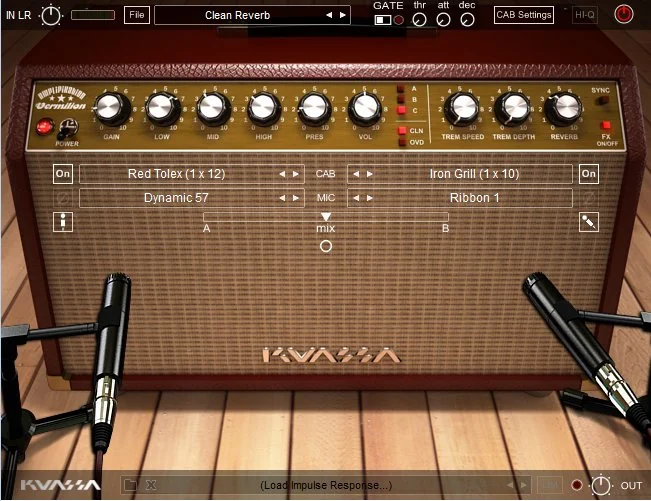
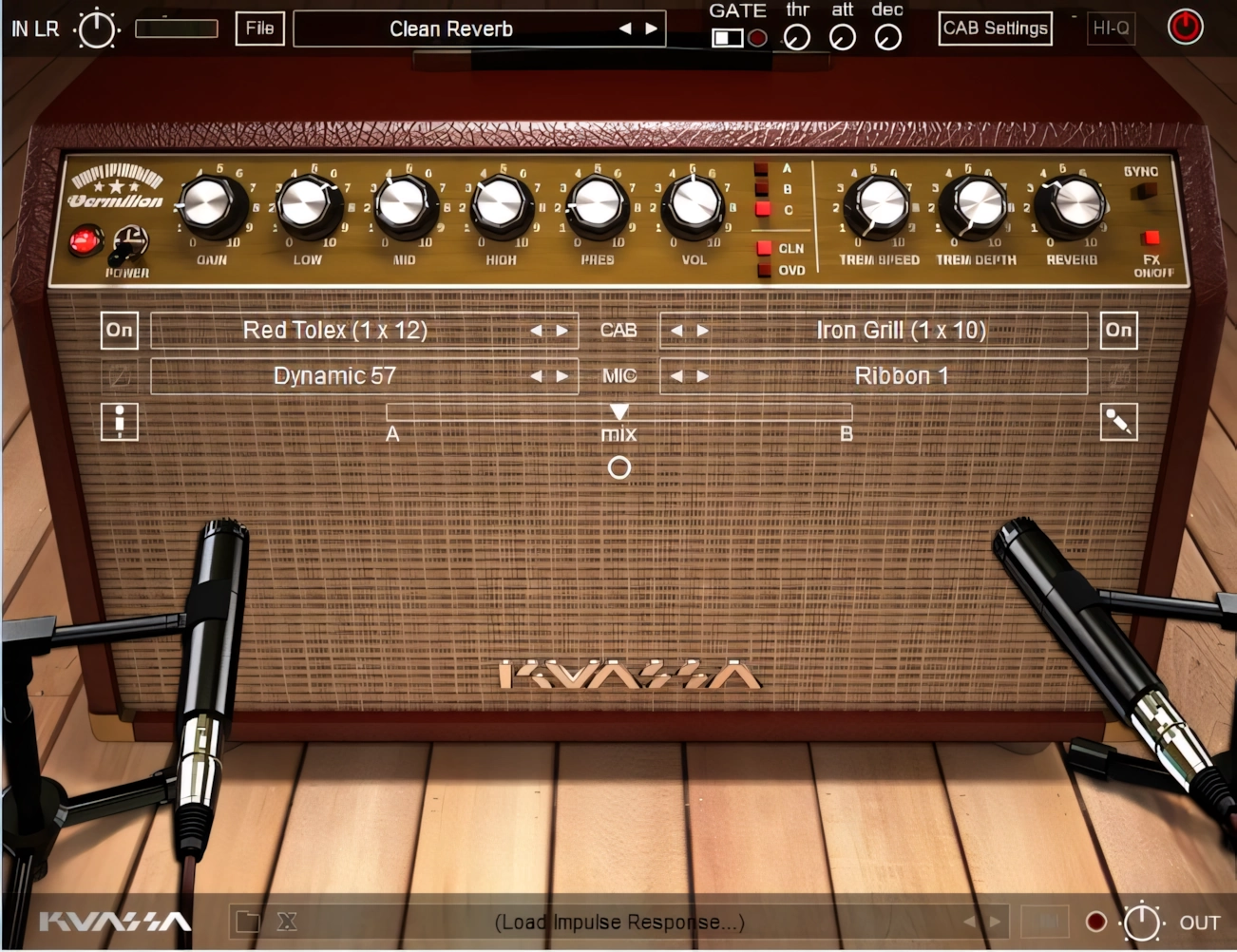
Purrdy. In a muscular, foxy, kind of way. The clean, silky 3D GUI tantalizes your retina and optic nerves in the manner that seeing a 1953 spotlight on Mae West would. The charming oxblood-colored tolex looks freshly polished and showroom-ready, with a rich sheen that immediately catches the eye.
Subtle, expertly-applied, photo-realistic lighting and shadowing effects add a defined, graphical elegance. Careful attention to detail is obvious; even the “brass” corner caps are eye-catching. Kuassa have certainly kept the bar held high with regard to photo-realistic, 3D-like GUI design.
The pair of virtual stereo mics are adjustable front-to-back and also from side-to-side. One, or both of the mics, can be angled off-axis at 45 degrees. The mics are very similar in appearance to the perennial “Shure SM57”. Even the twin mic stands look ‘sturdy’ and pristine. The ‘mic cables’ aesthetically match the amp cabinet.
Every UI element flawlessly flows in cohesive visual design.
All controls respond with smooth precision, and you can dial in settings with effortless accuracy. The knobs remind me of those used on a vintage Tube Screamer TS 808. This design brings the classic combo amp decals into sharp focus.
Check out the cool, sold school front panel.
Even the retro power indicator and active channel buttons shine with a classic red incandescent glow. The amp sim’s front mimics the tasteful appearance of a classic VOX grill-cloth – minus the Vox-iron and diamond shaped overlay.

Crisp, white text clearly labels every button, knob, and switch on the anodized brass faceplate. Guitarists will find this layout intuitive and immediately familiar.

All of this ‘de rigueur’ is handsomely presented in down-angled, 3D perspective on virtual hardwood studio flooring.
As Austin Powers would exclaim: “Yeah, baby. Pretty, but in a muscular, foxy kinda way.”
Hi, you! If you like these kinds of reviews,
be sure to subscribe.
The interface optionally displays speaker and cabinet type, mic selection, panning, and additional parameters as crisp white overlays, and it organizes them into clean, well-structured sections for fast, intuitive adjustment. These sections provide smooth mouse-controlled sliders and drop down menus.
The plugin presents a conservatively sized interface at 650px wide by 500px high, and it could benefit from a larger display or, alternatively, availability in multiple scalable sizes for improved usability.

This is a feature that many plugin developers have incorporated into their more recent offerings. Many modern PC monitors operate at resolutions of 1440px x 900px and greater; a plugin of this small-ish size can be difficult to view and manipulate.
Stereo Imaging and Depth Perception
Rich, full-bodied stereo spectrum is readily available here. The user easily configures the plugin’s speaker options across a range of stereo configurations, while independently blending, panning, and mixing each side with fine-grained control. The front-to-back mic positioning can simulate a substantial amount of believable depth, focus and placement.
Sound Quality
Attentively calculated emulation of classic tube amp tone-stacks, paired with finely recorded impulse responses of revered classic speakers/cabinets, lavish a guitarist with credible, authentic-sounding, vintage tube amp sound. The system provides three distinctly voiced channels and includes selectable overdrive and gain boost options for added tonal flexibility.
The individual channels can be summarized as follows:
(A) Channel
- Well-rounded and ‘organic-sounding’ with smooth, unobtrusive mids. Warm, rich tonal character featuring a lovely chime-like presence on top makes this channel the perfect choice for typical roots, country, blues and ‘earthy’ tones.
Engaging the overdrive boost, and applying moderate gain, results in smooth, creamy overtones. I wouldn’t exactly call it “crunch”; perhaps fluid, liquid overdrive is a more befitting accolade.
(B) Channel
- Best suited for ‘thinner’ vintage tone. Think SUN Recordings from the 50s. This channel has ‘Memphis’ twang splashed all over it! With liberal amounts of reverb added, you can dive right into some serious surf sounds, dude. It’s wild, man. Wild! Crank up the gain on this channel, and tasty blues notes can burrow their way through a mix in true Elmore James or Albert King fashion.
(C) Channel
- This channel approaches high-gain amp territory and does a good job of it. Perhaps the developer borrowed some code from the respectable “Kuassa Amplifikation One”. That being said, this channel is a little bit ‘vanilla’ for me. Wait! Please don’t take offense. What I mean by that statement is that there are a plethora of amp sims that emulate extremely overdriven, high-gain guitar amplifiers.
It seems to me, that there other amp sims that better suited for more aggressive, high-gain musical genres. Notwithstanding, the (C) channel in clean mode does lend itself especially well to round, warm jazz tones due to its fuller low end and well-balanced mids. This reviewer finds that the clean tones in this channel are more compelling than its higher-gain capabilities.
Vermilion is a tough little competitor.
It is reasonable to presume that most guitarists consider IK Multimedia’s Amplitude Fender™ to be one of the audio software industry leaders in vintage tube amp emulation. I, too, have been a faithful Amplitude user and admirer. I gotta tell ya, kids: this new gem from Kuassa, is a tube amp lover’s dream-come-true.
In particular, this plugin “NAILS” that great, classic “clean” tube amp sound; as well as silky smooth overdriven tones. If you’re looking for honest-to-goodness vintage vibe, this little combo amp simulator wins the gold!
Effects & Features
I would not describe this amp sim as ‘feature-rich’ in comparison with large, All-in-One packages such as Guitar Rig Pro, Amplitude, Overloud’s TH2, Peavey ReValver, and the like. However, we are discussing a boutique, speciality amp sim that truly NAILS authentic-sounding, vintage tube tone.
Vermillion may not be feature-rich, but its features are “Rich”.
I’m getting well along into my middle 40s, here in year 2013. I grew up with tube amps. At the time, these amps were not regarded as “vintage”; they were simply standard equipment. Ironically, and somewhat comically, an old Fender Twins drew little attention, while a brand-new Peavey Chorus 212 was what actually turned heads.
Thirty+ years ago, tubes were considered ‘antiquated’ and archaic. Young players wanted more headroom from the 200 watt RMS solid-state fare, and crazy distortion with Boss MetalZone pedals.
What Did We Want in Tube Amps of Old?
- Pulsating, tube-circuitry tremolo.
- Deep “sproingy” spring reverb.
- Mild overdrive and ‘singing’ harmonics once you set your pre-gain to “5”.
- Picking and dynamics sensitivity.
- Full range speakers with “paper” cones and heavy magnets that would ‘flap’ and start to ‘break up’ with enough juice delivered to them.
- Warm tone that had a live, organic quality.
- Sheen & presence with plenty of upper harmonics.
Well, friends – the aforementioned are the attributes that I know well, from good, 75+ lbs. tube amps. I’m excited to announce to you, my fellow tone chasers, that Kuassa has captured these attributions in spades. Vermilion delivers so well, you might look behind your computer — just in case there are glowing 12ax7T’s and 6L6-GCs burning your desk. 😉
I laud Kuassa for including a built-in, smooth-functioning noise gate. The gate features adjustable threshold, attack, and decay parameters.
Vermilion is not a one trick pony; It offers plenty of mic/speaker configuration options:
- 5 types of matching cabinets: Black Tolex (2×12), Red Tolex (1×12), Vintage Blonde (1×10), Iron Grill (1×10), and Cloth Grill (1×8).
- 4 microphone types: Dynamic 57, Dynamic 441, Condenser 1, and lastly, Ribbon 1.
Kuassa have kindly included a capable impulse loader to facilitate 3rd party IRs too. Just in case you want to load up that gnarly Marshall 1960 Greenback IR, you can easily do so.
CPU Consumption
The plugin remains very light on system resources in standard operating mode; kick it up to HQ (oversampled) mode, and the sound quality is breathtaking. HQ mode does understandably demand more CPU muscle, but most nearly any dual or quad core system should be able to handle at 3 or 4 simultaneous instances of Vermilion.
4 out of 5 Stars


:: Pros
- Excellent Value vs. Price ratio.
- BEST in Class, authentic-sounding tube amp tone.
- Deep spring reverb and pulsating tremelo.
- Excellent stereo imagery and perceived depth.
- Attractive, photo-realistic user interface.
- Familiar controls & easily configured.
- Friendly, professional product support.
- No dongles, call/response challenges, nor invasive piracy protection overhead.
- 32 & 64 bit (MAC/PC).
- Capable of 96Khz sample rate.
::Cons
- Slightly under-sized GUI dimensions.
- High gain emulation is slightly weaker than the sim’s clean/overdriven sounds.
Visit the Kuassa website. Kuassa.com
Intellectual Copyright – 2013 – All rights Reserved. This review may not be copied or reproduced in whole, nor in part, without express written permission from the author.

Leave a Reply